
STATION Ai in Nagoya, Aichi Prefecture, has established the physical AI data collection center for the manufacturing industry, “STATION Ai Data Foundry,” and has begun working toward its launch in December 2026. Behind this move is a national demand to aggregate real-world data to accelerate its industrial implementation in response to structural challenges such as a global labor shortage and the fragmentation of on-site data.
- Background of Establishment and Selection for the National Project “GENIAC”
- Data Collection Framework through Startup Co-creation and ROI-Focused Task Selection
- A ¥2.5 Billion-Scale Data Collection Factory and Overcoming the Sim2Real Gap
- Global Capital Shift and Positioning in National Growth Strategies
- Factory Implementation and Proprietary Edge AI Collaboration as Seen in Hitachi and FANUC
- Future Outlook and Key Points for the Social Implementation of Physical AI
Background of Establishment and Selection for the National Project “GENIAC”
“STATION Ai”, Japan’s largest open innovation hub located in Nagoya, Aichi Prefecture, is establishing “STATION Ai Data Foundry”, a physical AI data collection center for the manufacturing industry within its headquarters, with the aim of starting operations in December 2026. This initiative has been selected for the “Research and Development Project for the Enhancement of Infrastructures for Post-5G Information and Communication Systems / Research and Development on the Construction of Data Ecosystems (GENIAC),” a subsidization program publicly offered by the Ministry of Economy, Trade and Industry (METI) and the New Energy and Industrial Technology Development Organization (NEDO). In Japan’s manufacturing industry, the worsening labor shortage and the transfer of skills due to the aging of skilled technicians have become urgent issues, and expectations are growing for physical AI as a key to realizing automation and sophistication at production sites. However, the real-world environment data necessary for conventional AI development has been individually managed and concealed by each company and site, and the lack of sufficient accumulation and sharing of data necessary for learning across the industry as a whole has been a major barrier to social implementation. In particular, complex tasks such as assembly, picking, visual inspection, and parts transportation involve significant variations in the shapes of the parts handled and the layout environments of the sites, making them extremely difficult to handle with rule-based programming. This center will overcome these challenges and function as a hub that aggregates and provides data tailored to actual operational environments.
Data Collection Framework through Startup Co-creation and ROI-Focused Task Selection
At “STATION Ai Data Foundry,” rather than simply collecting massive amounts of data indiscriminately, data collection and verification are carried out intensively, specializing in tasks where a return on investment (ROI) can be expected in actual factory and logistics settings. For data collection and foundational model development, the facility works in strong collaboration with Tron Co., Ltd. (Representative Director: Kei Washima), a startup tenant at the hub. Together, they integrally promote the collection and processing of multimodal data capturing workers’ movements, mutual cooperation with robot control data, and the accuracy verification of AI models. Furthermore, in selecting specific challenges in manufacturing sites and organizing on-site rules, the initiative is collaborating with Boostec Co., Ltd. to design practical, issue-based use cases that directly lead to labor savings and improved productivity. The following diagram illustrates the concept of the data ecosystem co-created by startups and manufacturing enterprises.
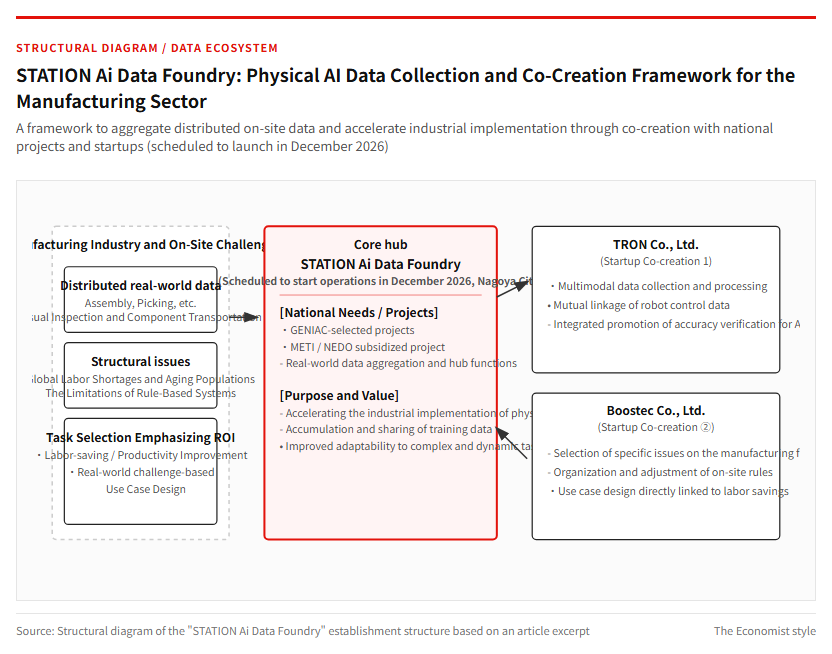
AI model development companies, robot manufacturers, parts and material manufacturers, system integrators (SIers), and adopting user companies will gather in one location to form an ecosystem that integrates previously scattered players. Following the start of operations in December 2026, the plan is to conduct demonstrations of assembly and picking together with manufacturers in the Tokai region, and horizontally roll out the obtained results to manufacturing sites across Japan.
Massive Private Investments in Physical AI and the Evolution of Data Infrastructure
A ¥2.5 Billion-Scale Data Collection Factory and Overcoming the Sim2Real Gap
Efforts toward the societal implementation of physical AI are also accelerating in the field of private investment. On April 14, 2026, Nexdata (Chiyoda-ku, Tokyo) announced that it has invested a total of 2.5 billion yen to expand its data collection plant, building a large-scale data infrastructure with a total floor space of 8,000 square meters. Inside the facility, scenarios precisely recreating actual operational sites—such as homes, factory production lines, and logistics warehouses—have been constructed, with over 400 humanoids and industrial robots operating in parallel at all times. A 600-person team of operators is stationed on-site, establishing a system capable of producing training data in real time, ranging from environmental perception and decision-making to the control of physical movements. The dataset provided by the facility consists of 288 million pieces of environmental data including 3D models, 4,000 hours of first-person (egocentric) perspective action data, and over 10,000 sets of control data including joint angles and haptic information. In particular, the massive supply of first-person perspective data greatly contributes to significantly reducing and eliminating the discrepancy (Sim2Real gap) that occurs between simulation learning in a virtual environment and actual machine operation. The existence of such an advanced data collection infrastructure makes it possible to shorten lead times and reduce costs for robot deployment.
Global Capital Shift and Positioning in National Growth Strategies
Capital market interest is rapidly shifting from digital-space language models and standalone semiconductors to the realm of physical AI, which is transforming the physical world. According to an analysis by U.S. research firm Pitchbook, global venture capital (VC) investment in the physical AI and robotics sector in 2025 surged by over 80% year-on-year to approximately $26 billion, setting a record high. Entering 2026, investment momentum has accelerated further, with funds flowing into the sector exceeding 60% of the previous year’s total by the end of March that year. In the Japanese government (Takaichi administration) as well, physical AI is positioned as the core of the “AI and Semiconductors” field (101.6 trillion yen) within the “17 Strategic Fields” (total public-private investment exceeding 370 trillion yen), which serve as the pillars of its growth strategy. A public-private investment plan on the scale of 10.5 trillion yen has been formulated for physical AI alone as a national policy, and robust support is being provided to strengthen the industrial base. While generative AI plays the role of providing “intelligence,” physical AI is a technology that translates that intelligence into “action” in the real world, leading a productivity revolution in key industries such as manufacturing, logistics, and agriculture.
Latest Industry Trends, Future Outlook, and Key Focus Areas
Factory Implementation and Proprietary Edge AI Collaboration as Seen in Hitachi and FANUC
The implementation of physical AI in operational fields is rapidly moving into a practical stage through strategic alliances among key players. On September 30, 2026, Hitachi, Ltd. and FANUC CORPORATION concluded a strategic partnership for joint commercialization toward the factory implementation of physical AI. By integrating Hitachi’s AI solution “HMAX Industry” with FANUC’s industrial robot technology, Hitachi’s own manufacturing plant is being used as “Customer Zero” (the first in-house deployment customer) to advance localized on-site learning. In this alliance, an ultra-compact, power-saving edge AI semiconductor developed by Hitachi (measuring 3 x 3.3 mm, with power efficiency more than 10 times that of advanced GPUs) will be mounted directly inside FANUC robots for verification. Rather than conventional fixed, simple repetitive tasks, the initiative aims to automate highly difficult processes that previously required human judgment in response to changing conditions such as component variations and setup changes. From fiscal 2027, the companies plan to roll out joint external sales targeting a wide range of industries, including semiconductors, pharmaceuticals, automobiles, food, and logistics.
Future Outlook and Key Points for the Social Implementation of Physical AI
In future physical AI development, the integration of “World Action Models” such as NVIDIA Cosmos 3 and simulation platforms is expected to advance further, in addition to the collection of vast amounts of real-world data. Development efficiency will improve dramatically as the generation of massive amounts of synthetic data via simulation environments and real-world data collection facilities such as STATION Ai Data Foundry and Nexdata complement each other. The primary focus for future societal implementation will be whether it can move beyond the realm of technical proof of concept (PoC) to demonstrate concrete return on investment (ROI), such as reducing takt times, improving operational rates, and lowering defect rates in factories and logistics facilities. The figure below illustrates the integration process between simulation and real-world data in the future deployment of physical AI.
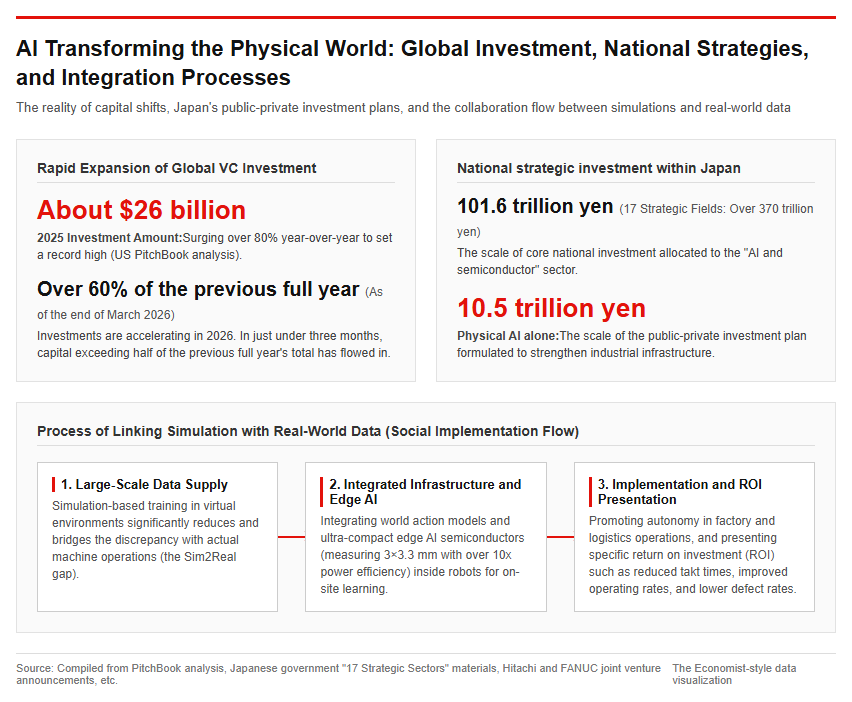
Rather than simply introducing robots, it is expected that by building an integrated ecosystem that combines sensors, edge AI semiconductors, data infrastructure, and on-site engineering, Japan’s physical AI industry will secure global competitiveness.
Reference Page
- [STATION Ai Official Announcement] https://prtimes.jp/main/html/rd/p/000000123.000095825.html
- [Hitachi, Ltd. Official Announcement] https://www.hitachi.com/ja-jp/press/articles/2026/09/0930a/
- [Official FANUC Announcement] https://www.fanuc.co.jp/ja/profile/pr/newsrelease/2026/news20260515.html
- [NVIDIA Cosmos Official Page] https://www.nvidia.com/ja-jp/ai/cosmos/
【#PhysicalAI #DataCollectionCenter #ManufacturingDX #STATIONAi #NEDO #Robotics #IndustrialAutomation #Hitachi】

コメント