On October 6, 2026, Google DeepMind, Google’s AI research division, announced “EmbeddingGemma 2,” a lightweight multimodal embedding AI that converts text, code, images, video, and audio into a common vector space. High expectations are mounting for it as a foundation for on-device AI that achieves on-device privacy protection and low-latency semantic search.
- Key point of the event: A versatile 740-million-parameter on-device model
- Multimodal Integration: Unified Vectorization of Text, Code, Images, Video, and Audio
- Memory Efficiency and Flexibility: Lightweight Techniques via Modular Structure and MRL
- Benchmark Evaluation: Code Search and Performance Improvements Across Various Modalities
- Practical Applications and Significance to Society: Realizing Local RAG and Decision-Making Engines
- Future Outlook and Key Points: The Expansion of the Ecosystem and the Future of On-Device AI
Key point of the event: A versatile 740-million-parameter on-device model
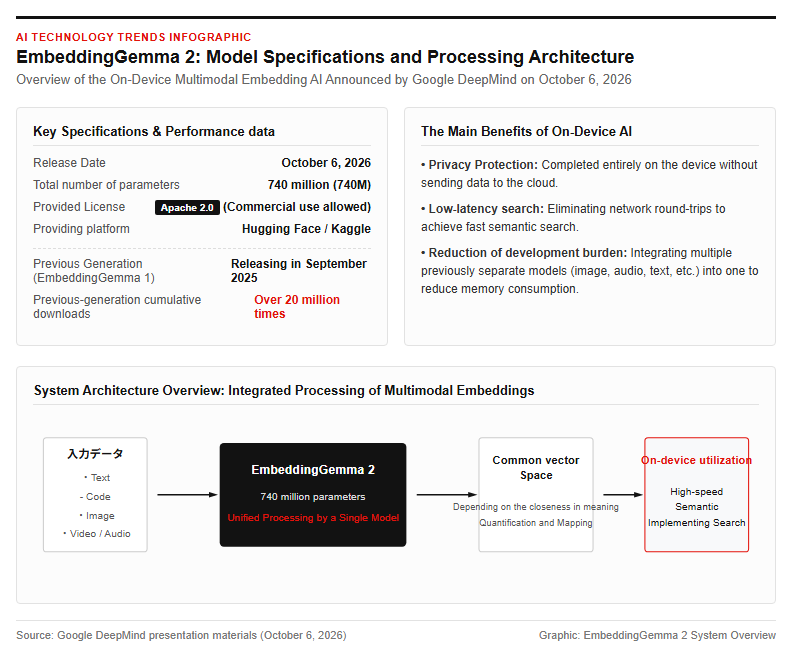
On October 6, 2026, Google DeepMind, Google’s AI research division, released “EmbeddingGemma 2,” an open embedding AI model. Embedding models are a technology that quantifies various data such as text, images, and audio according to their semantic similarity and maps them onto a vector space. The previous-generation EmbeddingGemma 1 was released in September 2025 and has received high praise from developers around the world, recording a cumulative total of over 20 million downloads. While the latest model has a compact size with a total parameter count of 740 million (740M), it is available on Hugging Face and Kaggle under the commercially usable Apache 2.0 license. Its standout feature is the ability to execute high-speed searches while maintaining privacy directly on devices such as smartphones and PCs (on-device) without sending data to the cloud. In conventional systems, it was necessary to individually combine models for image caption generation, speech recognition, and text embedding, which posed challenges such as processing delays and increased memory consumption. Because this model handles these tasks with a single integrated model, it significantly reduces the burden on developers. The diagram below shows an overview of the system architecture.
Multimodal Integration: Unified Vectorization of Text, Code, Images, Video, and Audio
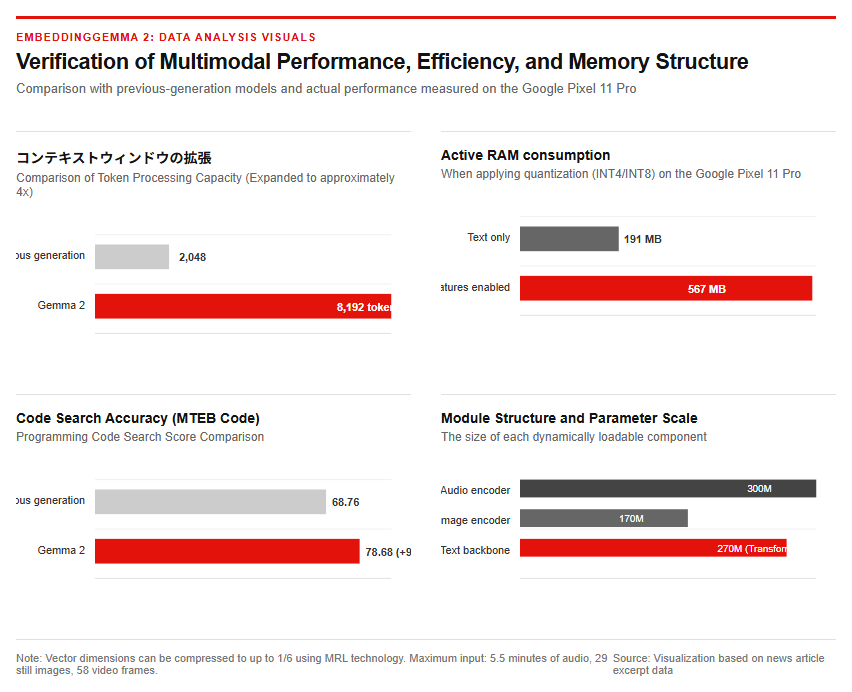
At the core of EmbeddingGemma 2’s technical innovation is its native multimodal architecture, which directly maps heterogeneous data into a single 768-dimensional vector space. Built upon the architecture of the state-of-the-art Gemma 4 model, it enables seamless cross-modal retrieval not only of text, but also of programming code, still images, video frames, and audio data. For instance, it can instantly extract a relevant photo from a locally stored collection based on a text input like “a cat sleeping on a keyboard,” or search for specific conversation scenes using words from an audio message recording. The context window has been expanded to 8,192 tokens, which is approximately four times larger than the previous generation’s 2,048 tokens. In a single input window, it can batch-process up to approximately 5.5 minutes (327 seconds) of audio, 29 still images, 58 video frames, or interleaved data combining these elements. Furthermore, it features multilingual comprehension capabilities supporting over 100 languages, designed for immediate application in international application development.
On-Device Optimization and Performance Verification
Memory Efficiency and Flexibility: Lightweight Techniques via Modular Structure and MRL
To ensure the stable operation of multimodal AI on resource-constrained mobile devices and edge devices, EmbeddingGemma 2 incorporates advanced lightweight technologies. The entire model is designed around a 270-million (270M) parameter text backbone (130 million for the transformer + 140 million for the encoder), and adopts a modular structure that can independently and dynamically load an image encoder (170 million) or an audio encoder (300 million) as needed. When performing only text processing, it can operate in a lightweight state of approximately 270M parameters. Furthermore, by applying quantization (INT4 and INT8), it achieves remarkably low active RAM consumption on the “Google Pixel 11 Pro” smartphone: approximately 191MB for text-only operation and approximately 567MB even with all multimodal features enabled. Additionally, Matryoshka Representation Learning (MRL) technology makes it possible to reduce the dimensionality of output vectors from the original 768 dimensions down to 512, 256, and 128 dimensions while keeping accuracy loss to a minimum. By reducing the vector dimensionality, the storage capacity and memory footprint of local vector databases can be compressed by up to one-sixth.
Benchmark Evaluation: Code Search and Performance Improvements Across Various Modalities
Performance evaluations have demonstrated that it achieves top-class accuracy as a small multimodal embedding model with under 1 billion parameters. On “MTEB Code,” a benchmark for evaluating programming code retrieval accuracy, it recorded a significant improvement of 9.92 points, jumping from the previous generation’s score of 68.76 to 78.68. This dramatically enhances the accuracy of codebase indexing in local environments and file searches by AI coding agents. Furthermore, in the image retrieval evaluation metrics “MIEB Lite” and “MMEB v2,” as well as the audio retrieval metrics “MSEB Retrieval” and “MAEB,” it has posted scores that rival or surpass existing specialized models more than twice its size. Additionally, in text-to-image retrieval experiments in independent academic research (based on hard negative evaluation using the Flickr30k dataset), it was confirmed that Gemini Embedding 2 achieves retrieval accuracy equivalent to large language models such as GPT-4.1 and Claude Sonnet 4.6, while being able to accelerate retrieval processing speeds by several thousand times or more through the use of pre-computation. The following figure shows a performance comparison across various benchmarks.
Practical Applications and Future Prospects
Practical Applications and Significance to Society: Realizing Local RAG and Decision-Making Engines
With the advent of EmbeddingGemma 2, the development of local RAG (Retrieval-Augmented Generation) systems and real-world assistance apps that perform advanced searches while protecting privacy has become a reality. In the cross-platform app “Google AI Edge Gallery” provided by Google, features are showcased such as “Instant Media Search,” which reranks local media in real time based on input text, and “Video Moments Finder,” which locates specific moments within videos using natural language. In addition, the experimental Mac app “Google AI Edge Foresight” indexes meeting recordings and transcriptions from the microphone or system audio, as well as local documents, solely on-device, supporting AI note-taking and Q&A while retaining confidential information even in offline environments. Furthermore, by combining it with MediaPipe Decision Task, it also functions as a zero-shot decision-making engine that performs classification and routing on input images, audio, and text in milliseconds.
Future Outlook and Key Points: The Expansion of the Ecosystem and the Future of On-Device AI
This model has extremely high affinity with the open-source ecosystem and is compatible with major AI development tools from the first day of its release. LiteRT, MediaPipe, transformers, sentence-transformers, vLLM, Ollama, llama.cpp, and MLX are available as inference engines, while Qdrant integrates as a vector database and Unsloth as a fine-tuning guide. Furthermore, for Android devices, high-speed processing via NPU (Neural Processing Unit) acceleration is scheduled to be provided as a standard feature through “ML Kit” in the future. On-device multimodal AI, which simultaneously achieves independence from cloud infrastructure, reduction of communication costs, and privacy protection, is expected to rapidly gain widespread adoption as a next-generation standard technology across diverse industries, ranging from mobile apps to edge computing, wearable devices, and the IoT sector.
Reference page
- 【EmbeddingGemma 2: an open, lightweight multimodal embedding model – Google Blog】https://blog.google/innovation-and-ai/technology/developers-tools/embeddinggemma-2/
- 【Bring multimodal semantic search to the edge with EmbeddingGemma 2 – Google Developers Blog】https://developers.googleblog.com/
- google/embeddinggemma-2 – Hugging Face
[#EmbeddingGemma2 #GoogleDeepMind #MultimodalAI #OnDeviceAI #SemanticSearch #RAG #Gemma4]


コメント