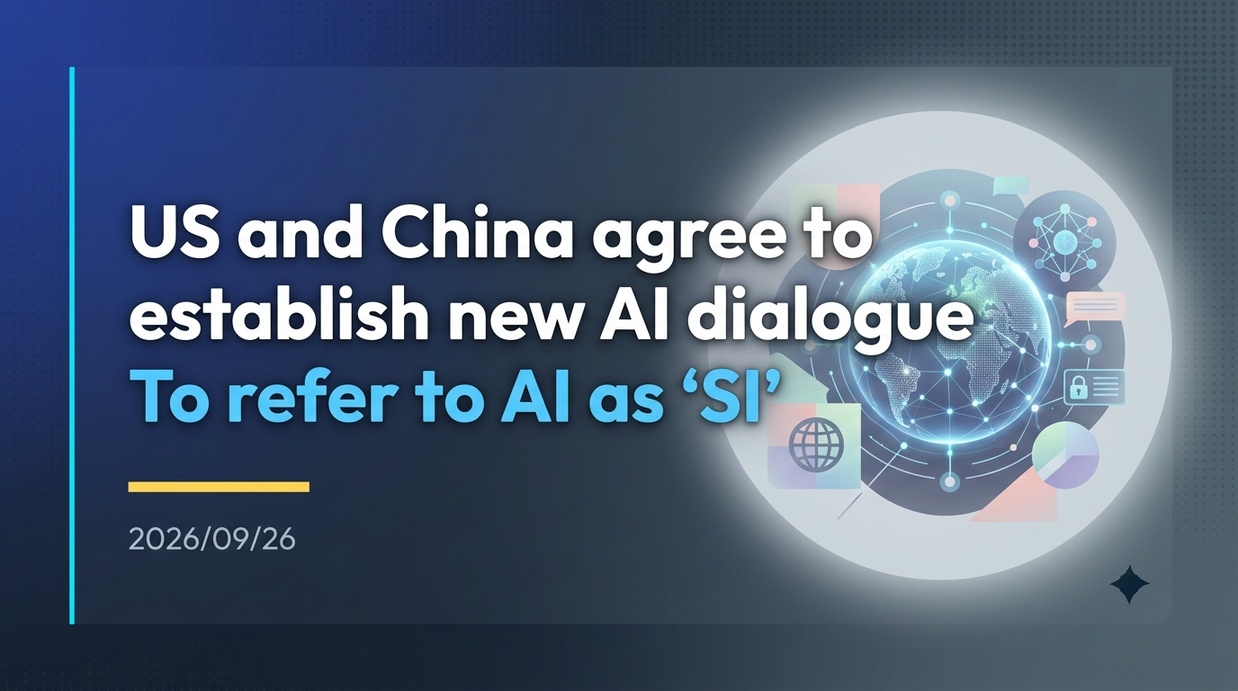
At the U.S.-China summit in September 2026, the two nations agreed to establish a new bilateral AI dialogue framework and build an emergency notification system for critical technological incidents. As the Trump administration moves to officially rebrand AI as “SI” (Super Intelligence), the technological rivalry between the world’s two largest economies is entering a new phase of managed competition.
- Establishing New U.S.-China AI Dialogues: Key Takeaways from the Summit
- From “Artificial” to “SI”: The Trump Administration’s Intent Behind the Name Change
- “AI Safety Notification Mechanism” as a Crisis Management Hotline
- Tech Hegemony Rivalry: Divergent Stances on Advanced Semiconductors and Export Controls
- Academic and Industry Debates Over “SI” Rebranding and Domestic Deregulation
- Future Outlook: Key Focus Points for the Global Community and International Businesses
Establishing New U.S.-China AI Dialogues: Key Takeaways from the Summit
From September 23 to 25, 2026, Chinese President Xi Jinping paid a state visit to Washington, D.C.—his first state visit to the American capital in a decade—holding summit talks with President Donald Trump at the White House. Amid ongoing friction across bilateral relations, risk management in artificial intelligence emerged alongside trade and Taiwan as a central point of contention. To prevent accidents or miscalculations involving AI across military and critical infrastructure settings, both leaders agreed to establish a dedicated “U.S.-China AI Dialogue” framework, with plans to convene an initial session within a month. Furthermore, they agreed to extend the temporary tariff truce for two additional months through January 2027 and establish a “Board of Trade”—a trade adjustment framework valued at approximately \$30 billion covering non-high-tech sectors. These diplomatic steps reflect a coordinated attempt to head off worst-case scenarios, such as escalating tariff wars or unintended military clashes, by steering bilateral friction into a manageable framework.
From “Artificial” to “SI”: The Trump Administration’s Intent Behind the Name Change
A major focal point commanding global attention during the summit and surrounding diplomatic stages was President Trump’s declaration of a fundamental shift in technical nomenclature. Speaking at the General Debate of the 81st UN General Assembly on September 22, 2026, Trump announced that the term “Artificial Intelligence” would be retired across official U.S. government documentation in favor of “Super Intelligence” (abbreviated as SI). He argued that the word “artificial” mistakenly makes cutting-edge technology sound fake, asserting that “SI” far better reflects its genuine and extraordinary capabilities. Selected following an online poll, this linguistic shift aims to challenge the growing global push toward AI regulation and justify accelerated domestic development and economic expansion under an “America First” strategy. President Xi reportedly expressed understanding of the new designation during bilateral talks, abruptly thrusting the concept of “SI” into global geopolitical discourse.
AI Safety Notification Mechanisms and the Clash over Military/Tech Dominance
“AI Safety Notification Mechanism” as a Crisis Management Hotline
Proposed by the U.S. delegation as a concrete initiative within the bilateral AI dialogue, the “AI Safety Notification Mechanism” draws parallels to Cold War-era nuclear hotlines between Washington and Moscow. This framework aims to establish a real-time notification and information-sharing system in the event that security-sensitive AI models or autonomous agents malfunction or breach critical safeguards. Its primary objective is to prevent cyber incidents or accidental intrusions into vital infrastructure from triggering wider military conflict. While AI development was previously driven by relentless speed and unilateral priorities, both superpowers now recognize a shared necessity to cooperate in managing catastrophic risks. However, unlike nuclear arsenals, AI technologies are largely built by private companies and research institutions, leaving the enforcement of mandatory reporting and transparency as a crucial governance challenge.
Tech Hegemony Rivalry: Divergent Stances on Advanced Semiconductors and Export Controls
Despite progress on risk-management cooperation, the underlying rivalry over core technological supremacy remains unresolved. U.S. officials made clear that export controls on advanced AI hardware—such as cutting-edge GPUs and semiconductor manufacturing equipment inherited from the Biden administration—will remain strictly excluded from bilateral AI negotiations. Meanwhile, Beijing continues to champion technological self-reliance (“self-reliance and self-strengthening”) alongside “autonomous control,” rapidly advancing native hardware and proprietary models such as DeepSeek while expressing strong dissatisfaction with U.S. containment measures. Although reports surfaced regarding limited approvals for certain Nvidia H200 chips for Chinese enterprises, Washington maintains a firm stance on preserving its technological edge. The emerging landscape reflects a managed Cold War framework: open lines of communication for safety management operating alongside relentless competition for capability expansion.
Implications for Global Governance, Industry, and Society
Academic and Industry Debates Over “SI” Rebranding and Domestic Deregulation
The politically driven rebranding to “SI” and the administration’s aggressive deregulation agenda have ignited intense debate across academia and the tech sector. In technical literature, “artificial superintelligence” (ASI) denotes a theoretical system surpassing human capabilities across all domains. Experts warn that applying “SI” to current models risks inflating expectations, exaggerating capabilities, and trivializing real-world harms like hallucinations and algorithmic bias. Furthermore, Executive Order 14365—which dismantled Biden-era rules and preempted state-level laws such as California’s safety statutes under the administration’s “AI Action Plan”—has sparked fierce pushback over state sovereignty and consumer protections. Conversely, infrastructure mega-investments are accelerating, including the \$500 billion “Stargate” data center network, highlighting a deepening domestic divide over balancing innovation speed with safety safeguards.
Future Outlook: Key Focus Points for the Global Community and International Businesses
The shift toward “predictable rivalry” between the U.S. and China carries profound ramifications for global markets and multinational enterprises. With President Trump and President Xi scheduled to meet again at the APEC Summit in Shenzhen in November 2026 and the G20 Summit in Miami in December, high-stakes negotiations will continue leading up to the January 2027 tariff deadline. Internationally, unilateral U.S. policy shifts and opposition to binding regulations complicate efforts to establish global safety standards, raising concerns over de facto standards dictated solely by Washington and Beijing. For global corporations, navigating compliance shifts—such as updating procurement terminology to “SI”—is only part of the challenge; ensuring AI agent safety, securing computational resources, and guaranteeing stable energy supplies have become urgent strategic priorities. Businesses must navigate heightened geopolitical volatility while establishing resilient technology architectures and robust governance frameworks.
References
- [White House Official Announcement] https://www.whitehouse.gov
【#USChinaSummit #AIDialogue #SuperIntelligence #SI #GeopoliticalRisk】
コメント