In October 2026, Microsoft announced a new strategy making Windows the foundation for “hybrid intelligence,” which optimally utilizes local and cloud AI. This move is driven by the need to resolve escalating cloud costs and processing delays associated with the growing scale of AI models, as well as the rising demand among enterprises for strict data security.
- Key Announcement Points and Overview of the Hybrid AI Initiative
- Dedicated Technologies and Execution Environments Supporting Hybrid Intelligence
- Security Control via Agent Execution Environment MXC
- Automatic Task Assignment Feature and Local Model Expansion
- Trends in Security Assurance and Cost Optimization in Enterprises
- Future Developments and the Vision for Personal PCs
Key Announcement Points and Overview of the Hybrid AI Initiative
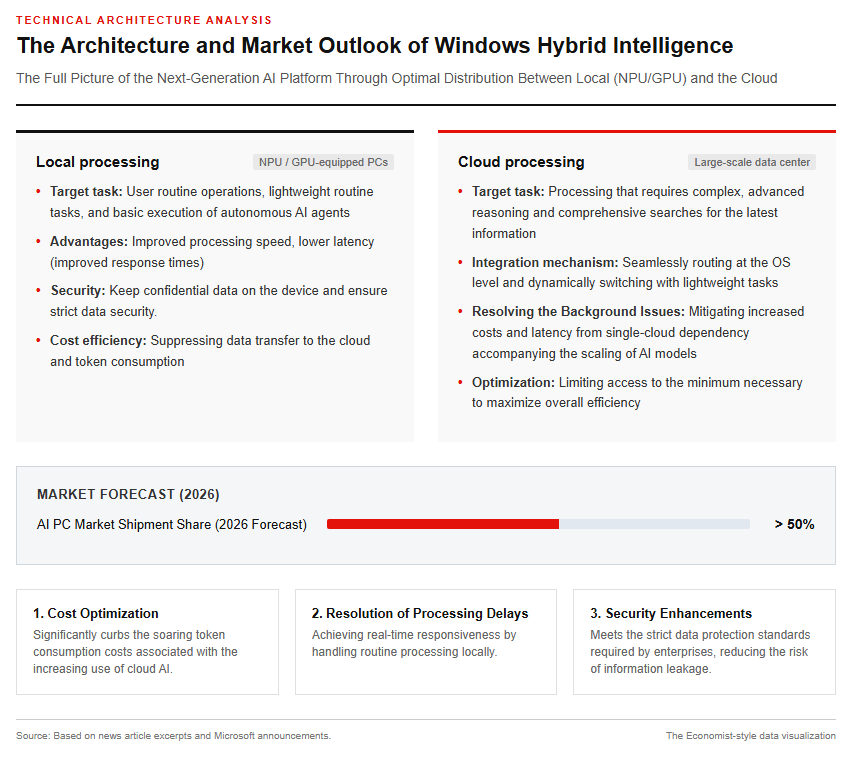
On October 7, 2026, Microsoft announced “Hybrid Intelligence,” a new design philosophy that evolves Windows into an execution platform for autonomous AI agents. This system integrates at the OS level a mechanism that optimally distributes AI processing—which has traditionally relied on massive cloud data centers—between local computing resources such NPUs (AI-dedicated processors) and GPUs built into local PCs, and advanced cloud AI models. Everyday user operations and lightweight routine tasks are processed locally at high speed, while access to the cloud occurs only when complex advanced reasoning or searches for the latest information are required. This not only achieves faster processing speeds and lower latency, but also significantly suppresses the increase in token consumption costs associated with cloud AI use. Furthermore, AI-PC market shipments are projected to exceed 50% in 2026, marking a major turning point toward a transition from the conventional application-centric operational framework to an environment where AI agents autonomously execute tasks. Please refer to the figure below.
Dedicated Technologies and Execution Environments Supporting Hybrid Intelligence
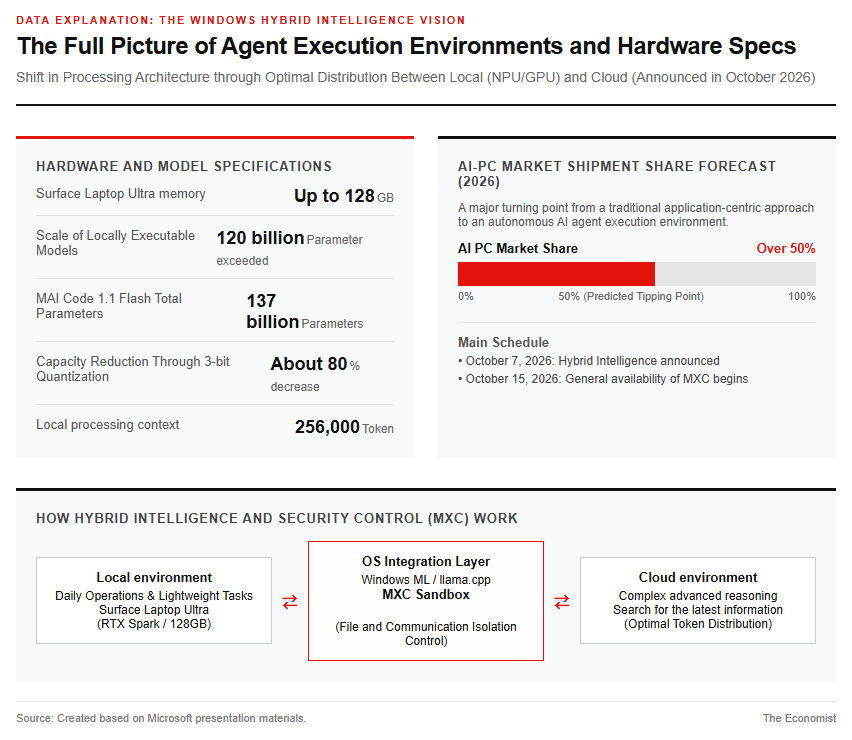
To realize this vision, dramatic technological expansions have been made in both hardware and software. On the hardware front, the high-end device “Surface Laptop Ultra” powered by the “RTX Spark” SoC, co-developed with NVIDIA, has been announced. Equipped with up to 128GB of unified memory, it possesses the processing power to directly run ultra-large-scale models exceeding 120 billion parameters locally—models that previously could only operate in the cloud. As for the model execution platform “Windows ML,” it now supports the open-source inference engine “llama.cpp,” enabling flexible inference processing that integrally utilizes CPUs, GPUs, and NPUs. Furthermore, by quantizing the coding-focused model “MAI Code 1.1 Flash,” which has a total of 137 billion parameters, down to 3-bit precision, its model size was reduced by approximately 80%, and it has been optimized to process a vast 256,000-token context window locally on a PC. As a result, advanced processing can be maintained even in offline environments.
Mechanisms for Optimizing Local AI and Cloud AI
Security Control via Agent Execution Environment MXC
Security management is the primary concern when autonomous AI agents perform file operations and code execution on PCs. To address this challenge, Microsoft has announced that it will begin the general availability of “Microsoft Execution Containers (MXC)”, a sandbox environment dedicated to AI agents, on October 15, 2026. MXC is an advanced isolation infrastructure operating at the OS level, providing guardrail features that allow organizations and users to strictly limit the range of folders and network communications accessible to agents. Conventionally, when adopting agent tools such as “OpenClaw”, it was necessary to perform cumbersome security configurations at the individual application layer, which acted as a barrier to corporate adoption. With the arrival of MXC, agents can be executed safely simply by setting common policies on the OS side. Major agents such as OpenClaw, GitHub Copilot, and Codex will natively support MXC, enabling highly transparent control. Please refer to the structural diagram below.
Automatic Task Assignment Feature and Local Model Expansion
To achieve optimal integration between the cloud and local environments, GitHub’s intelligent routing technology, “HydraFusion,” is being expanded and integrated into the Windows OS. HydraFusion is a technology that instantly analyzes the difficulty of input tasks and the required processing power, automatically routing the processing destination to either a large-scale model in the cloud or a local model on the PC. For example, lightweight tasks such as simple text formatting and code organization are processed instantly by the PC’s NPU, while only tasks requiring complex multi-step reasoning or external data references are transferred to the cloud. In addition, the AI assistant “Copilot” has been revamped, adding features that allow it to understand files on the PC with the user’s permission and to handle file organization and troubleshooting on the user’s behalf. With the “Autopilot” feature, a series of complex tasks such as searching for tax documents, zipping them, and attaching them to emails can be safely and automatically completed primarily by local models without sending confidential data externally.
Significance and Future Outlook of Enterprise Adoption
Trends in Security Assurance and Cost Optimization in Enterprises
Establishing hybrid intelligence brings significant changes to corporate IT investment strategies and data governance. In heavily regulated industries such as finance, healthcare, and legal, the risk of data leaks associated with transmitting customer data and confidential information to the cloud has been a major barrier to AI adoption. With an environment in place where processing can be completed locally using on-device NPUs and local models, users can enjoy the benefits of AI without any data transmission. Furthermore, amid the device upgrade cycle driven by the end of Windows 10 support in October 2025, the adoption of devices meeting the “Copilot+ PC” standard—equipped with an NPU of 40 TOPS or higher—is progressing. Compared to the cost of maintaining cloud AI subscription contracts for all employees, shifting routine tasks to local processing through a one-time hardware investment can significantly optimize long-term TCO (Total Cost of Ownership). Additionally, being able to avoid work interruptions caused by cloud service rate limits is of great practical value.
Future Developments and the Vision for Personal PCs
By transitioning into a foundation for “hybrid intelligence,” Windows will evolve personal PCs from mere passive work tools into personal partners that deeply understand user context and provide autonomous support. Moving forward, the taskbar search box (Windows Search) will expand its functionality beyond a simple file search tool into a command center that directly initiates operations such as changing settings or sending messages. At the same time, challenges remain. As seen with the pricing of the “Surface Laptop Ultra”—equipped with up to 128GB of memory—ranging from 513,480 yen to 1,094,280 yen, cutting-edge local AI-capable devices carry high initial costs, making phased pilot deployments and compatibility verification crucial. From 2026 onward, as processor vendors advance power-saving technologies and lower-cost models become more widespread, the integration of local and cloud systems is expected to firmly take root, strongly supporting AI-driven business transformation and personal productivity gains.
Reference Page
- 【Building Windows for hybrid intelligence – Windows Experience Blog】https://blogs.windows.com/windowsexperience/2026/10/07/building-windows-for-hybrid-intelligence/
- 【Microsoft Copilot+ PCs Official Site】https://www.microsoft.com/en-us/windows/copilot-plus-pcs
[#Microsoft #Windows11 #LocalAI #Copilot #HybridIntelligence #NPU]


コメント