It has been revealed that Sears Home Group, headquartered in Kumamoto City, made 127 inappropriate mortgage loan applications, including the falsification of customers’ income documents. This occurred against the backdrop of a sales-first corporate culture and deficient governance, prompting local financial institutions and the Financial Services Agency to heighten their vigilance.
- 127 cases of misconduct discovered at major Kyushu house builder
- The Scheme of Falsifying Tax Withholding Slips and Padding Car Loans
- A corporate culture that prioritizes sales over everything else and a misguided sense of customer-firstism
- The Ripple Effect of Reviewing Screenings and Negotiations at 14 Financial Institutions
- Financial Services Agency Steps Up Oversight of Housing Loan Concentration and Securitization
- Changes in the Financial Environment and Stricter Mortgage Screening
- Challenges in Establishing Governance to Restore Trust in the Housing Industry
127 cases of misconduct discovered at major Kyushu house builder
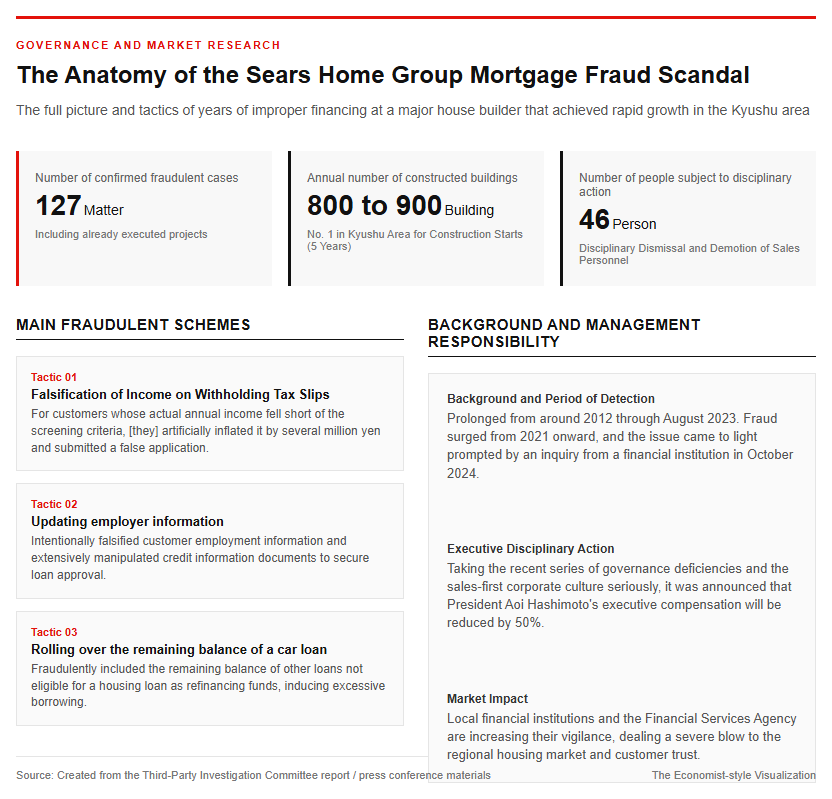
Headquartered in Kumamoto City and handling 800 to 900 residential constructions annually, Sears Home Group Holdings held a press conference on October 9, 2026, to announce that it had engaged in improper procedures when applying for mortgages. The number of confirmed fraudulent acts totals 127 cases, including those where mortgages were actually executed. The company boasted the top number of housing starts in the Kyushu area for the five-year period leading up to fiscal 2023, and had experienced rapid sales growth in recent years. However, a report by a third-party investigation committee involving outside lawyers revealed that, over a long period from around 2012 to August 2023, multiple sales employees had created fraudulent documents to apply to financial institutions. The fraudulent acts surged particularly after 2021, bringing to light a severe lack of compliance awareness behind the company’s rapid growth. At the press conference, President Aoi Hashimoto and other executives apologized for the series of inappropriate cases and announced disciplinary action consisting of a 50% reduction in the president’s executive compensation as management accountability. They also explained that severe disciplinary measures, such as summary dismissal and demotion, had been imposed on 46 sales employees other than executives whose involvement was identified. The revelation of long-term fraud by a major housing manufacturer representing Kyushu has delivered a major shock to the regional housing market and its customers.
The Scheme of Falsifying Tax Withholding Slips and Padding Car Loans
The methods used in this fraudulent procedure were extremely malicious, designed to get loan applications approved. According to the investigation findings, the most common method was falsifying the income amount on withholding tax slips submitted by customers. For customers whose actual annual income failed to meet financial institutions’ housing loan screening criteria, applications were submitted with their actual income inflated by several million yen, falsely representing their repayment capacity. In addition, cases of falsifying customers’ employer information and tactics involving rolling the remaining balance of auto loans—which are not eligible for housing loans—into the mortgage as additional refinancing funds were also confirmed. This issue came to light in October 2024 when financial institutions made inquiries regarding the purpose of the housing loans and application details. Following this discovery, an investigation revealed widespread falsification of documents related to credit information submitted to financial institutions. Allowing customers who would not normally qualify for loans to borrow excessively drastically increases the risk of future repayment defaults. This strongly calls into question the company’s ethical standards and social responsibility as a housing manufacturer.
Please refer to the figure below.
A corporate culture that prioritizes sales over everything else and a misguided sense of customer-firstism
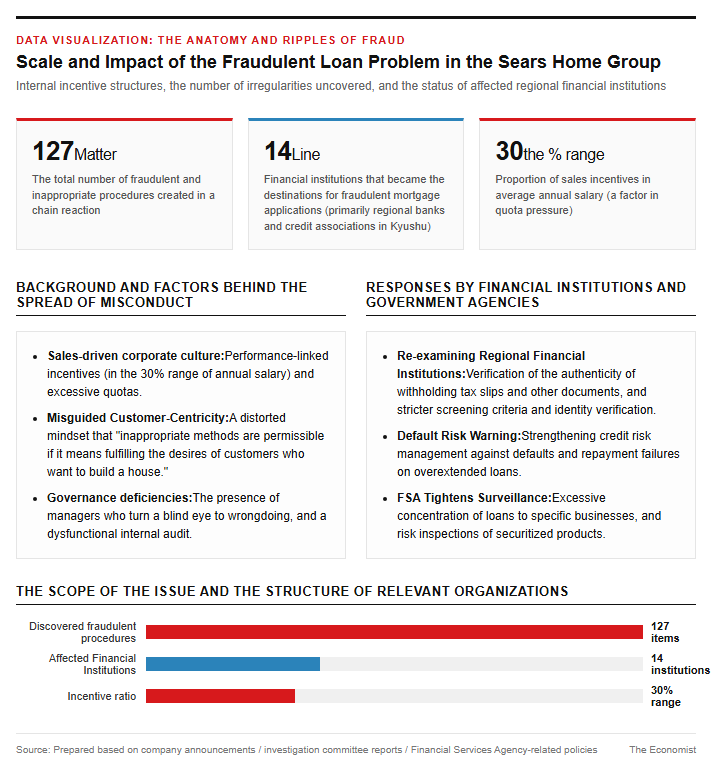
The fundamental cause of the spread of improper procedures within the Sears Home Group was a corporate culture that prioritized sales and securing projects above all else. The company had an incentive system in place for sales employees based on their performance, and incentives accounted for the 30% range of an average employee’s annual income. While this percentage itself is considered standard within the industry, the pressure regarding sales performance and quotas within the company became a major factor driving employees to resort to improper methods. According to analyses by management and the investigation committee, a sense of “misguided customer-firstism”—the belief that “improper methods are permissible if it means fulfilling the wishes of customers who want to build a house”—was rampant among frontline employees. Furthermore, the presence of supervisors who turned a blind eye to the wrongdoing and flaws in the governance structure, where the internal audit function did not operate adequately, prolonged the issue. The overlap of weak compliance awareness and a sales-first organizational structure resulted in the creation of a chain of as many as 127 fraudulent cases.
The Vigilance of Regional Financial Institutions and the Moves of Financial Administration
The Ripple Effect of Reviewing Screenings and Negotiations at 14 Financial Institutions
It has been revealed that fraudulent mortgage applications by the Sears Home Group were made to 14 financial institutions. Following the discovery of the fraud, the company is in discussions with the affected financial institutions and customers regarding the continuation of already executed loans and future measures. Many of the affected financial institutions are local financial institutions, such as regional banks and shinkin banks in the Kyushu region, including within Kumamoto Prefecture. For local financial institutions, mortgages are a core product for retail lending, and they have processed intermediaries based on trust with major housing manufacturers with established track records in the region. However, this document falsification issue has also called into question the validity of the screening systems and verification processes on the financial institutions’ side. Each financial institution is conducting re-inspections to verify the authenticity of submitted withholding tax slips and employer information, forcing them to tighten mortgage screening criteria and identity verification procedures. Concern is growing over the risk that loans excessively executed using fraudulent documents could fall into bad loans or defaults in the future, making the reinforcement of credit management structures at financial institutions an urgent priority.
Financial Services Agency Steps Up Oversight of Housing Loan Concentration and Securitization
Amid growing fraud and risks surrounding mortgages, the Financial Services Agency (FSA), which is responsible for financial administration, is also increasing its vigilance. In the FSA’s compiled financial administration policy and various monitoring reports for the 2026 business year, it has been pointed out that some regional banks show a tendency toward an excessive concentration of mortgages on properties sold by specific real estate agents or housing manufacturers. Amid sluggish local demand for funds, there are regional banks that rely on specific agents and take on excessive risks relative to their operational scale, and the FSA is conducting interview surveys to grasp the actual situation. Furthermore, monitoring is being strengthened regarding the trend of financial institutions securitizing mortgage claims they have issued and selling them to investors. This is because if inappropriate claims—such as those involving document falsification or misjudgment of repayment capacity during the screening stage—are circulated in the market as securitized products, there is a risk of undermining the stability of the entire financial system. The FSA has pledged to inspect the screening systems for mortgages, which are seeing increasingly longer repayment periods and higher amounts, and is demanding that regional financial institutions improve the effectiveness of their risk management.
Please refer to the figure below.
Spillover Effects on the Mortgage Market and Future Outlook
Changes in the Financial Environment and Stricter Mortgage Screening
The recent discovery of fraud has posed significant challenges to the market, as it coincides with the Japanese economy’s transition into an “era of rising interest rates.” Following the Bank of Japan’s policy rate hikes, financial institutions are raising their benchmark mortgage rates, as well as variable and fixed interest rates. Since rising interest rates increase the monthly repayment burden, borrowers who falsified their income to take out loans exceeding their limits face a dramatically higher risk of falling into repayment distress. Financial institutions have shifted toward a more cautious lending posture than ever before, thoroughly enforcing the validation of debt-to-income ratios and strict checks on supporting documentation. With this tightening of screening processes, there is a growing possibility of an increase in cases where customer segments that were previously able to secure loans can no longer pass the screening, raising concerns about the impact on overall housing demand. Furthermore, crackdowns on the fraudulent use of public loans such as Flat 35 and mortgage tax deductions are being strengthened; if false applications are uncovered, strict legal measures such as the lump-sum repayment of loan funds and additional taxation will be applied. A thorough adherence to compliance has become an indispensable requirement across the entire housing market.
Challenges in Establishing Governance to Restore Trust in the Housing Industry
Triggered by the inappropriate conduct at Sears Home, the reconstruction of governance and the assurance of transparency throughout the housing industry have become urgent issues. Amid increasingly severe profit environments for manufacturers driven by soaring building material prices and rising labor costs, sales systems that pursue only short-term sales or quotas are unsustainable. As future initiatives toward restoring trust, the first is securing the independence of internal audit organizations and strengthening on-site inspection systems. It is necessary to establish a system in which a management organization independent of the sales department rigorously checks application documents to prevent inappropriate misconduct in advance. The second is making data collaboration between housing manufacturers and financial institutions transparent. The introduction of digital technology that eliminates any room for document falsification—such as directly exchanging official income verification data with the customer’s consent—is required. Toward the healthy development of the real estate and housing market, it is essential for housing manufacturers to break away from prioritizing short-term profits and to establish genuine compliance and risk management systems.
Reference page
- [Financial Services Agency: Financial Administration Policy for Business Year 2026] https://www.fsa.go.jp/
[#Mortgage #SearsHome #Compliance #FSA #RegionalBank #FraudulentLoan #HomeBuilder]

コメント