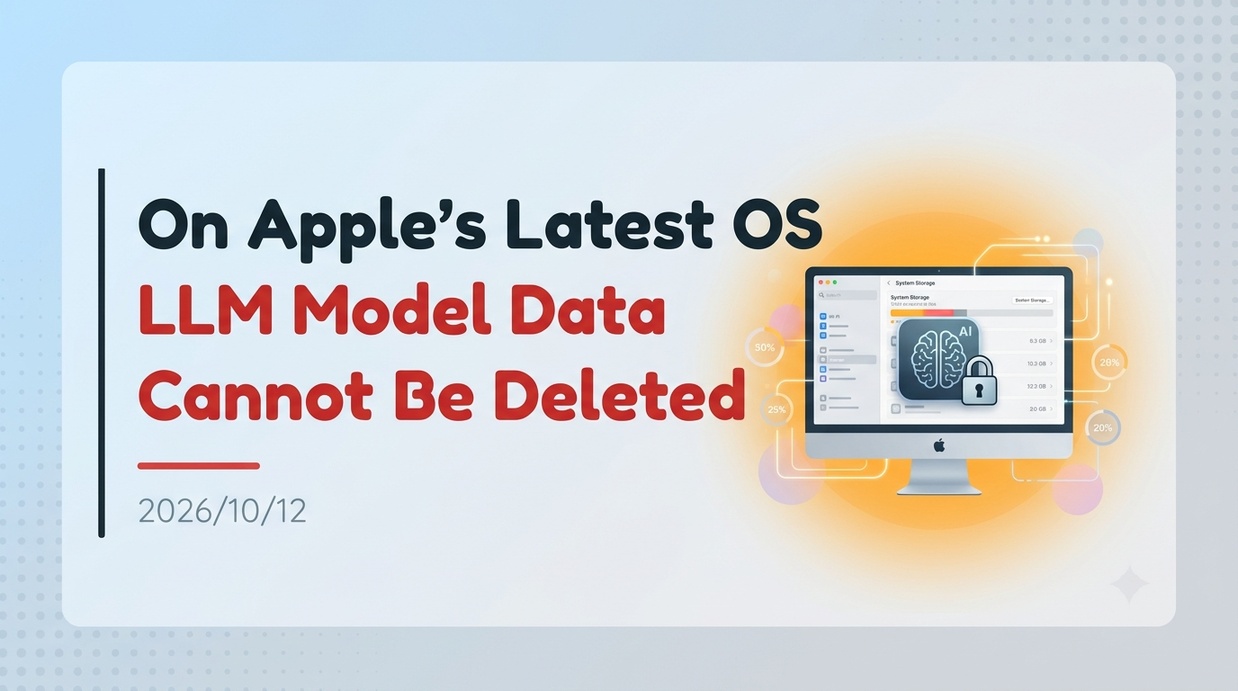
In macOS 27 Golden Gate, released by Apple, a specification change has been made that in principle prevents users from deleting Apple Intelligence LLM model data. While this change is driven by the enhanced integration of generative AI into OS features, it has sparked growing criticism due to storage constraints and corporate security concerns.
- Key points of the incident and background of the specification changes
- Effective Capacity Pressuring Storage and the Burden on Users
- Challenges from the Perspective of Enterprise Security and Data Privacy
- How the Open-Source Tool “RemoveMacAI” Works and Its Features
- Technical Risks and Concerns Over Issues Associated with the Adoption of Unofficial Tools
- Future Outlook and Measures Required of Apple
Key points of the incident and background of the specification changes
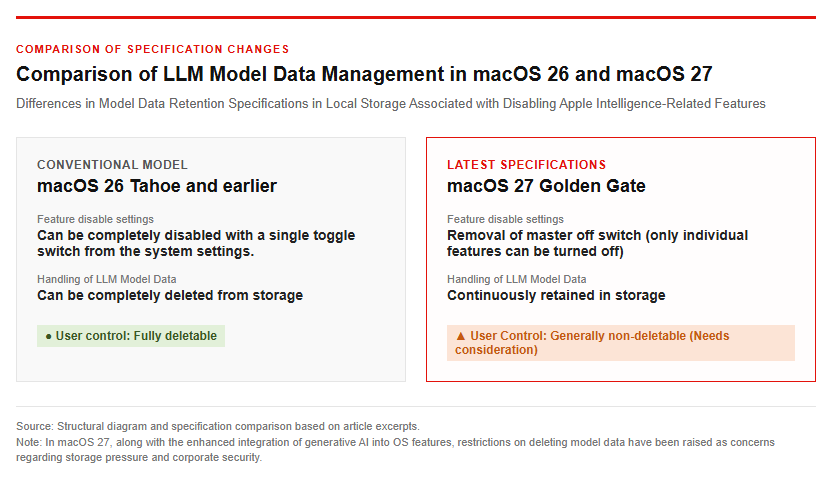
On September 14, 2026, Apple began rolling out macOS 27 Golden Gate, the latest operating system for Apple Silicon-equipped Macs and the MacBook Neo. In this OS, the generative AI feature sets Apple Intelligence and Siri AI have been fully integrated into the core of the operating system. In previous versions up to macOS 26 Tahoe, it was possible to completely delete pre-stored Large Language Model (LLM) data from storage by turning off the features all at once from the Apple Intelligence section in System Settings. However, in macOS 27, this master off-switch has been abolished. While it is still possible to disable individual AI features (such as text proofreading, summarization, and Genmoji), the underlying LLM model data running beneath them continues to be retained in storage, and the specification has been changed so that manual deletion by user operation is, in principle, no longer possible. The following figure shows an overview of the changes to the feature-disable settings.
Effective Capacity Pressuring Storage and the Burden on Users
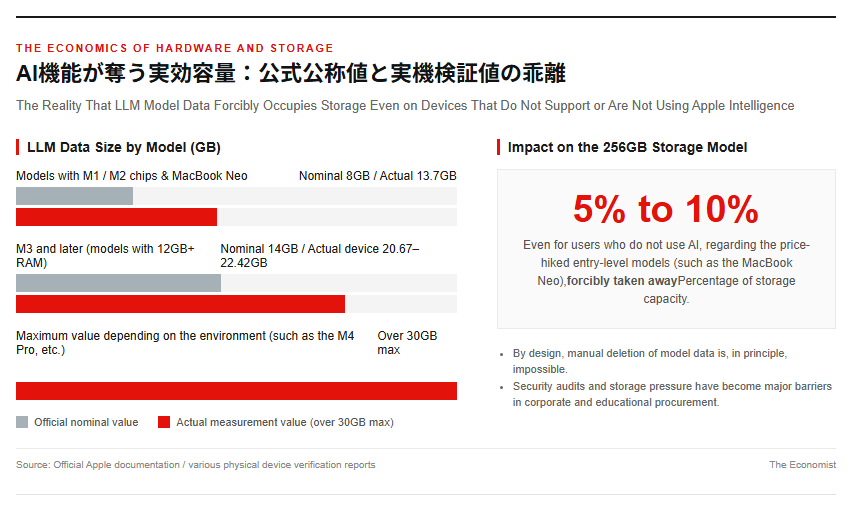
According to Apple’s official documentation, the storage capacity consumed by LLM model data is up to 14 GB for M3 and later models with 12GB or more of memory, and up to 8 GB for M1 and M2 models as well as the MacBook Neo. However, according to verification reports on actual devices, storage occupancy significantly exceeding the official figures has been confirmed. Measurements on an actual M1 MacBook Air show that approximately 13.7 GB is occupied, while on the Mac mini with M4 Pro and the M3 MacBook Air, it ranges from 20.67 GB to 22.42 GB, and there are even reports of cases where storage space exceeding 30 GB is permanently consumed depending on the environment. Especially for entry-level models with 256GB of storage (such as the MacBook Neo, whose price was increased by 20,000 yen to 119,800 yen in June 2026), approximately 5 to 10 percent of the total capacity is forcibly taken up even for users who do not use AI, posing a significant practical burden.
Challenges from the Perspective of Enterprise Security and Data Privacy
This concern extends far beyond the storage issues of individual users, sparking serious apprehension in enterprise sectors such as corporations and government agencies. Organizations requiring strict confidentiality and data governance—including finance, healthcare, and government institutions—have established zero-trust restrictions on the use of generative AI and local data retention. Traditional mobile device management (MDM) solutions only go as far as hiding AI icons and buttons on the screen, and specifications that leave 10GB or more of LLM model files potentially lingering on the hard drive risk failing security audits. As pointed out in academic research (“Local Is Not a Sufficient Privacy Boundary,” published on arXiv), even local execution carries the risk of context confusion and residual inference data. Consequently, it has been suggested that without the provision of an option for the physical deletion of model data, corporate procurement of new Macs could come to a halt.
Emergence of Volunteer-Driven Countermeasures, Future Outlook, and Challenges
How the Open-Source Tool “RemoveMacAI” Works and Its Features
Following the removal of the bulk deletion switch in macOS 27, independent developer Om Lahore has created and released an open-source tool called “RemoveMacAI” on GitHub. It sparked a major response immediately upon release, garnering over 3,200 stars as of October 2026. The tool is equipped to disable various Apple Intelligence features using macOS configuration profiles (.mobileconfig) while simultaneously calling Apple’s private system APIs, UnifiedAssetFramework and ResetAssetSets, to initialize and delete approximately 12 GB of LLM model data stored in storage. Furthermore, to prevent automatic re-downloading after deletion, it performs processes to redirect communication to a local loopback address ([suspicious link removed]). The following diagram illustrates the processing flow of RemoveMacAI.
Technical Risks and Concerns Over Issues Associated with the Adoption of Unofficial Tools
While RemoveMacAI offers the clear benefit of freeing up storage space, there are multiple technical risks involved in its adoption. Because the tool relies on private APIs not publicly disclosed by Apple, minor macOS updates (such as macOS 27.0.1) could cause it to stop working or lead to unexpected system glitches and instability. Furthermore, forcibly deleting Apple Intelligence model data creates side effects, preventing third-party apps that utilize the Foundation Models framework, the “Use Model” action in Shortcuts, and the calendar’s natural language input feature from functioning properly. Experts are urging users to exercise caution rather than casually adopting such unofficial tools.
Future Outlook and Measures Required of Apple
At WWDC 2026, Apple has indicated a policy of opening up the Foundation Models framework to third-party LLM providers as well, but has yet to announce an official stance on the non-removable specification of its OS-integrated models. However, considering the risk of stagnating procurement of new devices in the corporate market and regulatory compliance with the DMA (Digital Markets Act) and GDPR in Europe, there is a strong view that Apple will be forced to introduce an official model deletion option or a complete enterprise-level disable setting in future updates. Striking a balance between the advancement of AI features and the user’s right to choice and privacy has become the primary focus in the next-generation OS.
Reference Page
- GitHub – omlahore/RemoveMacAI
- 【Apple Developer – Foundation Models Documentation】[suspicious link removed]
- [Apple Support – How to get the next-generation Apple Intelligence] https://support.apple.com/ja-jp/121115
【#Apple #macOS27 #AppleIntelligence #LLM #Storage #DataPrivacy #Security】


コメント