According to the Tankan (Short-Term Economic Survey of Enterprises) for September 2026 released by the Bank of Japan’s Oita Branch, the business conditions diffusion index (DI) for all industries in Oita Prefecture stood at plus 17, improving for the first time in two quarters. This recovery is driven by a rebound in the manufacturing sector due to surging global demand for AI-related data centers, as well as progress in passing on costs in the accommodation and food services sectors.
- Developments and Overall Picture of the September Tankan Released by the Bank of Japan’s Oita Branch
- The Recovery of the Manufacturing Industry Driven by AI Data Center Demand
- Trends in the Non-Manufacturing Sector Driven by Inbound Tourism and Cost Pass-Through
- High Inflation and Middle East Tensions Behind the Slowing Pace of Economic Recovery
- The Structure of Cash Flow Burdens and Increased Borrowing Among Companies in Oita Prefecture
- Future Economic Outlook and Key Focus Areas for Regional Enterprises
Developments and Overall Picture of the September Tankan Released by the Bank of Japan’s Oita Branch
According to the September Tankan (Short-Term Economic Survey of Enterprises in Japan) released by the Bank of Japan’s Oita Branch in October 2026, the Business Conditions Diffusion Index (DI) for all industries in Oita Prefecture registered plus 17. This represents a 4-point increase compared to the previous survey in June 2026, indicating an improvement in business sentiment for the first time in two quarters. The latest survey was conducted from August 26 to September 30, 2026, and valid responses were obtained from a total of 151 companies—65 manufacturing and 86 non-manufacturing—out of the 153 target companies in Oita Prefecture. The DI, calculated by subtracting the percentage of companies reporting unfavorable business conditions from those reporting favorable conditions, is showing signs of recovery from the previous downturn. Please refer to the figure below for the trend in business sentiment among companies in the prefecture.
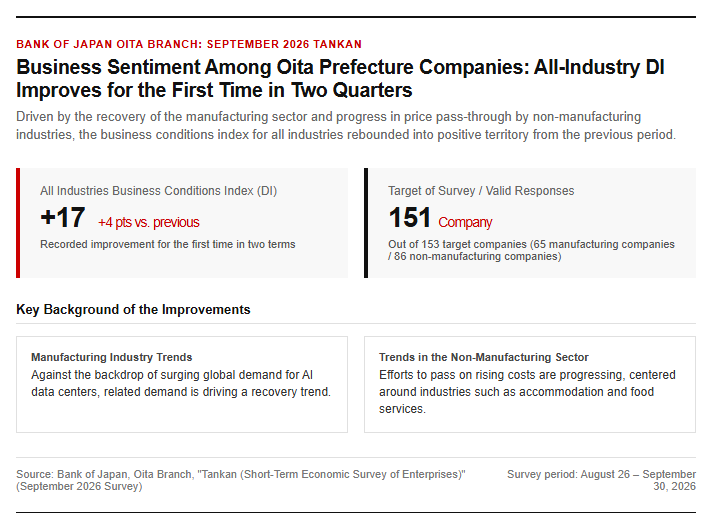
Looking at the breakdown by industry, indexes improved in both manufacturing and non-manufacturing sectors, seemingly halting the deteriorating trend in business sentiment that was a concern in the previous quarter. However, it must be noted that this improvement is largely supported by specific demand, and overall, the situation is far from unreservedly optimistic. There is a need to examine the challenges for a sustained recovery moving forward.
The Recovery of the Manufacturing Industry Driven by AI Data Center Demand
The business sentiment DI for manufacturing in the September 2026 Tankan stood at plus 11, improving by 2 points from the previous June survey. The biggest factor pushing up manufacturing business sentiment was the surge in data center demand accompanying the global spread of artificial intelligence (AI) technology. A rush of new data center construction and expansion rapidly expanded inquiries for core materials such as semiconductor-related components, steel, and non-ferrous metals. Oita Prefecture is home to a concentration of material and component manufacturers supporting these advanced technologies, and the securing of steady orders, centered on upstream industries, has directly driven the index upward. Meanwhile, raw material and energy costs remain high, leaving a lingering challenge where manufacturing companies dealing in final products and small- to medium-sized factories have not yet sufficiently passed on increased costs through price hikes. It is necessary to carefully monitor how future demand trends and raw material price fluctuations will impact earnings.
Trends in the Non-Manufacturing Sector Driven by Inbound Tourism and Cost Pass-Through
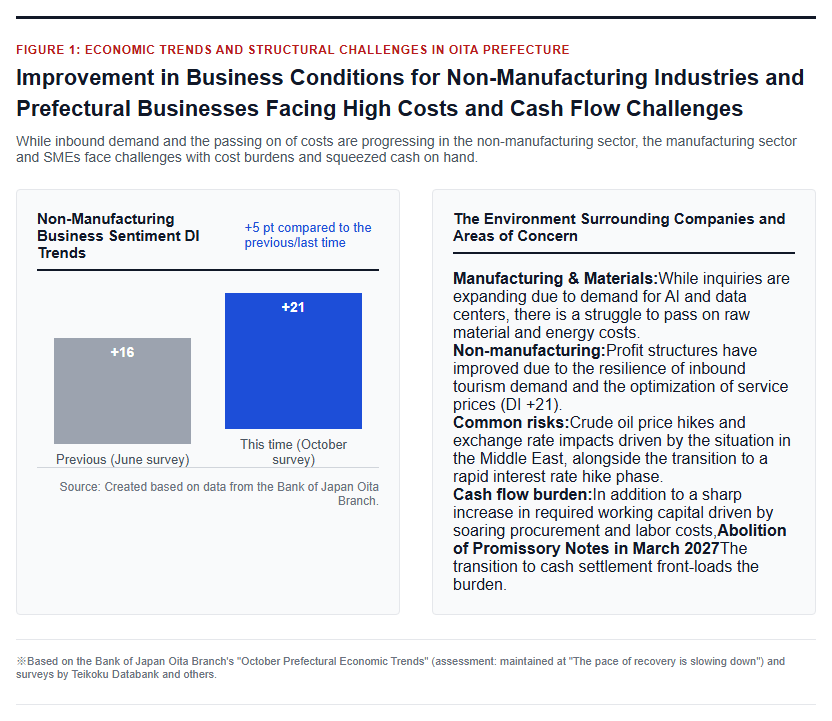
The business conditions DI for the non-manufacturing sector stood at +21, showing a significant 5-point improvement from the previous June survey. The recovery in the non-manufacturing sector was driven by the resilience of tourism demand, including inbound foreign tourists, and the optimization of service prices. Particularly in the accommodation and food services sector, progress in passing on costs to cope with rising labor and ingredient expenses and the resulting improvement in profit structures had a positive impact. Oita Prefecture boasts abundant tourism resources such as hot springs, and tourist spending is generating economic ripple effects across a wide range of industries within the prefecture, including commerce and transportation. Despite shouldering the burden of soaring labor costs due to labor shortages, the creation of a virtuous cycle through strong demand and appropriate price increases is underpinning business sentiment in the non-manufacturing sector. Looking ahead, expectations remain high for customer-attracting effects leading into the autumn tourism season and the sustainability of personal consumption.
The Environment Surrounding Regional Economies and the Reality of Cash Flow
High Inflation and Middle East Tensions Behind the Slowing Pace of Economic Recovery
While the business conditions DI improved, the Bank of Japan’s Oita Branch kept its overall assessment unchanged in its October economic report for the prefecture released that same month, stating that “the pace of recovery is slowing down.” Sohei Kaihatsu, manager of the Oita Branch, pointed out the risk that rising oil prices due to escalating tensions in the Middle East and inflation caused by currency fluctuations could cool household consumer sentiment and squeeze corporate profits. In fact, soaring crude oil and material prices have significantly inflated companies’ working capital, and the difficulty in passing on energy costs such as electricity and fuel expenses is acting as a factor pushing down profits. Furthermore, compounded by the transition to a phase of rapid interest rate hikes, although the employment and income environment is improving moderately, households’ frugality mindset and companies’ caution regarding the future remain deeply rooted. Establishing a virtuous cycle between rising prices and wages will be a major focus moving forward.
The Structure of Cash Flow Burdens and Increased Borrowing Among Companies in Oita Prefecture
While business sentiment indicators remain in positive territory, the actual financing and cash flow environment for local companies is becoming increasingly severe. According to sentiment surveys by Teikoku Databank and others, the top concern cited by businesses is the rise in crude oil and material prices, followed by a rapid surge in worries over rising interest rates and uncertainty in the overseas economy. Due to soaring procurement costs and labor expenses, a structural issue has emerged in which the working capital required simply to maintain the same scale of operations is surging. Furthermore, the transition to cash settlement associated with the abolition of paper promissory notes and transaction optimization scheduled for March 2027 is accelerating financial burdens, acting as a factor that drives the expansion of borrowing limits and overdraft facilities from financial institutions. Close attention must continue to be paid to the risk of profitable bankruptcy, where companies are generating sales yet facing severe pressure on their cash reserves. Businesses are now required to implement even stricter cash flow management.
Future Economic Outlook and Key Focus Areas for Regional Enterprises
The key to the future outlook of the prefectural economy will be the sustainability of AI-related demand and further progress in price pass-through. Please refer to the figure below for the trajectory of future economic trends.
Regarding the future outlook, not a few companies are expressing cautious views due to developments in the Middle East situation and concerns over a slowdown in overseas economies. Amidst these circumstances, for local companies to achieve sustainable growth, it is essential to continue appropriate price pass-through in response to soaring crude oil and labor costs, and to make capital investments to improve productivity. Furthermore, anticipating an increase in interest burdens associated with changes in monetary policy, a financial strategy that clearly separates short-term working capital from long-term structural improvement funds is required. While promoting labor-saving investments and improvements in the working environment to resolve labor shortages, strengthening management resilience to weather the wave of high costs will be the biggest point of focus moving forward.
Reference Page
- [Bank of Japan Oita Branch] Economic trends and Tankan in Oita Prefecture ([Suspicious link removed]
【#OitaPrefecture #BOJTankan #BusinessSentiment #Manufacturing #DataCenter #Inbound】

コメント