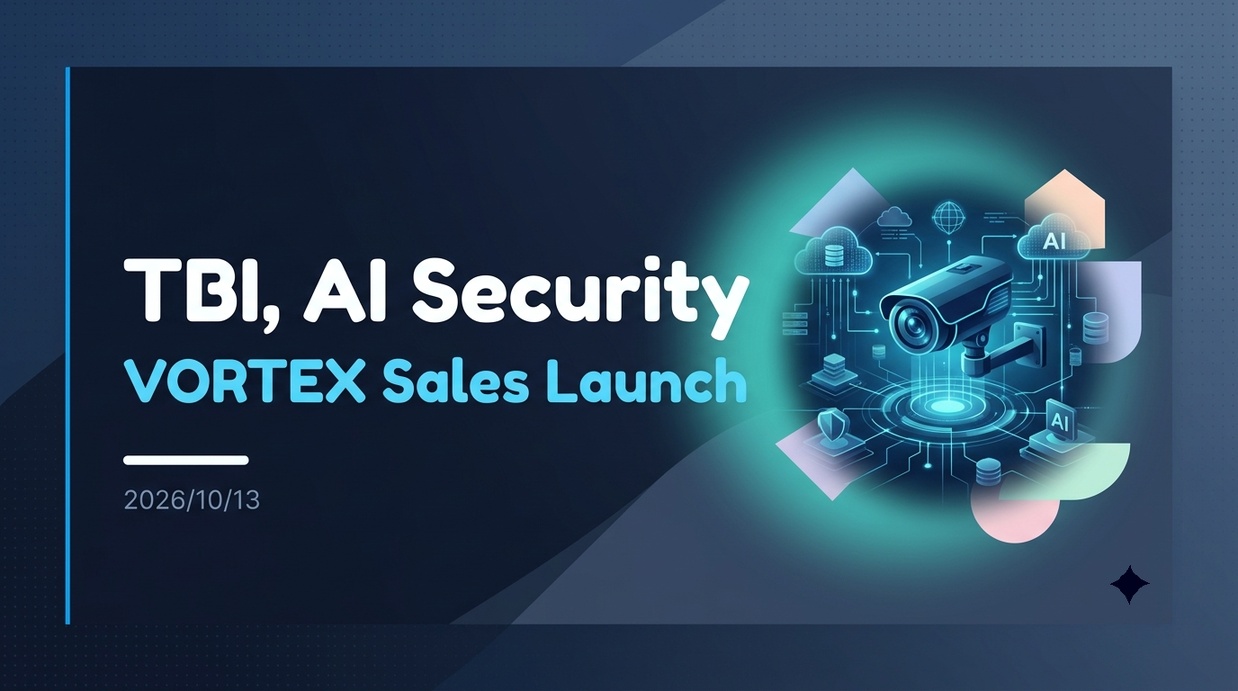
TBI Inc. and AI Link Inc., both members of the Tokyo Boeki Group, have entered into a distributor agreement with VIVOTEK and launched sales of the “VORTEX” cloud AI security camera service in Japan. This launch comes amid a growing demand to solve the challenges of communication load and costs associated with conventional constant cloud transmission, and to efficiently promote on-site DX and enhanced security by combining it with edge AI analysis.
- The Emergence of Next-Generation Security Solutions with Edge Recording and Cloud Integration
- Innovations in Video Analysis Brought by VLM Technology and Natural Language Search
- Promoting labor savings through intercom integration and on-site operations
- Comparison of Major Brands in the Industrial Camera Market and VORTEX’s Positioning
- Legal Obligations and Privacy Considerations in AI Camera Operations
- Future Market Trends and the Potential of Camera Solutions
The Emergence of Next-Generation Security Solutions with Edge Recording and Cloud Integration
Tokyo Boeki Holdings Corporation’s group companies, TBI Co., Ltd. and AI Link Co., Ltd., have signed a distributor agreement with Taiwan-based VIVOTEK and launched sales of the cloud AI security camera service “VORTEX” in the Japanese market on October 9, 2026. In conventional surveillance camera systems, the common architecture involved constantly transmitting and storing high-definition video to cloud servers, which posed major challenges such as increased network communication loads and soaring monthly storage costs. In addition, manually searching through recorded data to find specific scenes where troubles or accidents occurred required a tremendous amount of effort and time.
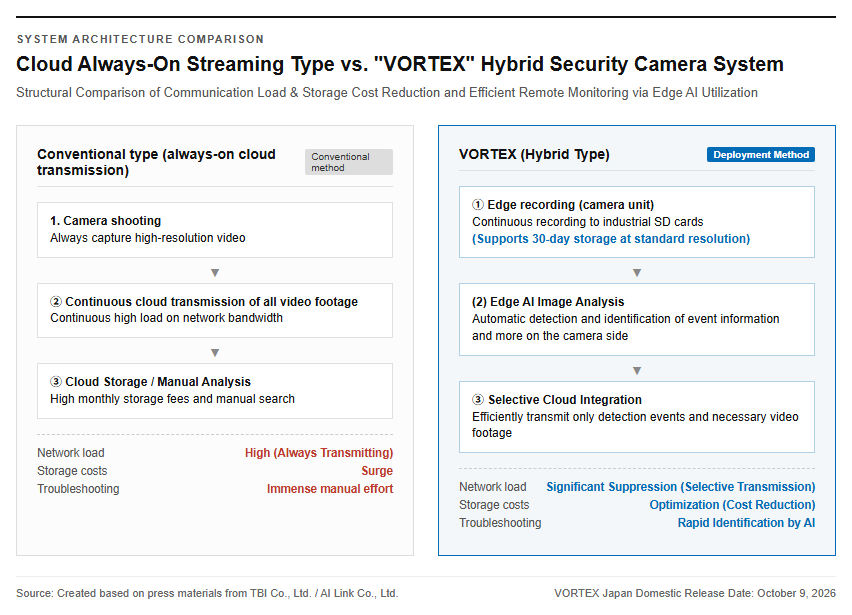
VORTEX features an edge recording function that continuously records video to an industrial SD card built into the camera body, supporting 30 days of storage at standard resolution. Furthermore, it adopts a hybrid system architecture that performs AI image analysis on the camera itself, selectively transmitting only detected event information and footage requiring long-term storage to the cloud.
As shown in the configuration diagram below, advanced remote monitoring is achieved while significantly reducing communication load and storage costs.
. Users can utilize live video viewing and playback, AI search, and alert notifications 24 hours a day, from anywhere, via PCs or smartphones. TBI provides a consistent, one-stop system ranging from system proposals and design to installation, configuration, and post-implementation remote support, powerfully supporting the promotion of onsite DX for businesses.
Innovations in Video Analysis Brought by VLM Technology and Natural Language Search
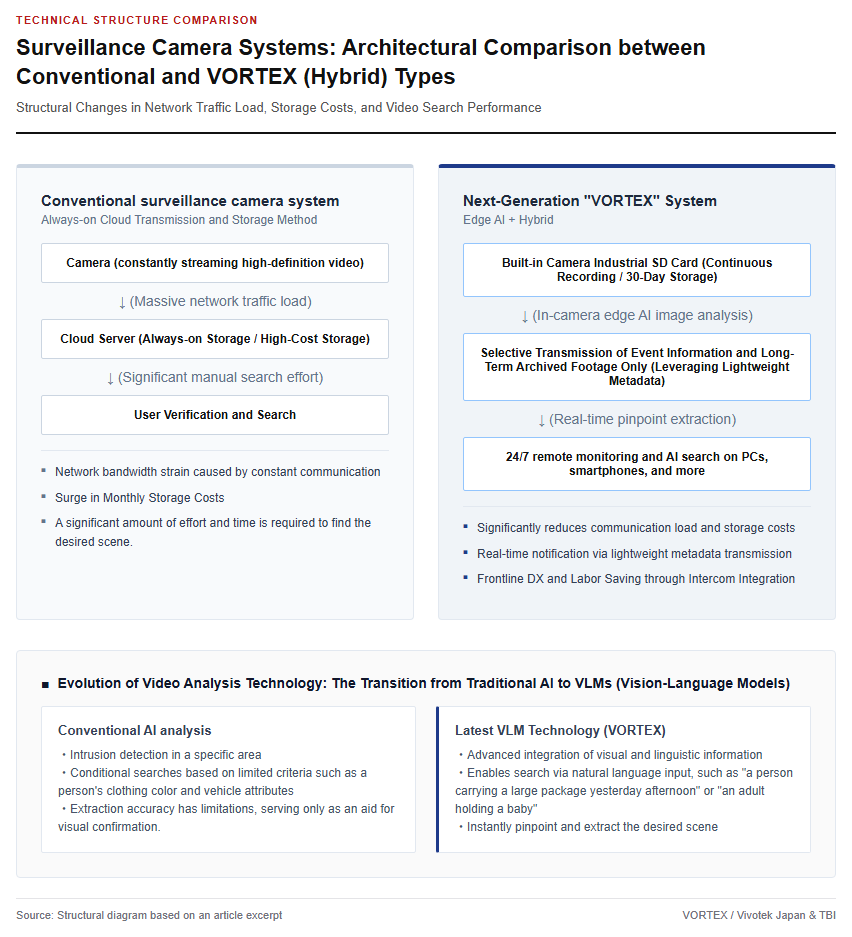
The true technical core of VORTEX lies in the latest AI video analytics algorithm implemented by its developer, VIVOTEK. Traditional AI analytics technologies have been limited to stages such as intrusion detection in specific areas and conditional searches based on clothing colors or vehicle attributes. However, the latest generation introduces VLM (Vision Language Model) technology, which highly integrates and processes visual and linguistic information.
This enables input search using natural language sentences, such as “a person carrying a large package yesterday afternoon,” “an adult holding a baby,” or “a sedan of a specific manufacturer.” Because the desired scene can be pinpointed and instantly extracted from a massive amount of recorded footage, the search for lost children in commercial facilities and the tracking operations of specific individuals will be revolutionized in efficiency.
Supporting this high-precision search is the utilization of lightweight search metadata generated at the time of recording, rather than the video footage itself. The design of sending and receiving only metadata to and from the cloud avoids bandwidth constraints while enabling real-time alert notifications. For the Japanese market, Japanese-language technical support and deployment assistance systems by VIVOTEK Japan Inc. have also been established, creating an environment where advanced technology can be smoothly adopted on-site.
Practical Application and Social Significance through Field DX and Integration with Other Systems
Promoting labor savings through intercom integration and on-site operations
VORTEX goes beyond standalone security monitoring, achieving highly effective on-site DX by integrating with on-site business processes and external systems. By integrating with various products and intercom systems independently developed by TBI, it is possible to build a mechanism that sends camera alert detection information to on-site staff’s smart devices or intercoms as real-time voice notifications.
For example, in medical and nursing care settings, notifications are sent to the nurses or care workers the moment a patient’s or user’s fall accident or suspicious behavior at night is detected, enabling an immediate initial response. In retail stores, it is used to deter shoplifting and improve service by detecting the arrival of VIP customers, while across the vast grounds of factories and logistics hubs, it helps automate security guards’ patrol operations.
As shown in the following use cases, video surveillance and on-site communication are seamlessly integrated.
. Compared to traditional manual monitoring systems that rely on the deployment of security guards, cases have also been reported where security- and patrol-related costs were reduced by up to roughly one-tenth. TBI provides a comprehensive service covering everything from pre-installation site surveys to post-implementation troubleshooting, significantly lowering the operational hurdles for adopting companies.
Comparison of Major Brands in the Industrial Camera Market and VORTEX’s Positioning
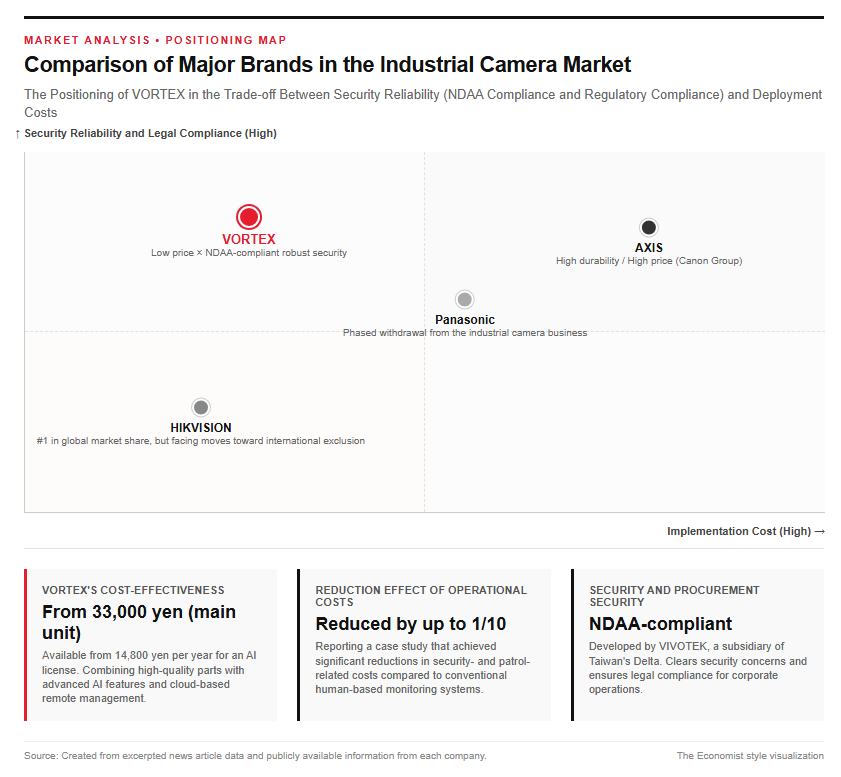
In the industrial AI security camera market, there are various global brands, each with distinct characteristics and market backgrounds. AXIS, headquartered in Sweden and part of the Canon Group, is an industry pioneer boasting high durability and exceptional reliability, though its equipment installation costs are relatively high. China’s HIKVISION, which holds the top global market share, leverages low pricing as its strength, but faces a growing international trend of exclusion due to national security concerns, including past vulnerability disclosures, equipment certification bans by the U.S. Federal Communications Commission (FCC), and business suspension orders by the Canadian government. Meanwhile, Panasonic, which has a solid track record in the domestic market, has announced its phased withdrawal from the industrial camera business.
Under these circumstances, VORTEX ensures robust security by adopting high-quality parts developed by VIVOTEK, a subsidiary of Taiwan’s Delta Electronics, which comply with the National Defense Authorization Act (NDAA). While offering accessible pricing starting from 33,000 yen for the base unit and 14,800 yen annually for the AI license, it achieves both advanced AI search functions and cloud-based remote management. Its report output function, which boasts high evidentiary value, is also highly regarded, making it a prominent choice that combines cost performance with security reliability.
The Act on the Protection of Personal Information and Secure Operations / Future Outlook
Legal Obligations and Privacy Considerations in AI Camera Operations
With the proliferation of AI cameras, facility managers and business operators are required to take strict measures regarding the Act on the Protection of Personal Information and privacy. Even footage captured by security cameras is treated as personal information under the law if specific individuals can be identified and matched. In particular, facial feature data calculated by facial recognition functions falls under individual identification codes that can identify an individual on their own, and strict security management measures are mandated.
For corporations and businesses to ensure secure operations, it is essential to establish management rules such as clarifying the purpose of installation, notifying visitors and employees through notices or similar means, restricting access privileges, and minimizing data retention periods. Furthermore, when using cloud-based services, an obligation arises to monitor and supervise the security systems of the contracted vendor.
For marketing purposes such as store traffic analysis and demographic analysis, the use of technologies that compile statistics only on attribute information without storing video footage, as well as anonymizing AI solutions that process abstracted human imagery, is becoming widespread. Designing operations with legal compliance in mind from the initial stages of technology implementation leads to enhanced corporate credibility.
Future Market Trends and the Potential of Camera Solutions
In the Japanese network camera market, demand for security purposes aimed merely at crime deterrence has been reaching a plateau, accelerating a shift toward business improvement using AI and the field of operational AX (Appliance/Transformation). Particularly against the backdrop of labor shortages and the overtime regulations for the construction and logistics industries enforced in April 2024 (the “2024 Problem”), there is a remarkable surge in demand for automated truck berth management via license plate recognition, as well as remote progress management and remote supervision at construction sites.
As shown in the future projections below, the integration of image analysis technology and the cloud is becoming an essential infrastructure supporting productivity improvements across industries.
Currently, the actual activation rate of AI functions in security cameras remains at around 5% to 10%, but moving forward, AI features are expected to come standard on the majority of surveillance cameras, excluding entry-level models.
Hybrid architectures combining edge AI analysis and the cloud, typified by VORTEX, are expected to establish themselves as a central presence driving the future monitoring solutions market by achieving both optimized data communication and operational flexibility.
Reference page
- [TBI Co., Ltd. Official Website] https://www.tbeye.com/
- [VIVOTEK Official Japanese Website] https://www.vivotek.com/ja
- [Tokyo Boeki Holdings Corporation Press Release] https://prtimes.jp/main/html/rd/p/000000214.000098548.html
[#AICamera #SecurityCamera #VORTEX #TBI #PrivacyProtection #OnSiteDX #ImageAnalysis]


コメント