The commercial debris removal demonstration satellite “ADRAS-J,” operated by Astroscale Inc., has succeeded for the first time in the world in approaching and capturing detailed images of actual space debris. This achievement marks a decisive step toward solving the worsening debris problem and realizing sustainable space development.
- The world’s first achievement achieved by ADRAS-J
- Overview of the Commercial Debris Removal Demonstration (CRD2) Program
- Technical Challenges of Approaching Non-Cooperative Objects
- Four business domains that are not just about removal
- Platform Strategy Supporting Sustainable Space Use
- Strong collaboration with governments and national security
- Next step: capture and removal with ADRAS-J2
- Realizing a Circular Space Economy with a Vision to 2030
The world’s first achievement achieved by ADRAS-J
Astroscale’s commercial debris removal demonstration satellite “ADRAS-J” was launched from New Zealand on February 18, 2024. The main mission of this satellite was to investigate the upper stage of a Japanese rocket (approximately 11 meters long, 4 meters in diameter, weighing about 3 tons) that had been left in orbit for a long time, and to approach it safely and precisely. Relying solely on orbital information from the ground, ADRAS-J succeeded in approaching the target debris within an extremely close distance of 15 meters using autonomous navigation.
Please refer to the diagram below.
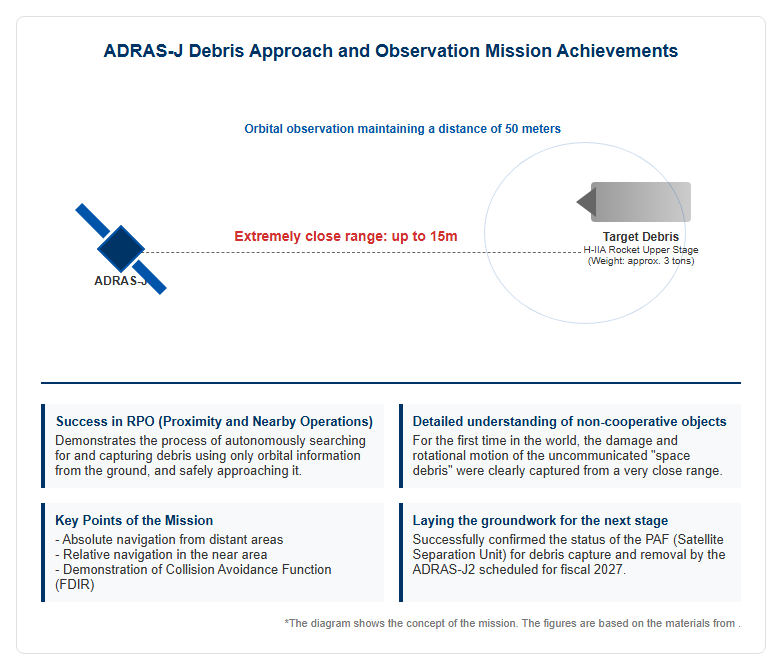
Furthermore, orbital observations were conducted while maintaining a distance of 50 meters from debris, recording the damage status and rotational motion of debris in clear images. This mission is a groundbreaking achievement in the world, as it has uncovered the true nature of “non-cooperative objects,” which no one had previously been able to know in detail. On March 25, 2026, it was announced that the orbital descent accompanying ADRAS-J’s end of operation would begin, and it is expected to eventually re-enter the atmosphere and burn up.
Overview of the Commercial Debris Removal Demonstration (CRD2) Program
This mission was carried out as Phase I of the “Commercial Debris Removal Demonstration (CRD2)” program promoted by the Japan Aerospace Exploration Agency (JAXA). CRD2 is a new initiative by JAXA aimed at establishing large debris removal technologies by leveraging the technical expertise of private companies. Unlike the conventional JAXA project, this one adopts a contract structure that procures research and development results and the services themselves, rather than simply procuring satellites.
CRD2 consists of two phases.
-
Phase I: Close-range rendezvous and filming and investigation of large debris (handled by ADRAS-J)
-
Phase II: Capture of large debris and removal by atmospheric reentry (ADRAS-J2 is scheduled to be responsible)
The success of Phase I marked a significant step forward toward the next step: actual debris removal. This program aims to establish debris removal as a business and enable Japanese companies to demonstrate leadership in the international space market.
Technical Challenges of Approaching Non-Cooperative Objects
At the core of Astroscale’s technology lies in RPO (Proximity and Near Operation) technology for “non-cooperative objects” that cannot be controlled independently. Satellites (cooperating objects) during normal operation transmit their exact position information and can control their attitude as needed. However, debris from rockets, which are space debris, flies at high speeds without communication or power sources, spinning unpredictably.
Approaching such an object within a few meters carries an extremely high risk of collision and requires highly advanced technology. At ADRAS-J, we demonstrated the following processes:
-
Absolute navigation using GPS and other means to approach from distant areas
-
Relative navigation that uses onboard sensors to capture and approach targets
-
Technology that synchronizes posture with the movements of the target
These technologies form the foundation for all orbital services, including future debris removal but also repairs and refueling of failed satellites. Currently, Astroscale is considered the only private company to have successfully demonstrated technology at this level.
Expanding Potential for On-Orbit Services
Four business domains that are not just about removal
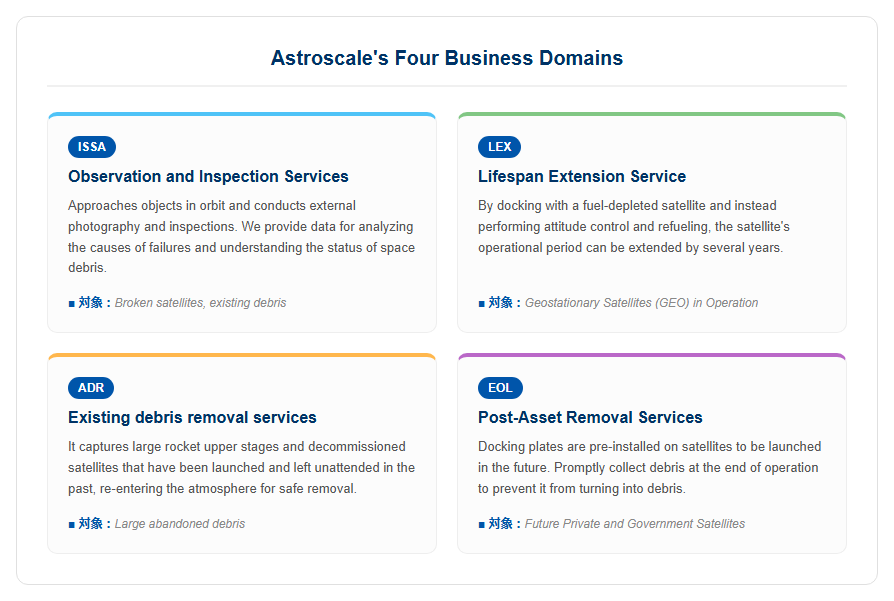
Astroscale aims to go beyond debris removal by offering comprehensive infrastructure services in space. Specifically, we have identified the following four main service areas (business domains).
-
ISSA (Observation and Inspection Service): Checking the condition of failed satellites and debris in orbit
-
LEX (Extended Life Service): Docks satellites that run out of fuel or face difficulties with attitude control, supporting continued operations.
-
ADR (Existing Debris Removal Service): Collecting and removing massive debris already in orbit
-
EOL (Post-Operational Satellite Removal Service): Newly launched satellites are pre-equipped with removal devices and promptly retired after the end of their operation
Please refer to the diagram below.
In particular, for private satellite operators, extending the lifespan of satellites launched at a cost of hundreds of millions of dollars by several years through LEX is extremely economically viable. Additionally, demand for refueling services is rapidly increasing from the U.S. Space Force and others, and by the fiscal year ending April 2025, we have secured additional contracts for refueling missions (APS-R) from the U.S. Space Force.
Platform Strategy Supporting Sustainable Space Use
A device called the docking plate (DP) plays a crucial role in Astroscale’s business model. This concept involves equipping all satellites launched in the future with a “handle” or a joint point in advance. Once DP is standardized, it will become easier to recover and maintain satellites in emergencies, preventing the deterioration of the space environment before it occurs.
In fact, a commercial contract for DP has been signed with Airbus Defence and Space in Europe. This is part of a platform strategy to make certain technologies the de facto standard (de facto global standard).
-
Lobbying for the mandatory installation of DP on all future satellites through rule formation
-
When a satellite equipped with DP malfunctions, Astroscale’s servicer exclusively repairs and retrieves it
In this way, it is striving to establish itself not just as a “cleaner” but as an “infrastructure OS” supporting all kinds of work in outer space.
Strong collaboration with governments and national security
Ensuring the safety of space activities has now become a challenge directly linked to national security. If space debris collides with satellites, it would severely disrupt daily life such as broadcasting, communications, and weather forecasting. Astroscale has offices in five countries: Japan, the UK, the US, France, and Israel, establishing a “global multi-local” system that directly contracts with governments and militaries in each country.
The main recent achievements of each site are as follows:
-
UK: Awarded a 15 billion yen debris removal project (COSMIC) from the UK Space Agency (UKSA)
-
United States: Signed research contracts for refueling and proximity operations with the U.S. Space Force and Air Force
-
Japan: Awarded demonstration project related to Space Domain Awareness (SDA) from the Ministry of Defense
Because debris removal technology is inseparable from technologies that neutralize other countries’ satellites (killer satellite technology), venture companies from other countries cannot easily secure government budgets. Astroscale’s trust as a “family” in various countries serves as a powerful barrier to entry (moat) against competitors.
Future Prospects and Building a Space Economy
Next step: capture and removal with ADRAS-J2
Astroscale’s next major goal is the ADRAS-J2 mission, scheduled for fiscal year 2027. This is the world’s first attempt to actually capture the upper stage of a rocket, which ADRAS-J successfully investigated and photographed, using a robotic arm, removing it from orbit, and re-entering the atmosphere.
The main operations planned for ADRAS-J2 are as follows:
-
Safe approach to target debris and continued proximity control
-
Reliable capture of uncooperative objects using robotic arms and similar tools
-
Post-capture Attitude Stabilization and Implementation of Deorbit Manuba
If successful, this will demonstrate to the world that the long-standing issue of “massive debris that already exists” can be removed. The success of the technology demonstration will directly translate into subsequent commercial service orders, making the late 2020s a crucial period for the company.
Realizing a Circular Space Economy with a Vision to 2030
The future envisioned by Astroscale is to transform outer space from a “one-time disposable” space that can be “repaired, replenished, and reused.” By 2030, on-orbit services will become routine, and by 2035, we aim to establish a “circular space economy” that supports sustainable space development.
When this vision is realized, the space industry will likely undergo the following transformations:
-
The spread of ‘space gas stations’ that continue to operate for refueling even after satellites reach the end of their lifespan
-
Normalization of ‘on-track upgrades,’ replacing deteriorated parts with the latest ones
-
Establishing rules that require companies that dispose of debris to bear the removal costs responsibly
In September 2024, the United Nations Headquarters adopted the “Agreement for the Future,” reaffirming the reduction of space debris as a global challenge. Alongside technological development, Japan is also expected to take the lead in international rule-making initiatives led by the Cabinet Office and others, leading to the construction of a new space economy centered on Astroscale.
[#アストロスケール #宇宙ゴミ #スペースデブリ #JAXA #宇宙開発 #SDGs #科学技術 #宇宙安全保障]


コメント