
The Bank of Japan raised its policy interest rate to 1.25%. Behind this move is a change in the economic environment where the underlying inflation rate is becoming firmly established at the 2% target.
- Additional Rate Hike to 1.25% and a Historic Turning Point Not Seen in 31 Years
- The Rational Background of the Rate Hike Decision Created by a Virtuous Cycle of Wages and Prices
- The Impact of Fluctuations in Long-Term Interest Rates and Rate Checks in the Foreign Exchange Market
- Trends in Mortgage Interest Rates and the Structural Risks Lurking in Variable-Rate Mortgages
- The Polarization of Winners and Losers Between Overall Household Financial Assets and Debt-Holding Households
- Pressure from Rising Interest Payments on Corporate Earnings, Business Restructuring, and an Excess of Zombie Companies
- Structural Changes in the Stock Market and Future Outlook to Monitor
Additional Rate Hike to 1.25% and a Historic Turning Point Not Seen in 31 Years
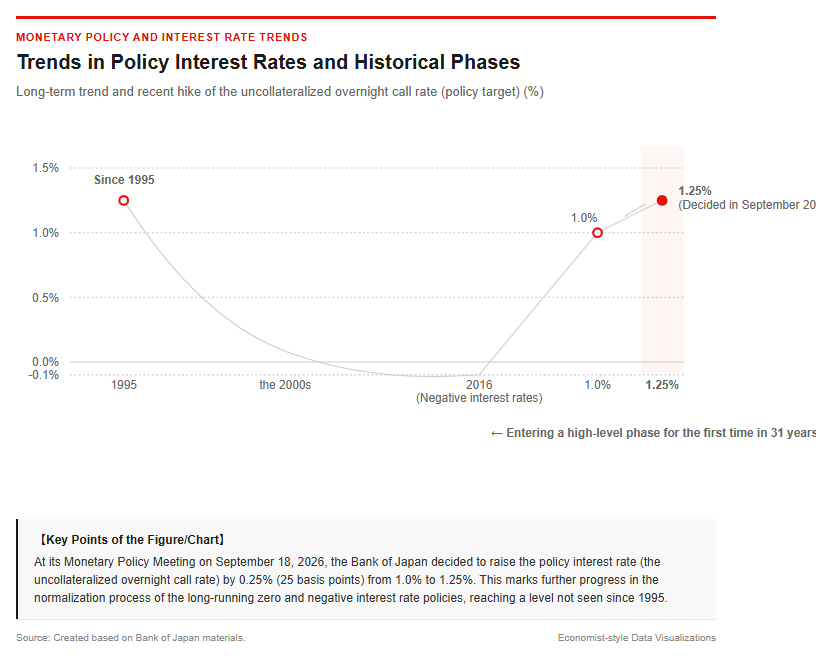
At the Monetary Policy Meeting held on September 18, 2026, the Bank of Japan decided to raise the policy interest rate—the uncollateralized overnight call rate target—by 25 basis points, from 1.0% to 1.25%. This level marks the highest policy interest rate in 31 years, since 1995. At this meeting, although two board members dissented against the rate hike, the normalization process away from unprecedented monetary easing progressed further, in line with widespread expectations. The backdrop to the BOJ’s move to adjust monetary policy lies in the fact that domestic economic and price trends have been moving largely in line with the outlook presented by the bank. The extraordinary monetary easing environment of long-standing zero and negative interest rates has been dismantled, and the Japanese economy has made a major pivot, both in name and reality, into a new phase where interest rates exist. In financial markets, the impact on long-term interest rates and exchange rates has emerged immediately, making it essential for corporate and household decision-making to factor in interest rate fluctuations.
The figure below is an image showing recent trends in the Bank of Japan’s policy interest rate.
The Rational Background of the Rate Hike Decision Created by a Virtuous Cycle of Wages and Prices
The primary factor behind the Bank of Japan raising its policy interest rate to 1.25% is that a virtuous cycle of rising prices and wages is becoming firmly established. In the 2025 and 2026 shunto (spring labor-management wage negotiations), high-level wage hike rates were achieved, and the wage increase rate, including regular pay rises, has maintained an annual growth rate of around 5%. As a result, the increase in nominal wages has outpaced the rise in consumer prices, and signs of real wages stabilizing in positive territory have begun to be confirmed. Meanwhile, the core inflation rate, excluding fresh food, continues to hover around the BOJ’s target level of 2%, and risks of the underlying inflation rate overshooting the target are also beginning to be recognized. BOJ Governor Kazuo Ueda has expressed the view that the situation has shifted from lifting underlying prices—which were below the 2% traditional policy objective—to a phase of stabilizing prices at around 2%. The confirmation of strong demand accompanying the autonomous expansion of the economy has underscored the validity of continuing with gradual interest rate hikes.
The Impact of Fluctuations in Long-Term Interest Rates and Rate Checks in the Foreign Exchange Market
Following the policy rate hike, clear changes have emerged in the formation of short- and long-term interest rates and the foreign exchange market. Long-term interest rates, typified by the newly issued 10-year government bond yield, are under upward pressure toward a range of around 1.0% to 1.65%, and the recovery of interest rate functionality in the market is progressing. On the other hand, in the foreign exchange market immediately after the rate hike decision, phases of temporary US dollar appreciation and yen depreciation were observed due to market participants’ speculations and speculative moves. In response to this, financial authorities are reported to have conducted rate checks—inquiring about market levels with participants—aimed at curbing rapid fluctuations in the dollar-yen exchange rate and excessive yen depreciation. Because the rapid depreciation of the currency raises concerns of triggering cost-push inflation via soaring import costs, the Bank of Japan and the government are cautiously monitoring market trends. Ensuring that interest rates converge to appropriate levels while maintaining stability in financial conditions remains a shared challenge among market participants.
Impact on Household Budgets and Daily Life: Changes in Mortgages and Asset Structures
Trends in Mortgage Interest Rates and the Structural Risks Lurking in Variable-Rate Mortgages
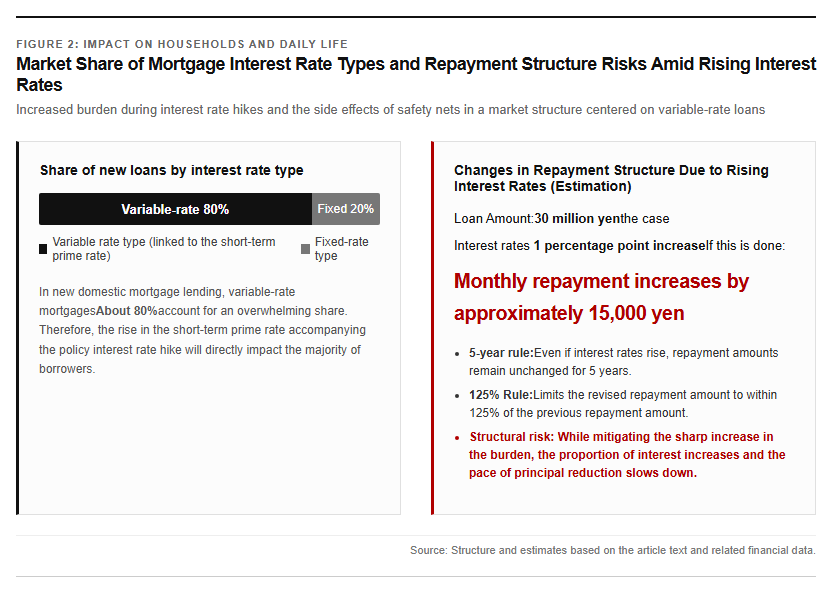
The hike in the policy interest rate is having a significant impact on mortgage interest rates, which are directly connected to people’s daily lives. Floating-rate mortgages, which account for about 80% of new mortgage lending, are set primarily using banks’ short-term prime rates as an index. With the policy rate rising to 1.25%, financial institutions are raising their short-term prime rates, and benchmark floating rates are expected to rise in tandem. For those using the principal-and-interest constant repayment method, there are safeguards such as the “5-year rule,” which keeps repayment amounts unchanged for five years even if rates rise, and the “125% rule,” which caps the revised repayment amount at 125% of the previous amount. However, these mechanisms are merely relief measures to temporarily avoid a sudden surge in monthly payments, and they carry the side effect of slowing down the pace of principal reduction due to the increased proportion of interest in the payments. A simulation for a 30 million yen loan shows that a 1 percentage point increase in interest rates will raise the monthly repayment amount by approximately 15,000 yen after the repayment review, making advance preparation essential.
Please refer to the figure below for changes in housing loan interest rate types and repayment structures.
The Polarization of Winners and Losers Between Overall Household Financial Assets and Debt-Holding Households
Analyzing the impact of rising interest rates on households as a whole, a dual nature emerges: positive effects driven by massive financial assets, and an increased burden on debt-holding households. Since total financial assets held by Japanese households reach approximately 2,200 trillion yen, while total liabilities remain at around 400 trillion yen, the increase in deposit interest rates and government bond interest income outweighs the increase in mortgage interest payments. According to estimates, combining the increases in deposit and government bond interest income with dividend income results in a positive impact of approximately 4.1 trillion yen per year for the household sector as a whole. However, when looking at the breakdown by household attributes, a striking disparity exists in how these effects manifest. For working-age households in their 20s and 30s who have just taken out mortgages, the increase in mortgage interest payments exceeds the increase in deposit interest, resulting in an estimated negative impact of about 150,000 to 170,000 yen per year. On the other hand, older generations who have finished paying off their mortgages and households with abundant financial assets are structured to reap significant benefits from rising interest rates.
Sector-by-Sector Impact on Industry, Corporate Management, and the Stock Market
Pressure from Rising Interest Payments on Corporate Earnings, Business Restructuring, and an Excess of Zombie Companies
In a phase of rising interest rates, the business operating environments of companies diverge significantly depending on the scale of their interest-bearing debt and their industrial structure. The rise in borrowing rates across all industries increases companies’ interest payments, acting as a factor that pressures profits, particularly for non-manufacturing industries with a high reliance on interest-bearing debt—such as real estate, electric utilities and gas, and logistics—as well as small and medium-sized enterprises. Furthermore, “zombie companies” that have survived through loan rescheduling and similar measures under the past low-interest-rate environment are estimated to account for approximately 14.3% of all companies, totaling an estimated 210,000 firms. For companies that have continued management dependent on excessively low interest rates, the interest coverage ratio, which indicates the ability to pay interest, deteriorates alongside rising borrowing rates, causing the risk of bankruptcy, suspension, or closure to rise sharply. Corporate bankruptcies nationwide in 2025 exceeded 10,000 cases for the first time in 12 years, and the government is intensifying its policy to encourage the streamlining of out-of-court workouts and drastic business restructuring by utilizing measures such as the Early Business Turnaround Act enacted in June 2025.
Structural Changes in the Stock Market and Future Outlook to Monitor
The Bank of Japan’s policy interest rate hike is also bringing about sector-by-sector selection and revaluation in the Japanese stock market. The banking sector receives the biggest tailwind from rising interest rates, and its fundamental earnings capacity has improved dramatically due to the expansion of loan-deposit margins, which had been a long-standing challenge. Centered around megabanks, a profit-boosting effect of tens of billions of yen per year per rate hike is anticipated, and the revaluation of stock prices toward the improvement of PBR is progressing. On the other hand, the real estate sector and the J-REIT market, which require massive fund procurement, as well as high-PER tech growth stocks—which are evaluated by discounting future growth expectations—are strongly weighed down by the gravity of rising discount rates, creating downward pressure on their stock prices. Looking ahead, key focuses will be the pace of interest rate hikes by the BOJ, trends in U.S. monetary policy, and the entrenchment of real wages. Whether sustainable economic growth can be maintained while avoiding sudden interest rate hikes will determine the future of the Japanese economy.
Reference Page
- [Bank of Japan][suspicious link removed]
- [MUFG Bank Mortgage Loan Column][suspicious link removed]
【#BOJRateHike #PolicyInterestRate #WorldWithInterestRates #MortgageLoans #JapaneseEconomy】

コメント