
Bear Robotics, a U.S. commercial robot manufacturer, has acquired Kinishi Robotics, a British humanoid development startup. Through this integration, the company aims to add advanced object manipulation capabilities to traditional autonomous driving technology, evolving the definition of service robots from “mobile entities” to “physical AI that performs tasks.”
- Acquisition of Kinishi Robotics UK and New Structure
- Technical Complementarity and Deep Trust Between the Two Companies
- From Movement to Operation: Completion of a Physical AI Platform
- LG Electronics’ strategic support and ecosystem building
- Worsening Labor Shortages and Addressing the ‘2024 Problem’
- Next-generation automation envisioned by an integrated platform
Acquisition of Kinishi Robotics UK and New Structure
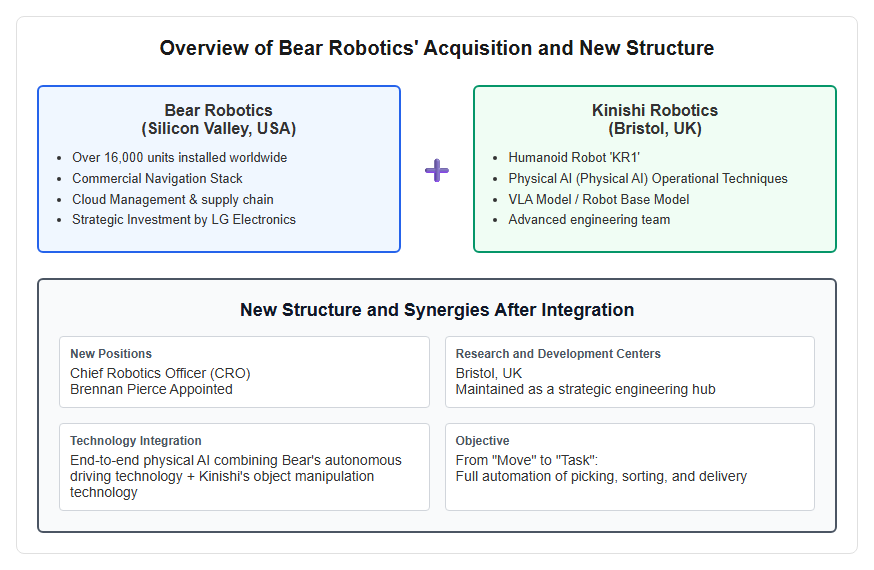
Bear Robotics, based in Silicon Valley, USA, announced that it has signed a definitive agreement on June 22, 2026, to acquire Kinishi Robotics, a UK robotics startup. This acquisition will integrate Kinishi Robotics’ wheeled humanoid robot “KR1,” Physical AI technology, and its engineering team based in Bristol, UK, into Bare Robotics. The transaction is expected to be completed within days of the announcement, and under the new post-acquisition structure, Brennan Pierce, founder of Kinishi, will join Bear Robotics’ leadership team as Chief Robotics Officer (CRO). Pierce was once one of the co-founders of Bear Robotics, and this acquisition can be seen as a de facto reunion. The Bristol development site will be maintained as Bear Robotics’ strategic engineering hub, which will be responsible for further evolution of the KR1 platform. Please refer to the diagram below.
Technical Complementarity and Deep Trust Between the Two Companies
Bear Robotics and Kinishi Robotics had a deep technical partnership even before this acquisition. Since its founding, Kinishi has adopted Bear Robotics’ commercial navigation stack as the foundation for its robots, the same technology that supports Bear’s commercial fleet. Through this collaboration, Bear Robotics was able to gain a detailed understanding of the high quality of Kinishi’s engineering and the depth of its physical AI research. To date, Bear Robotics has introduced more than 16,000 commercial service robots in markets such as the United States, Japan, and South Korea, building robust supply chains and cloud management systems. On the other hand, the company’s existing products specialized in navigation and delivery, lacking the ability to grasp, carry, and position objects. In contrast, Kinishi has strengths in object manipulation technology using humanoids for industrial and logistics applications, and this acquisition perfectly complements this technological gap.
Innovation in Service Robots with Physical AI
From Movement to Operation: Completion of a Physical AI Platform
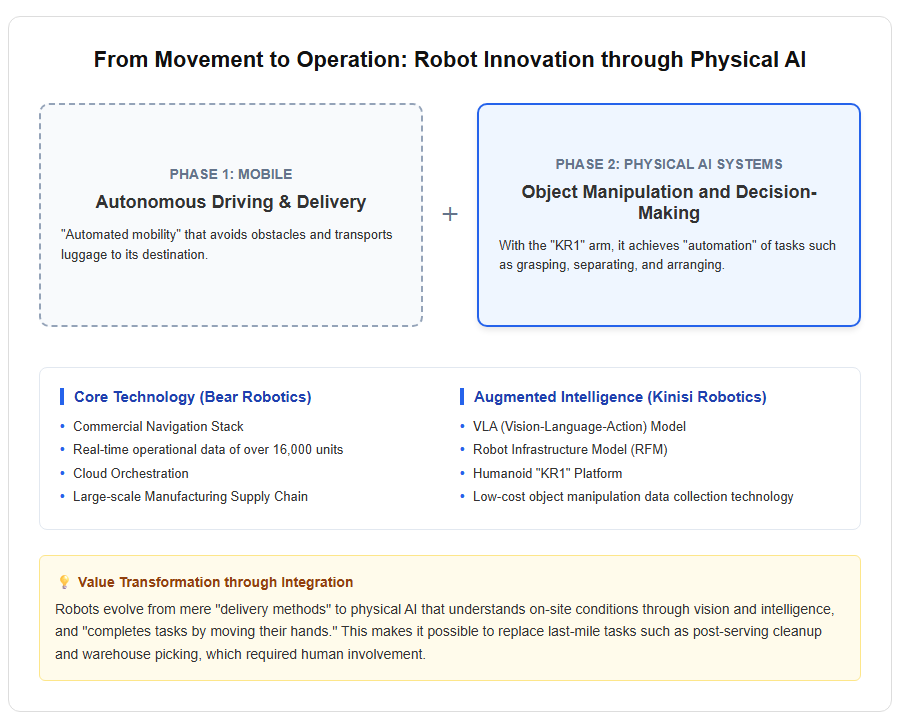
The main focus of this acquisition is to expand the robot’s capabilities from mere “movement” to complex real-world “tasks.” The technology provided by Kinishi utilizes vision-language-action (VLA) models and robotic foundational models for object recognition and manipulation. As a result, conventional autonomous delivery robots and floor cleaning robots will evolve into “physical AI systems” capable of performing more advanced tasks that previously required human hands, such as picking, sorting, and transporting. Kinishi’s KR1 platform features a proprietary robotic arm, end effectors, and low-cost data acquisition devices, all integrated with Bear’s existing cloud management stack. John Ha, CEO of Bear Robotics, stated that this integration not only allows robots to move to their destinations but also gains a layer that actually handles the tasks in front of them. Please refer to the diagram below.
LG Electronics’ strategic support and ecosystem building
Behind Bear Robotics’ rapid growth and technological expansion is LG Electronics’ strong support. In March 2024, LG Electronics made a $60 million strategic investment in Bear Robotics, securing the largest share as a single shareholder. LG Electronics positions this investment as part of its portfolio strengthening toward long-term growth in the service robotics sector. LG Electronics has a proven track record of deploying robot solutions in diverse commercial spaces such as airports, hotels, and hospitals, and by combining Bear’s software technology with its own manufacturing and service network, it is promoting the standardization of its robot platform. In particular, LG has set out to realize ‘Software Defined Robotics (SDR),’ shifting from hardware-centric to software-centric, and the acquisition of operational technology through the acquisition of Kinishi aligns with LG Electronics’ vision of ‘expanding living spaces through robots.’
Market Environment and Future Service Landscape
Worsening Labor Shortages and Addressing the ‘2024 Problem’
The rapid expansion of the service robot market is driven by a global labor shortage and rising labor costs. Especially in Japan, regulations on overtime work limits in logistics, construction, and medical settings—the so-called ‘2024 problem’—are becoming more serious, and autonomous delivery robots and transport robots are becoming essential social infrastructure. The global market for service robots is projected to grow from about 2.7 trillion yen in 2021 to about 5.7 trillion yen by 2030. Traditional service robots have only been used to replace certain repetitive tasks such as serving food in restaurants or cleaning buildings. However, the fusion of physical AI and large language models (LLMs) has made it possible to understand ambiguous instructions and respond to dynamic environmental changes, making the provision of detailed services that only humans could do feel real. Bear Robotics’ acquisition of object manipulation technology holds the potential to meet these market demands and dramatically expand the scope of automation.
Next-generation automation envisioned by an integrated platform
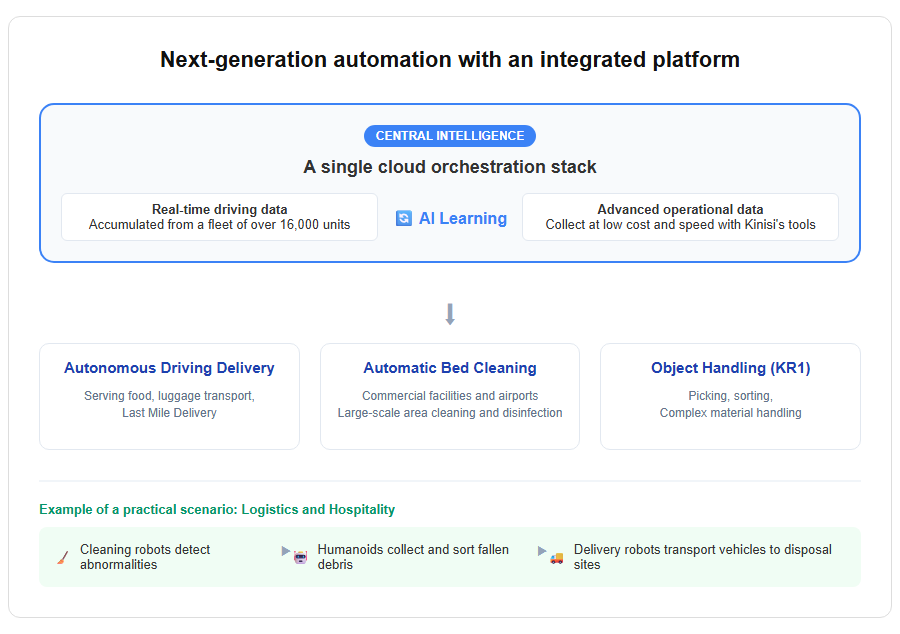
Bear Robotics plans to integrate the acquired Kinishi technology and complete a multi-robot automation platform controlled by a single cloud orchestration stack. This means that delivery robots, cleaning robots, and humanoids will work together as a single team, rather than as separate systems. For example, a future where cleaning robots discover trash, humanoids pick it up, and delivery robots transport it to collection points—a whole process of automation. While many existing robot ventures go bankrupt due to failed fundraising or excessive expectations, Bear Robotics possesses vast operational data from over 16,000 operational units, which is a strength in accelerating AI model training. This integration will mark the beginning of a new chapter where physical AI steps out of the lab and is implemented on a commercial scale in society. Please refer to the diagram below.
[#サービスロボット #ベアロボティクス #物理AI #ヒューマノイド #M&A #LG電子 #2024年問題 #自動化]

コメント