
Cool Project Co., Ltd., which is based in Ishikawa Prefecture and engages in beauty equipment development and aesthetic salon operations, received a special liquidation commencement order from the Kanazawa District Court on September 28, 2026. Behind this is a sharp increase in industry-wide bankruptcies driven by fierce price competition in the aesthetic and hair-removal salon industry and the collapse of the advance-payment business model.
- [Key Event] Kanazawa District Court issues order to commence special liquidation
- 【Company Profile and Business Journey】Transition from Salon Operations to the Development of Proprietary Beauty Devices
- [Mechanisms of Special Liquidation] Differences from Bankruptcy Proceedings and the Purpose of Business Reorganization
- [Drastic Changes in the Industry Environment] Structural Challenges in the Esthetic Industry Amid Successive Major Bankruptcies
- [Business Restructuring Trends] Initiatives through Brand Transfer and DX Collaboration
- [Future Outlook and Key Points] The Future Vision of the Beauty Market Toward Optimization and Soundness
[Key Event] Kanazawa District Court issues order to commence special liquidation
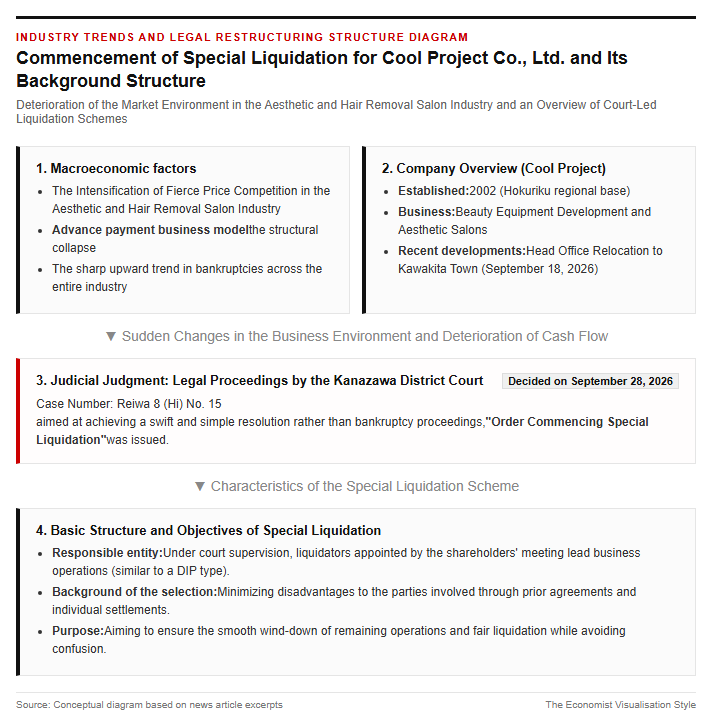
On September 28, 2026, Cool Project Co., Ltd., located in Kawakita-machi, Nomi-gun, Ishikawa Prefecture, received an order to commence special liquidation from the Kanazawa District Court (case number: 2026 (Hi) No. 15). Records show that just prior to this, on September 18, 2026, the company relocated its head office from Nonoichi City, Ishikawa Prefecture, to Kawakita-machi, Nomi-gun. Since its establishment in 2002, the company has operated beauty-related businesses based in the Hokuriku region, but was forced to make a fresh start through legal liquidation due to sudden changes in the business environment.
Special liquidation is a procedure designed to swiftly and simply liquidate a stock company facing an excess of liabilities or significant impediments to the execution of liquidation, under the supervision of the court. Unlike bankruptcy proceedings, it has a DIP-type (debtor-in-possession) aspect where liquidators appointed by the general meeting of shareholders take the lead in operations. In the aesthetic salon industry, where fierce market competition continues, the background behind the company’s choice of special liquidation rather than bankruptcy is believed to be aimed at winding down its remaining business operations while minimizing disadvantages to related parties through prior agreements and individual settlements. The following diagram illustrates the basic structure of special liquidation.
【Company Profile and Business Journey】Transition from Salon Operations to the Development of Proprietary Beauty Devices
After its establishment in 2002, Cool Project Co., Ltd. developed brands such as “Cool Aesthetic,” “Cool Grand Body,” and “Cool Facial Beaute” across the three prefectures of the Hokuriku region, centered around Ishikawa Prefecture, and operated a total of nine salon locations as of 2017. Later, building on the know-how cultivated through its store expansion, the company expanded its business domain into the research, development, and sales of beauty equipment and cosmetics for salons.
In particular, its beauty equipment division, “J.B.MACHINERIE,” independently developed and marketed products such as the commercial LED beauty device “LEDist,” the home-use LED beauty device “LEDitch,” and the multi-functional beauty device “LEDitch Tri-Pro.” In October 2021, it acquired a patent related to LED modules (Patent No. 6950898), leveraging its technological capabilities as a strength. Furthermore, it handled cosmetic brands such as the skincare line “BEAUTE de Coeur” and the delicate zone care brand “Pico Donna,” while also promoting participation in trade shows like “Beautyworld Japan” and overseas exports to the Asian and ASEAN regions.
The Mechanics of Legal Procedures and the Background Behind Sudden Changes in the Salon Industry
[Mechanisms of Special Liquidation] Differences from Bankruptcy Proceedings and the Purpose of Business Reorganization
Special liquidation, stipulated in Article 510 of the Companies Act, is a legal liquidation procedure that can be processed more quickly and at a lower cost compared to bankruptcy proceedings. Generally, former management personnel such as former directors are frequently appointed as liquidators, which offers the advantage of enabling them to smoothly lead the liquidation process. There are two procedural forms: the “agreement type,” in which an agreement is approved by obtaining the consent of two-thirds or more of the total voting rights at a creditors’ meeting, and the “individual settlement type,” in which individual settlements are concluded with all creditors.
Special liquidation has the advantage of allowing major creditors to record bad debt losses regarding debts waived through a composition agreement, and it is frequently utilized for the liquidation of subsidiaries by parent companies or business reorganization via the “second company” method. In the case of Cool Project as well, it is suggested that an agreement had been reached in advance with major creditors regarding repayment and debt waiver policies. This is thought to have been aimed at orderly proceeding with the liquidation of intellectual property and assets cultivated over many years while minimizing reputational damage compared to bankruptcy.
[Drastic Changes in the Industry Environment] Structural Challenges in the Esthetic Industry Amid Successive Major Bankruptcies
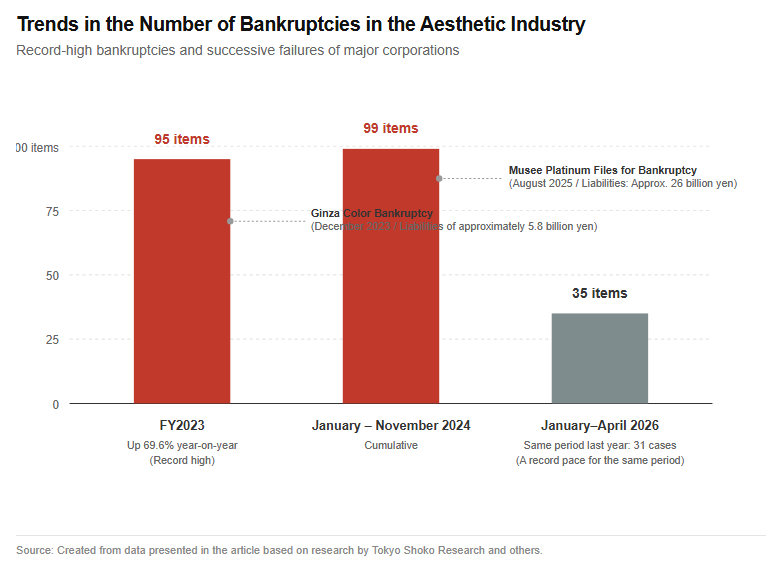
In recent years, the aesthetic and hair removal salon industry has seen a severe wave of bankruptcies. According to a survey by Tokyo Shoko Research, aesthetic industry bankruptcies in fiscal 2023 reached 95 (a 69.6% increase year-on-year), setting a record high. This was followed by a sharp increase to a cumulative 99 cases from January to November 2024, and in the January–April period of 2026, bankruptcies reached 35 cases, surpassing the 31 cases of the same period last year and continuing to set a record-high pace for that period.
Behind the industry-shaking events is the collapse of the “advance payment business model,” in which customers were required to pay hefty course fees upfront in a lump sum, with those funds being used to finance new store openings and online advertising expenses. In December 2023, the operating company of “Ginza Color” went bankrupt with liabilities of approximately 5.8 billion yen (affecting about 100,000 victims), and in August 2025, MPH, the operator of the industry giant “Musee Platinum,” went bankrupt with liabilities of approximately 26 billion yen (affecting over 1.2 million victims). Driven by a combination of fierce price competition, competition with medical hair removal, and skyrocketing online advertising costs, consumer caution toward the entire industry had been rising. The following chart shows the trend in the number of bankruptcies in the industry.
Attempts at Business Restructuring and the Future Outlook of the Market
[Business Restructuring Trends] Initiatives through Brand Transfer and DX Collaboration
Facing a deteriorating business environment, Cool Project was seeking to survive through prioritization and focus. In March 2024, the company announced that it would transfer the business of its flagship beauty device brand, “Dr.Caviet,” to A. GLOBAL Co., Ltd., a Gifu-based beauty device manufacturer, effective April 1, 2024. The move was reportedly aimed at ensuring business continuity and a support system for existing customers by passing on its core brand to another company.
In addition, in January 2024, the company announced a collaboration with IT-related firm GMJ Inc., introducing the store information management service “Signalizer” and the AI-powered review response support tool “Response AI.” It promoted digital transformation (DX) in salon operations by leveraging digital technology to improve operational efficiency and the precision of customer acquisition efforts. However, this was not enough to compensate for the prolonged sluggishness in customer traffic and the burden of past investments, ultimately resulting in the filing for tokubetsu seisan (special liquidation).
[Future Outlook and Key Points] The Future Vision of the Beauty Market Toward Optimization and Soundness
The special liquidation of Cool Project goes beyond the bankruptcy of a single company, symbolizing a major turning point for the salon industry as a whole to shift from “quantitative expansion” to “high-quality, sound management.” Government authorities are also stepping up their actions; in March 2024, the Cabinet Office’s Consumer Commission raised concerns over advance payment risks and unfair solicitation, and with the formulation of an “Aesthetic JIS” being promoted under the leadership of the Ministry of Economy, Trade and Industry, there is a rapid demand for stricter adherence to laws and enhanced compliance.
Although the market size shrank to 279.7 billion yen in fiscal 2025, it is expected to turn to a slight increase to 280.3 billion yen in fiscal 2026, entering a reorganization phase following the shakeout of unhealthy operators engaging in excessive discounting. Moving forward, the industry is transitioning into an era where surviving salons will be those that introduce consumer-friendly “pay-as-you-go” or monthly subscription models, adopt niche strategies specialized in men’s beauty and age-specific needs, and maintain highly transparent management structures.
Reference Page
- [[Ishikawa] Beauty Equipment and Esthetic Business Coeur Project Undergoes Special Liquidation] https://n-seikei.jp/2026/10/coeur-project-ishikawa-tokubetsu-seisan.html
【#CoolProject #SpecialLiquidation #BeautyIndustryBankruptcy #BeautyEquipment #EconomicNews】


コメント