
The Chinese government has notified Japan that it will expand the intake quota for a small Keidanren delegation visiting China in mid-November to approximately 20 people. Amid stagnant intergovernmental dialogue, this could serve as an important catalyst for the full-scale resumption of exchanges with the Japanese business community.
- Key points of the event and concrete details of the scale expansion
- Stagnant Intergovernmental Dialogue and the Role of Business Diplomacy
- The Footsteps and Appeals of Keidanren’s Business Delegation to China
- China’s Policy Stance and Economic Security Risks
- A New Bilateral Relationship Where Competition and Cooperation Coexist
- Future Outlook, Key Points to Watch, and Prescriptions for the Business World
Key points of the event and concrete details of the scale expansion
On October 14, 2026, it was revealed that the Chinese government notified the Japanese side of its policy to expand the acceptance quota for a small-scale Keidanren delegation scheduled to be dispatched in mid-November. This communication came immediately after former Foreign Minister Takeshi Iwaya, who serves as the chairman of the Japan Association for the Promotion of International Trade, visited China in late September 2026 and held individual meetings with Vice Premier He Lifeng and Foreign Minister Wang Yi. Initially, Keidanren was making arrangements to dispatch about 5 people, centered mainly on administrative staff, but following the notification from the Chinese side, it decided to significantly expand the delegation size to approximately 20 people, including working-level personnel from member companies. For an overview of the delegation and a tentative itinerary for the local schedule, please refer to the diagram below.
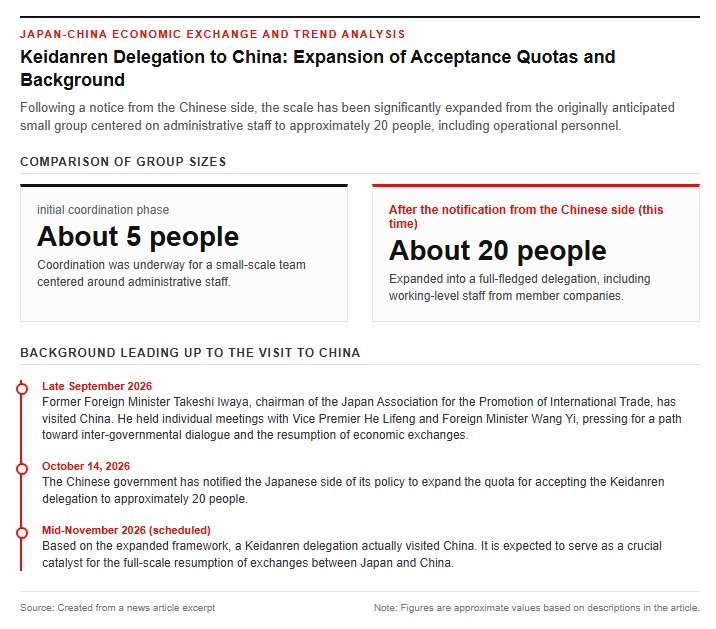
This expansion of the acceptance quota is not merely a procedural change; it is seen as a sign that the Chinese side is showing a strong interest in working-level dialogue with the Japanese business community. In particular, now that working-level personnel are able to participate, it is expected that on-site inspections and exchanges of views will be conducted with a view toward more concrete and multifaceted business cooperation.
Stagnant Intergovernmental Dialogue and the Role of Business Diplomacy
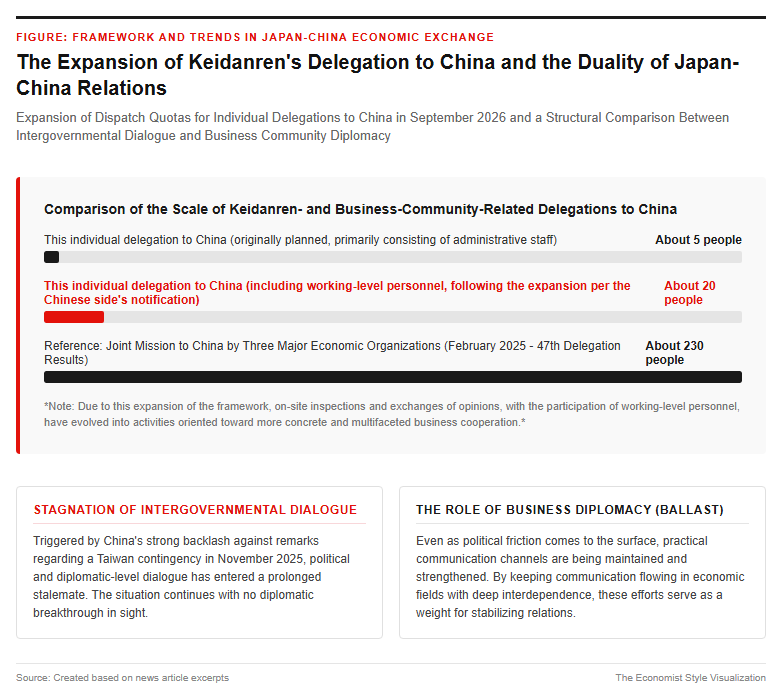
Intergovernmental dialogue between Japan and China has remained stalled since November 2025, triggered by China’s strong backlash against Prime Minister Sanae Takaichi’s statements in the Diet regarding a contingency in Taiwan. As a situation where diplomatic breakthroughs remain out of sight drags on, the importance of practical exchange channels through the business community is being re-recognized. Even in past Japan-China relations, there is a history of exchanges between business communities functioning as a ballast for improving relations during phases when political or diplomatic frictions surfaced.
The expansion of the Keidanren delegation this time provides an important opportunity for private-sector economic diplomacy to maintain and strengthen its channels amid a diplomatic stalemate. In economic areas characterized by deep interdependence between Japan and China, sustaining working-level communication is a vital element for preventing unforeseen circumstances and ensuring the stabilization of bilateral relations. It can be said that the intentions of both sides to pursue the separation and coexistence of political conflict and economic cooperation are reflected in this decision by the Chinese side.
Historical Context of Japan-China Economic Exchange and Challenges in the Business Environment
The Footsteps and Appeals of Keidanren’s Business Delegation to China
The dispatch of a joint business delegation to China by Japan’s three major economic organizations—Keidanren, the Japan-China Association on Economy and Trade, and the Japan Chamber of Commerce and Industry—has a half-century-long history since it began in 1975. Except for temporary unforeseen circumstances such as the COVID-19 pandemic, it has been conducted almost every year, and in February 2025, the 47th delegation (a total of approximately 230 people, including Keidanren Chairman Masakazu Tokura, JCCI Chairman Ken Kobayashi, and Japan-China Association on Economy and Trade Chairman Koji Shindo) visited Beijing. The delegation held direct talks with top leadership figures, including Vice Premier He Lifeng, as well as ministers from key ministries and agencies such as the National Development and Reform Commission, the Ministry of Commerce, and the Ministry of Industry and Information Technology.
At this meeting, the Japanese side strongly requested the establishment of a safe, secure, transparent, and predictable business environment in the Chinese market. Furthermore, they urged that the implementation of export control measures on dual-use critical raw materials, such as graphite and antimony, not be delayed. While recognizing the importance of the Chinese market—which boasts a middle-class population on the scale of 500 million—the business community has strongly urged the resolution of practical, operational challenges.
China’s Policy Stance and Economic Security Risks
In response to lobbying from the Japanese business community, the Chinese government has indicated an attitude of emphasizing the cultivation of private enterprises, national treatment for foreign-funded enterprises, and the principles of fairness and reciprocity. The Ministry of Commerce has also explained that the Anti-Espionage Law and the Export Control Law do not unfairly impact legitimate corporate activities. However, among local subsidiaries and headquarters of Japanese companies, there remain deep-seated concerns regarding the strict enforcement of the three data-related laws (the Cybersecurity Law, the Data Security Law, and the Personal Information Protection Law) and the opacity of various regulations. The overall picture of economic security-related legislation in China and the challenges for Japanese companies in responding to them are as follows.
The “dual circulation” strategy centered on domestic circulation, promoted by China, and the building of autonomous supply chains also serve to pressure foreign companies into technology transfer and localization. Consequently, Japanese corporate headquarters tend to be increasingly cautious about expanding investment, citing geopolitical risks and the low predictability of legal frameworks. This expansion of visit quotas is also drawing attention as an opportunity for direct dialogue to dispel these concerns and improve the practical business environment.
Medium- to Long-Term Outlook for Japan-China Relations and Japanese Corporate Strategies
A New Bilateral Relationship Where Competition and Cooperation Coexist
The current Japan-China economic relationship has moved past the era of one-way support and mere mutual complementarity seen in the past, entering a phase where the two sides compete as technologically and structurally equal rivals across numerous fields. As analytical papers by agencies such as the Ministry of Finance point out, the bilateral relationship is transitioning into a new structure of “cooperation premised on competition.” Particularly as industrial structures become increasingly advanced, the areas in which Japanese and Chinese companies compete and drive each other forward in global markets and the Asian region are expanding.
At the same time, however, building a strong cooperative relationship is essential when addressing the global challenges and structural changes that both nations face in common. Specifically, there is significant potential for cooperation in areas such as green growth toward carbon neutrality, the silver economy and healthcare sectors to cope with the rapidly aging population with declining birthrates, and the digital content industry. A multifaceted approach that clearly distinguishes between competition and cooperation while identifying mutual interests is indispensable.
Future Outlook, Key Points to Watch, and Prescriptions for the Business World
The focus moving forward will be on what concrete results and agreements will be achieved through working-level discussions during the Keidanren mission’s visit to China, scheduled for mid-November 2026. Attention will be paid to whether this visit will yield progress toward improving the pending business environment, such as the early and full resumption of visa exemption measures for short-term stays by Japanese nationals, the simplification of various administrative procedures, and the clarification of customs clearance and data transfer regulations.
For Japanese companies, a strategy is required to calmly assess the economies of scale and innovation opportunities offered by the Chinese market, while simultaneously advancing risk hedging (such as establishing local production for local consumption systems and diversifying supply chains) to prepare for the prolonged U.S.-China conflict and legal risks related to economic security. Even during periods of ongoing diplomatic tension, effectively utilizing the dialogue channels built by the business community and maintaining and expanding a rule-based, transparent, and sustainable cooperative relationship will contribute to the long-term interests of both parties.
Reference page
- [Joint Delegation of Three Business Groups (Keidanren, Japan-China Association on Economy and Trade, and JCCI) Dispatched to Beijing][suspicious link removed]
【#JapanChinaRelations #Keidanren #EconomicSecurity #JapanChinaEconomicExchange #Delegation #ChinaBusiness】


コメント