ROHM has successively partnered with two local Indian companies, expanding its outsourcing of semiconductor backend processes (OSAT). Behind this are the semiconductor localization policy promoted by the Indian government and the rapid expansion of the power semiconductor market for automotive and industrial equipment.
- Key Points of the Partnership Drama and Strategic Collaboration with Two Local Indian Companies
- Moving Away from the Traditional IDM Model and a Major Transformation in Manufacturing Strategy
- The Rapidly Expanding Indian Semiconductor Market and the Surge in Automotive Demand
- The Rationale Behind the Indian Government’s “ISM” Subsidy Scheme and OSAT Attraction
- Reinforcement of Global Supply Chains and Transfer of Quality Control Technology
- Future Developments and Key Industry Trends to Watch
Key Points of the Partnership Drama and Strategic Collaboration with Two Local Indian Companies
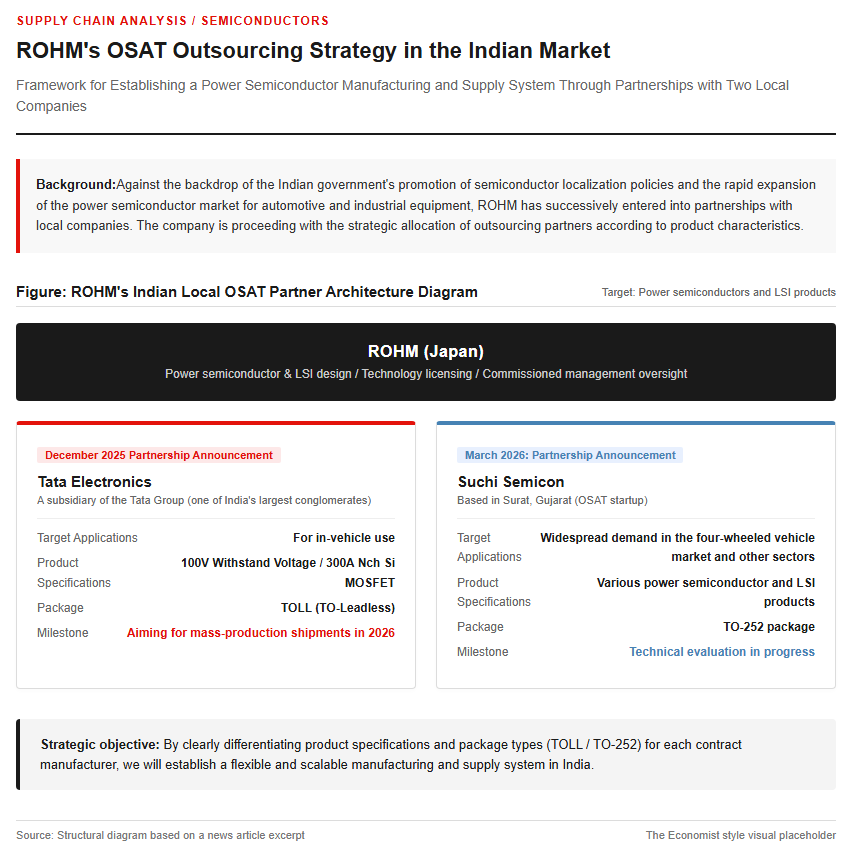
Major Japanese semiconductor manufacturer ROHM has sequentially concluded strategic partnerships with two local Indian companies, significantly expanding its outsourcing of semiconductor back-end processes (OSAT). In December 2025, it announced a partnership with Tata Electronics, a subsidiary of India’s largest conglomerate the Tata Group, followed in March 2026 by the establishment of a cooperative relationship with Suchi Semicon, an OSAT startup based in Surat, Gujarat. Through these partnerships, ROHM will outsource the packaging (encapsulation and assembly) and testing processes for power semiconductors and LSI products to local companies. For Tata Electronics, it has allocated TOLL (TO-Leadless) packaged products of automotive-grade 100V breakdown voltage, 300A Nch Si MOSFETs, aiming for mass-production shipments starting during 2026. Meanwhile, for Suchi Semicon, it is advancing technical evaluations aimed at outsourcing TO-252 packages, which are in broad demand in the automotive market and other sectors. By tailoring product specifications and package formats for each outsourcing partner, the aim is to build a flexible and scalable manufacturing and supply structure within India. For an overview of the partnership details, please refer to the structural diagram below.
Moving Away from the Traditional IDM Model and a Major Transformation in Manufacturing Strategy
Since its founding in 1957, ROHM has maintained the IDM (Integrated Device Manufacturer) model as its core business posture, consistently carrying out everything from chip design to front-end processes (wafer processing) and back-end processes (assembly and inspection) in its own factories. However, in recent years, as responding to market fluctuations after large-scale capital investments and reducing fixed costs have become challenges, the company has been shifting toward a flexible manufacturing strategy that utilizes external partners while curbing direct in-house investment. In its recent expansion into India as well, the company adopted an approach of strictly managing the front-end wafer manufacturing processes at its own facility while outsourcing the back-end processes to a local OSAT company. This has realized a locally self-contained approach of “Designed in India, Manufactured in India,” meeting the expectations of local Indian customers seeking domestically produced goods while promoting a strategy to increase added value through local production (Domestic Value Addition). The fusion of proprietary technology and external manufacturing capabilities is transforming the company’s manufacturing structure.
The Rapid Growth of the Indian Semiconductor Market and the Background of the “Make in India” Policy
The Rapidly Expanding Indian Semiconductor Market and the Surge in Automotive Demand
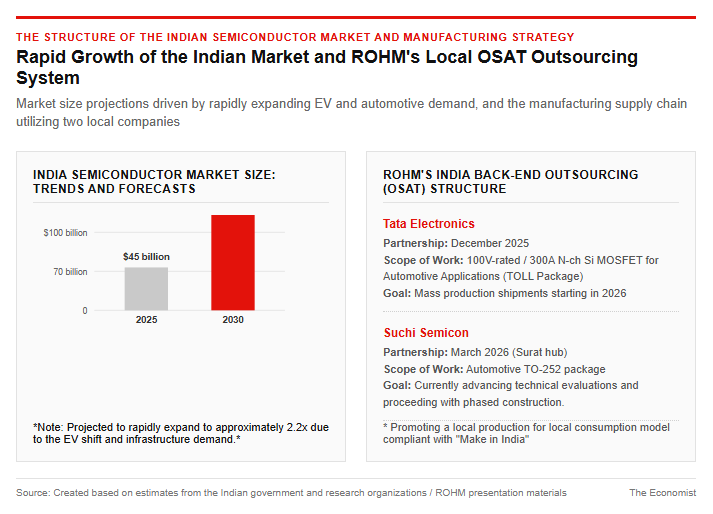
India’s semiconductor market is attracting international attention as one of the fastest-growing markets in the world. According to estimates by the Indian government and research organizations, the country’s semiconductor market size is projected to expand rapidly from approximately $45 billion in 2025 to the scale of $100 billion by 2030. This is driven by demand for smartphones and data centers, alongside the rapid shift to EVs (electric vehicles) within India—the world’s third-largest automotive market—as well as railway modernization and the accelerated adoption of renewable energy. In particular, demand for power semiconductors and analog ICs, which are indispensable for EV motor drive inverters and solar power conditioners, is surging explosively, and calls for local procurement (local production for local consumption) of semiconductor components are rapidly increasing among electronics and automotive manufacturers. For information on major local plants and market expansion, please refer to the map image below.
The Rationale Behind the Indian Government’s “ISM” Subsidy Scheme and OSAT Attraction
To break away from its overseas dependence on semiconductors and establish economic security, the Indian government established the “India Semiconductor Mission (ISM)” in 2021. Under the ISM, a total of $10 billion (approximately 1.5 trillion yen) in financial support measures has been introduced, offering up to 50% capital expenditure subsidies for the construction of front-end fabs and back-end (OSAT/ATMP) facilities. Combined with state government subsidies, a generous support system reaching up to 70% is in place. In attracting semiconductor plants, while the construction of a front-end (fab) requires a massive amount of funds exceeding $10 billion as well as huge volumes of ultrapure water and stable power, a back-end (OSAT) facility can be launched with a capital of about $1 billion to $3 billion, and is relatively less affected by infrastructure constraints. Furthermore, since India can accumulate manufacturing know-how while leveraging its abundant design talent—accounting for about 20% of chip design engineers worldwide—a phased entry starting from the back-end is considered extremely rational.
The Future of the Semiconductor Supply Chain Forged by Japan-India Cooperation
Reinforcement of Global Supply Chains and Transfer of Quality Control Technology
ROHM’s collaboration with Indian OSAT companies goes beyond mere production cost reduction or outsourcing; it strongly entails the transfer of Japan’s advanced quality control technology to the local region. To meet automotive-grade quality standards, ROHM is implementing long-term training programs at its own facilities in Japan to accept local technicians and engineers, thereby advancing the certification of manufacturing processes and the strict application of quality standards. Furthermore, by establishing a system to package and ship automotive power devices developed and designed in India locally, the company will significantly shorten supply lead times for the Indian market. This enhances resilience against supply chain disruptions caused by geopolitical risks and natural disasters, contributing to the construction of a robust and sustainable semiconductor supply chain for both Japan and India.
Future Developments and Key Industry Trends to Watch
The most anticipated future development is the planned mass-production shipment of automotive power MOSFETs from the plants of Tata Electronics and Suchi Semicon scheduled for 2026. Successfully ramping up initial products and maintaining manufacturing yields will serve as the first major test for ROHM’s India strategy. Looking ahead, the plans also envision the joint development of higher-value-added power modules and next-generation packaging, as well as expanding the global supply of semiconductor products manufactured in India. As India evolves into a “global semiconductor back-end hub,” the development of a comprehensive ecosystem—including collaboration with Japanese manufacturing equipment and materials makers—will be a key industry highlight to watch in the future.
Reference Page
- [ROHM Co., Ltd. News Release: Conclusion of Strategic Partnership with Tata Electronics] https://www.rohm.co.jp/news-detail?news-title=2025-12-22_news_tata&defaultGroupId=false
- [ROHM Co., Ltd. News Release: Conclusion of Strategic Partnership with Suchi Semicon] https://www.rohm.co.jp/news-detail?news-title=2026-03-03_news_suchi&defaultGroupId=false
【#ROHM #IndiaSemiconductor #OSAT #PowerSemiconductor #MakeInIndia #SemiconductorBackend #AutomotiveSemiconductor】

コメント