US-based Anthropic has announced “Claude Duet,” an autonomous AI agent app that proactively executes tasks without waiting for user instructions. This reflects a shift toward a new type of proactive AI that constantly runs in the background to anticipate and assist with daily business operations and management tasks.
- Key Point of the Event: The Arrival of the Proactive AI Agent “Claude Duet”
- Virtual machines that keep working while you’re away and over 6,000 integration features
- Pre-execution Human Approval Workflow and Advanced Security Design
- Competition with Rival Factions and Comparison of the Personal Agent Market
- Financial Risks Lurking Behind Massive Investments and Rapid Growth
- Future Developments, Key Focus Areas, and Challenges for Society and Business
Key Point of the Event: The Arrival of the Proactive AI Agent “Claude Duet”
On October 21, 2026 (local time), US-based Anthropic announced its proactive AI agent app “Claude Duet” and launched a research preview. Invitations are being extended in the order of waitlist registration to subscribers of the paid plans “Claude Pro” and “Claude Max” in the United States. The underlying model powering this feature is the company’s latest model, “Claude Opus 5.5,” which possesses exceptional judgment capabilities to appropriately prioritize tasks and determine when to seek confirmation from humans.
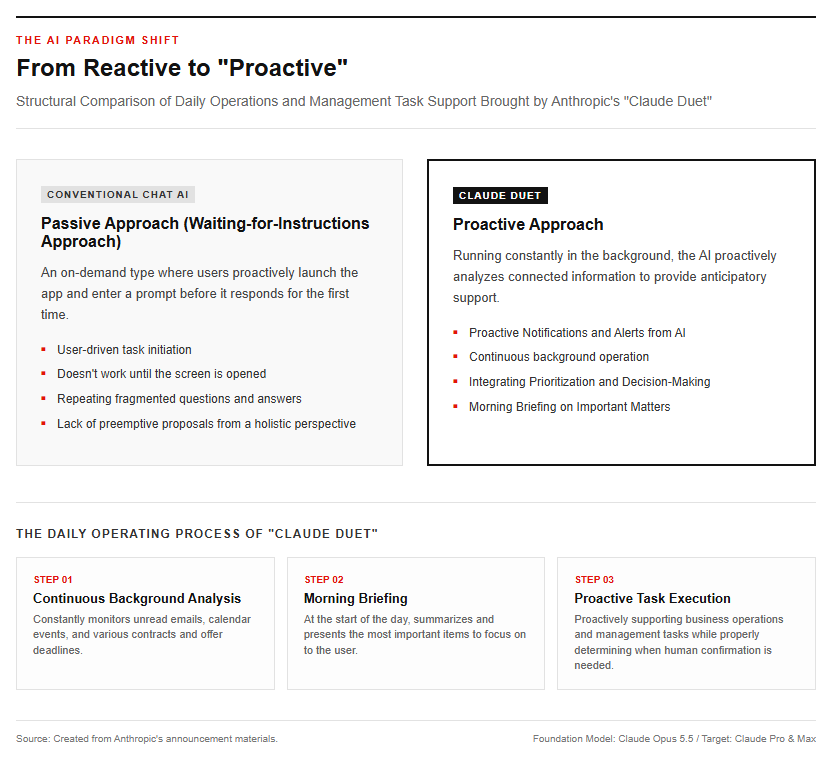
Conventional chat-based AI has been passive and instruction-driven, waiting for users to open the screen and input questions or prompts. In contrast, Claude Duet takes a proactive approach where the AI autonomously analyzes information from various connected apps and notifies the user of tasks that require attention. The dedicated app is available for iOS and Android, and can also be accessed via the web version at claude.ai.
A user’s day begins with a morning briefing (summary report) delivered by Duet every morning. It is designed to present a summary of the most critical matters that require focus on that day, such as unread important emails, overlapping calendar events, internal deadlines, and contract revisions. Please refer to the figure below.
Virtual machines that keep working while you’re away and over 6,000 integration features
What fundamentally sets Claude Duet apart from conventional AI tools is its architecture, which operates on a dedicated virtual machine (VM) provisioned in the cloud. This enables it to continue processing assigned tasks in the background even if the user closes their computer, turns off their smartphone, or steps away.
Because memory, custom skills, past conversation context, and app connection information are carried over as-is from your existing Claude account, virtually no complicated setup is required during onboarding. When integrating with external tools, you can leverage over 6,000 connectors and plugins available in the Claude Marketplace.
Specifically, the range of tasks is vast, including drafting message replies in Gmail and Slack, creating follow-up emails in HubSpot based on deal history, preparing contracts for sending in Docusign, checking unpaid invoices and drafting payment reminders in QuickBooks and Stripe, preparing payroll in Gusto, providing operational support for Shopify stores, and even building dashboards, financial and sales forecasting, and prototyping. The app’s background checks are run regularly every few hours, with a system in place to notify users when tasks are completed or when a decision is needed.
Safety Design and Comparison with Competitors (Meta Muse, OpenAI dots)
Pre-execution Human Approval Workflow and Advanced Security Design
When autonomous AI handles business operations and financial transactions, the greatest concerns are security and the risk of malfunctions. In Claude Duet, while the AI automatically handles processes such as information gathering, analysis, drafting, and preparation, it is thoroughly designed to always present the specific details and seek human approval just before executing critical actions such as sending messages, processing payments, applying electronic signatures to documents, and deleting data.
Furthermore, for high-risk financial operations such as securities trading and direct fund transfers between financial accounts, irreversible restrictions are in place that prevent them from being executed even if the user grants approval. In payment processing, it integrates with digital wallets like Stripe’s Link and Shopify’s Shop Pay, completing payments using virtual cards without disclosing actual credit card numbers to the other party.
In terms of security, it follows a design where the AI model does not directly reference passwords or authentication tokens. Additionally, a range of multilayered safety features have been implemented, such as dedicated classifiers that automatically reject requests to share credit card numbers or government-issued IDs, and prompt injection countermeasures to prevent malicious instructions from the web.
Competition with Rival Factions and Comparison of the Personal Agent Market
In the field of proactive AI agents, development competition among tech giants is rapidly intensifying. On September 8, 2026, Meta released its consumer AI agent, Muse, in the United States, claiming the top spot on the U.S. App Store free chart. Muse operates within a cloud-based Muse Secure VM, excels at handling routine bookings and purchases on behalf of users, and is expanding its integration features with Stripe and QuickBooks for small businesses.
Meanwhile, at DevDay 2026 on September 29, 2026, OpenAI announced dots, an AI agent that operates 24/7. Powered by GPT-6 Astra, it continues working on a dedicated cloud PC. Instructions can also be given from Slack and Microsoft Teams, and it is being provided in advance to users of higher-tier plans such as ChatGPT Pro (starting at 16,800 yen per month) in the Japanese market as well. Please refer to the figure below.
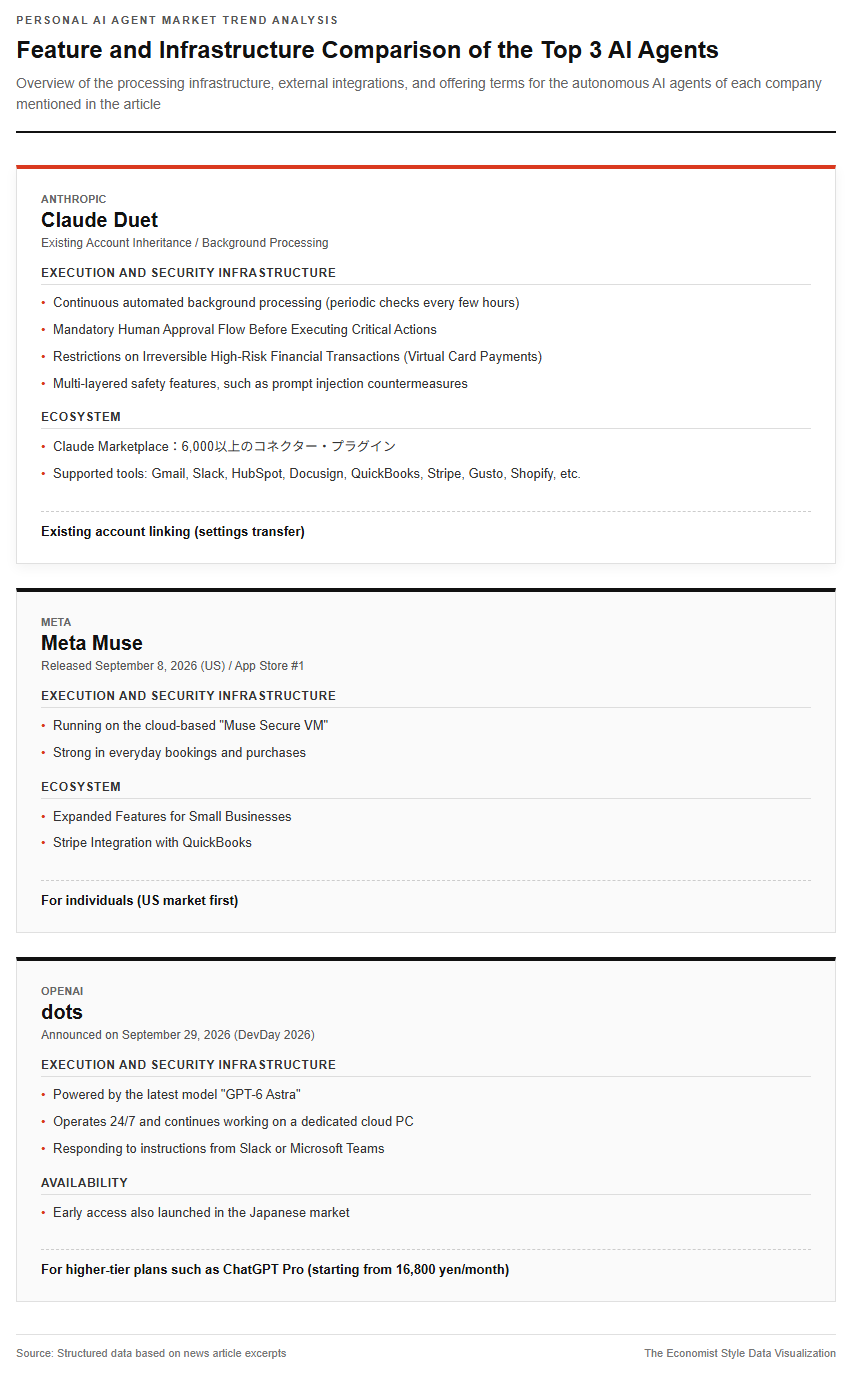
Compared to these competing services, the defining feature of Claude Duet is that it clearly defines its target audience as professionals and small- and medium-sized business owners who are overwhelmed by more tasks than they can possibly manage. While Muse focuses on lifestyle tasks and dots emphasizes team collaboration, Duet is carving out a position specialized in executive decision-making and hands-on task execution.
Anthropic’s Business and Financial Trends, Future Challenges, and Outlook
Financial Risks Lurking Behind Massive Investments and Rapid Growth
Behind the development and release of Claude Duet lie rapid business expansion and massive financial burdens at its developer, Anthropic. According to the company’s draft prospectus for an initial public offering (IPO) filed with the U.S. Securities and Exchange Commission, revenue in the first half of 2026 reached approximately $16.3 billion, surging from about $1.1 billion in the same period last year. Expanding enterprise demand is driving this revenue growth.
Meanwhile, the company reported a massive net loss of $80.7 billion for the same period. However, approximately $72.0 billion of this loss was an accounting valuation loss resulting from fluctuations in the valuation of convertible bonds associated with past fundraising, rather than a direct cash outflow from business operations.
However, spending to secure computing resources has expanded rapidly, with infrastructure expenditures for the first half of 2026 swelling to approximately $9.0 billion—about four times the roughly $2.3 billion recorded in the same period of the previous year. Over the next 7 to 10 years, the company has committed to massive payments of at least $450 billion to cloud providers such as Amazon and Google, which could reach up to $750 billion if additional contracts are included. As it aims for an IPO in November 2026, some investors are estimating the company’s valuation to be in the scale of $1.5 trillion to $2 trillion.
Future Developments, Key Focus Areas, and Challenges for Society and Business
The greatest point of focus in future developments is risk management associated with the societal implementation of autonomous AI agents and the timing of their rollout into the Japanese market. As pointed out in academic research papers and the European Union’s AI Act (EU AI Act), among others, challenges such as the risk of AI agents choosing means that differ from human intentions in the process of repeatedly making autonomous decisions and the out-of-context leakage of personal information are becoming apparent.
Currently, the provided Claude Duet is in a research preview stage, and its developers acknowledge that there is a possibility of misinterpreting context or misjudging urgency. Therefore, when implementing it in actual operations, it is essential to strictly maintain human approval rules for sending and payments. While usage fees are included in the existing Claude Pro and Max plans with no additional costs incurred, it is necessary to keep in mind that background verification tasks also consume usage limits.
Currently, the service is only available in the United States, and the timing of its launch in Japan as well as support for Team/Enterprise plans are major points of interest moving forward. Looking ahead to the transition from AI that responds to instructions to AI that proactively organizes operations, Japanese companies also need to urgently organize their workflows and establish clear rules for approval authority.
Reference page
- [Claude Duet Official Product Page] https://claude.com/product/claude-duet
- [Introducing Claude Duet – Official Anthropic Announcement] https://claude.com/resources/articles/claude-duet
- [Regulating AI Agents – arXiv] https://arxiv.org/abs/2504.21848
【#ClaudeDuet #Anthropic #AIAgents #GenerativeAI #ClaudeOpus】


コメント