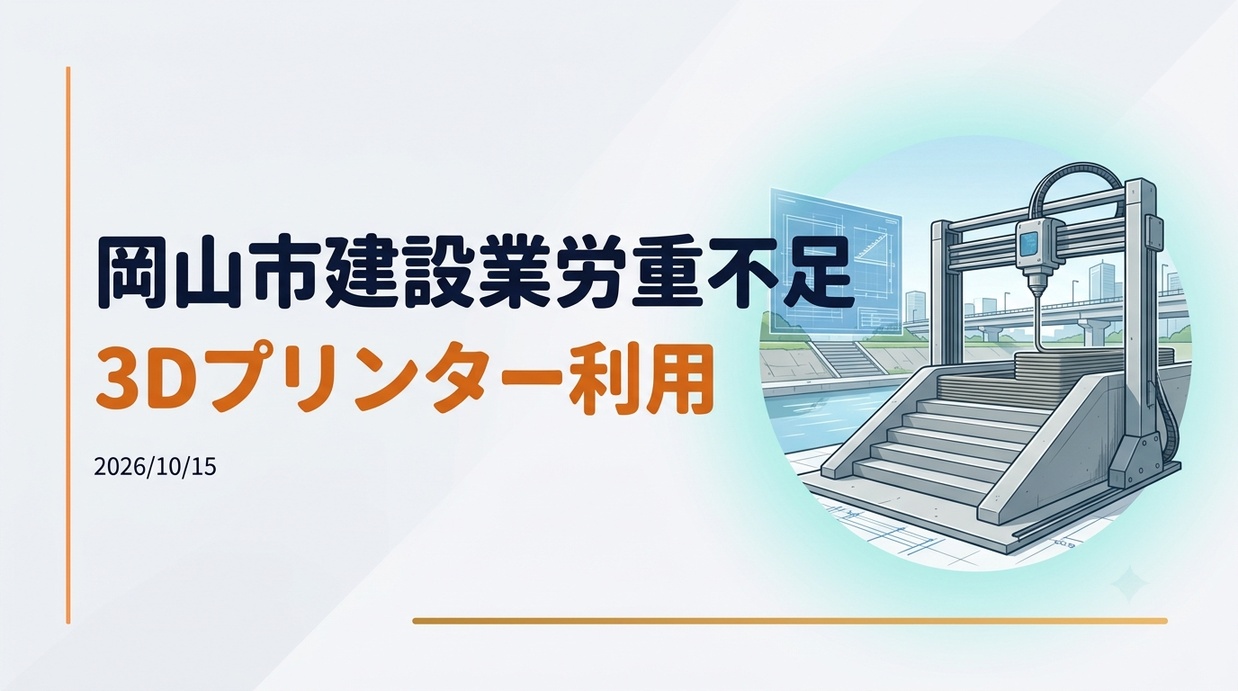
Arakimugi, a general construction company based in Okayama City, has installed stairs manufactured using a construction 3D printer in embankment maintenance work. As a countermeasure against the chronic and severe labor shortage in the construction industry and the “2024 problem,” the initiative aims to achieve on-site labor savings and a significant reduction in construction time.
- Stair Construction in Levee Improvement Work and Dramatic Reduction in Construction Time
- Moving Away from the Cast-in-Place Concrete Method and the Mechanism of Labor-Saving
- The 2024 Problem and the Severe Labor Shortage Brought by Aging
- The Rise of Domestic Startups and Their Adoption as Ministry of Land, Infrastructure, Transport and Tourism Recommended Technologies
- The Impact of Building Standards Act Deregulation in 2026
- Future Outlook for Talent Development and Local Infrastructure Maintenance
Stair Construction in Levee Improvement Work and Dramatic Reduction in Construction Time
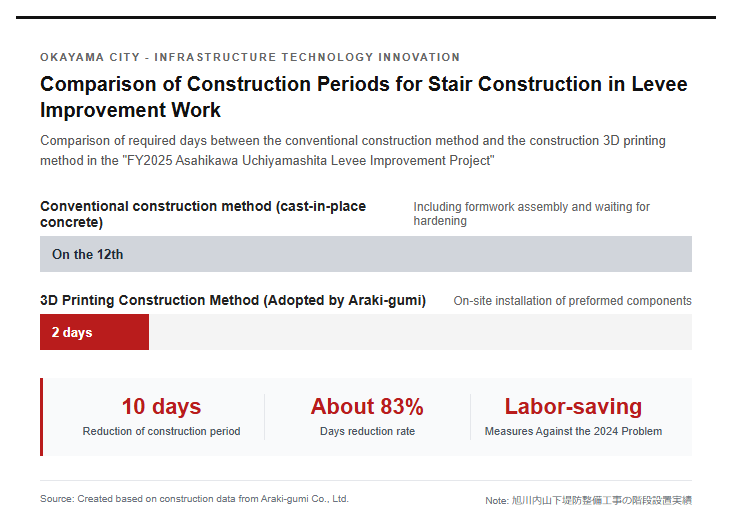
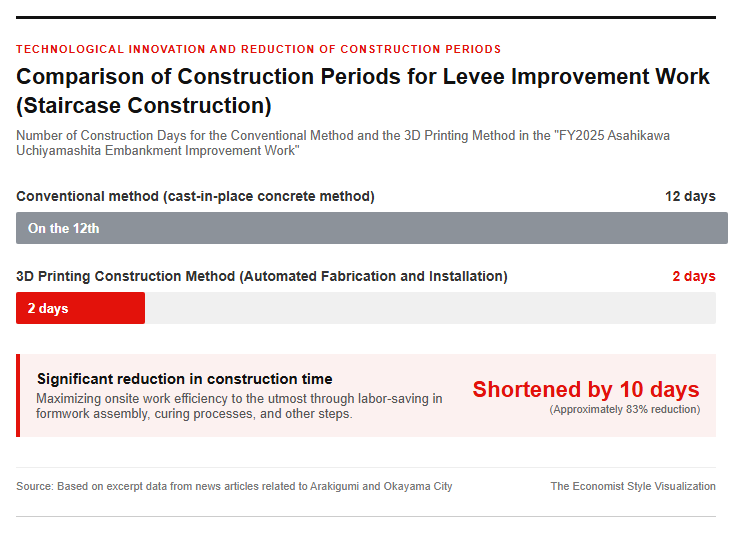
Araki-Gumi Co., Ltd., a general construction company based in Kita Ward, Okayama City, has carried out construction work using stair components fabricated with a construction 3D printer at an actual site for the “FY2025 Asahigawa Uchiyamashita Embankment Maintenance Construction” project underway in Okayama City. Conventionally, when constructing such structures as stairs, the “cast-in-place concrete method” has been common, in which workers assemble formwork on-site, pour concrete, and wait for it to harden. However, this conventional method required 12 days to complete the construction. In contrast, by adopting the 3D printer construction method—where finished components printed in advance based on 3D data are transported to the site and installed—they succeeded in reducing the construction period to just 2 days. This is a significant reduction in the construction period spanning a full 10 days, expected to yield a reduction effect of approximately 83% in terms of days. The on-site installation work was made public in October 2026, attracting major attention as a new technological innovation in regional infrastructure maintenance sites.
Moving Away from the Cast-in-Place Concrete Method and the Mechanism of Labor-Saving
In the conventional cast-in-place concrete method, building stairs with complex shapes and continuous steps required a multi-stage process in which highly skilled craftsmen spent days assembling formwork, curing the concrete after pouring, and finally removing the formwork. This series of tasks consumed a large amount of manpower and time, placing a heavy burden on the site. On the other hand, in the construction method utilizing a 3D construction printer, components are automatically fabricated by layering specialized mortar material based on pre-created 3D CAD data. Consequently, the work of assembling complex formwork on-site is eliminated altogether, dramatically reducing the required workforce. Furthermore, since there is no need for long curing wait times or dismantling work on-site, it also contributes to improving construction safety and reducing noise for the surrounding environment. This effectively demonstrates a labor-saving mechanism that thoroughly eliminates redundant processes while fully ensuring quality and safety.
Structural Challenges Facing the Construction Industry and Technological Innovation
The 2024 Problem and the Severe Labor Shortage Brought by Aging
Behind this demonstration experiment lie the extremely severe labor shortages and structural challenges facing the construction industry. Currently, the aging of skilled workers in the construction sector is progressing rapidly; while approximately 30% of all workers are aged 60 or older, the proportion of young workers aged 29 or under remains at only around 10%. In addition to this, April 2024 marked the full-scale onset of the so-called “2024 Problem,” in which the upper limits on overtime work based on the Work Style Reform Act became fully applicable to the construction industry. Because legal penalties such as imprisonment and fines are now imposed if the caps on overtime work—such as 720 hours per year—are exceeded, the conventional approach of forcibly managing site construction through long hours and increased headcount is no longer viable at all. Amidst a steadily rising demand for the maintenance and management of aging infrastructure such as roads and dikes, achieving dramatic labor-saving and digitization in on-site operations has become an unavoidable imperative in order to complete construction work with limited personnel and limited time.
The Rise of Domestic Startups and Their Adoption as Ministry of Land, Infrastructure, Transport and Tourism Recommended Technologies
As a trump card for such worksites, advanced technologies such as the domestically produced construction 3D printer “Polyuse One,” developed by the domestic startup Polyuse Inc., have emerged. Through a one-stop solution that integrally provides dedicated software, an automatic shaping device, and special mortar material, a track record of over 200 construction projects has been accumulated at civil engineering sites nationwide. These achievements have also been highly evaluated from an administrative perspective, having been registered in the Ministry of Land, Infrastructure, Transport and Tourism’s “NETIS (New Technology Information System)” and designated as a recommended technology for fiscal year 2025. The Ministry strongly promotes “i-Construction” and construction DX aimed at improving productivity at construction sites, and because the utilization of 3D printer technology also qualifies for bonus points in construction performance evaluations, adoption by local governments and major general contractors is accelerating. Construction work that used to depend on the skills and experience of seasoned technicians is shifting toward a technology that anyone can handle with uniform quality.
Future Developments and Key Focus for Social Implementation of Construction 3D Printers
The Impact of Building Standards Act Deregulation in 2026
For the full-scale social implementation of construction 3D printers, we are also reaching a major turning point in terms of legal regulations. Under the conventional Building Standards Act, mortar components printed with 3D printers did not fall under the category of specified building materials, requiring the acquisition of individual Minister of Land, Infrastructure, Transport and Tourism approvals every time a building was constructed, with the massive costs and time involved acting as a barrier to adoption. However, the Ministry of Land, Infrastructure, Transport and Tourism is moving toward deregulation by the spring of 2026, newly formulating specification provisions targeting one-story buildings and the like with a total floor area of 200 square meters or less. Public comment procedures are underway toward enforcement in May 2026, and once the institutionalization is complete, it will become possible to smoothly construct small-scale buildings and civil engineering structures without receiving individual ministerial approvals. With institutional obstacles removed, it is predicted that the scope of application for 3D printers in the housing and infrastructure domains will expand rapidly.
Future Outlook for Talent Development and Local Infrastructure Maintenance
The future focus will be on training personnel capable of mastering the technology on-site in parallel with regulatory easing, as well as penetration into the local community. In an initiative in Okayama City, an on-site tour was held for students from the local Okayama Technical High School, including PR activities to let them experience firsthand the actual sites where cutting-edge ICT and AI technologies are in operation. This is expected to dispel the conventional industry image of being demanding and hazardous, and appeal to young people as an attractive profession that makes full use of digital technology. Furthermore, in emergency restoration work during disasters and infrastructure development in remote islands, mountainous areas, and other regions where it is difficult to transport equipment and materials, 3D printers—capable of rapidly outputting components on-site—will serve as powerful disaster prevention and maintenance tools. In regional cities facing depopulation and aging, further technological evolution and nationwide deployment of 3D-printed construction are desired as a sustainable social model to continuously protect local safety and infrastructure.
Reference page
- [Ministry of Land, Infrastructure, Transport and Tourism] FY2025 Recommended Technology: Construction 3D Printing (Polyuse Inc.) https://www.mlit.go.jp/
- [Araki-gumi Co., Ltd.] Aiming for labor savings and shorter construction periods at construction sites using construction 3D printers https://prtimes.jp/main/html/rd/p/000000017.000163331.html
[#OkayamaCity #Construction3DPrinter #LaborShortage #2024Problem #ConstructionDX #Arakigumi #Polyuse]


コメント