Meta and Apple have announced a collaboration on technology to run the large-scale AI model “Muse Spark Open” locally on a configuration of two or more Mac Studios. The background to this is the growing corporate demand to simultaneously escape the high costs of cloud infrastructure and ensure privacy.
- Key Points and Background of the Collaboration Announced in October 2026
- The Full Picture of Muse Spark Open, Boasting 816 Billion Parameters
- How Distributed Inference Works with MLX and Thunderbolt 5 RDMA
- Comparison with Data Center Costs and Cost Calculation in Enterprises
- Shifting Rivalries and Tectonic Shifts in the Local AI Market
- Future Developments and Key Points to Watch for the Adoption of On-Device AI
Key Points and Background of the Collaboration Announced in October 2026
On October 15, 2026, Meta and Apple announced a historic partnership to build an environment that runs Meta’s open-weight AI model, “Muse Spark Open,” locally on Apple’s high-performance desktop, the “Mac Studio.” Meta CEO Mark Zuckerberg and Apple CEO John Ternus reported their success on social media, sending shockwaves through the tech industry. This collaboration aims to enable developers to run cutting-edge agentic AI solely on their local devices without sending data to external clouds. In the background are growing concerns among enterprises regarding token usage-based pricing for cloud-based generative AI and data privacy. Up until now, the two companies had been engaged in fierce conflicts over issues such as ad-tracking regulations, but they have shifted to a cooperative relationship driven by the shared interest of popularizing on-device AI. Please refer to the following system architecture diagram.
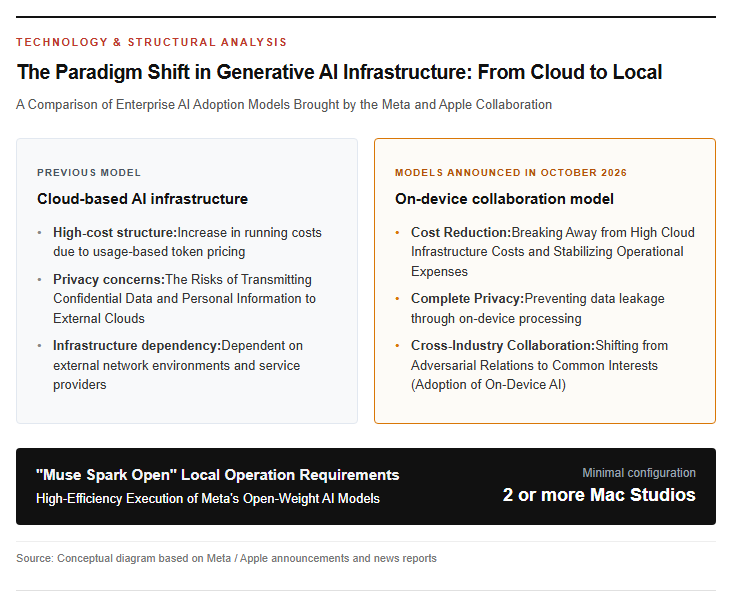
In this verification, by linking two to four Mac Studios equipped with the M5 Ultra chip, we have achieved local inference for ultra-large-scale models that was impossible with a single conventional PC.
The Full Picture of Muse Spark Open, Boasting 816 Billion Parameters
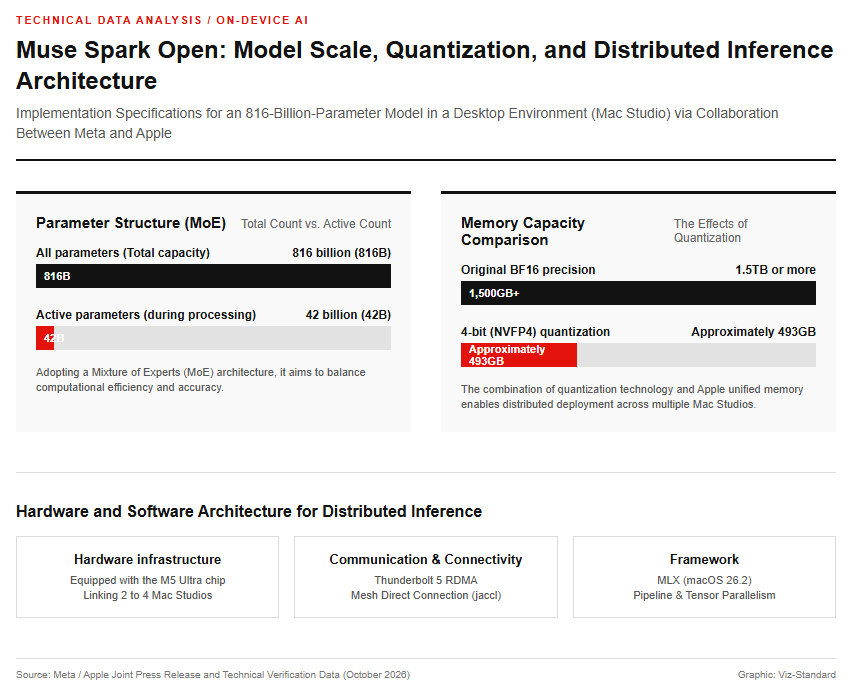
Muse Spark Open, which was recently announced to be optimized for Mac Studio, is a Mixture of Experts (MoE) language model boasting a total of 816 billion (816B) parameters. Of all the parameters, only 42 billion (42B) are active during actual processing, striking a balance between computational efficiency and accuracy. Specialized in automated programming and complex task processing, the model demonstrated in Meta’s demo advanced local workflows such as bug fixing and feature addition for the open-source Mastodon client “Ice Cubes,” as well as automated video editing using DaVinci Resolve. Because the model data occupies approximately 493GB in a 4-bit (NVFP4) quantization format, it does not fit into a single PC’s memory, making memory sharing across multiple Mac Studios essential. While the original BF16 precision requires over 1.5TB of memory, combining quantization technology with Apple’s unified memory makes desk-side operation a reality. Developers can acquire the model weights directly via Hugging Face and others, and commercial use is also supported under certain license conditions.
Technical Specifications and Cost Structure for Moving Away from Cloud Dependency
How Distributed Inference Works with MLX and Thunderbolt 5 RDMA
To distribute and rapidly process large models across multiple Mac Studios, Apple Machine Learning Research has enhanced the open-source machine learning framework “MLX”. Specifically, it leverages the Thunderbolt 5 RDMA (Remote Direct Memory Access) driver in macOS 26.2, released in 2026, and the communication library “jaccl”. By directly connecting the Mac Studios in a mesh topology with Thunderbolt 5 cables, it enables low-latency memory data exchange while minimizing CPU load. The model partitioning methods adopt pipeline parallelism, which splits models along the depth dimension, and tensor parallelism, which horizontally distributes internal layer computations. Please refer to the processing speed comparison graph below.
In a tensor parallel configuration using four M5 Ultra-powered Mac Studios, at a context size of 8,192 tokens, it recorded a generation speed of approximately 36.7 tokens per second—exceeding human reading speed. Additionally, the Neural Accelerator built into the M5 Ultra’s GPU significantly accelerates matrix operations, reducing the time to first token (TTFT) by up to 4.6 times compared to the previous generation.
Comparison with Data Center Costs and Cost Calculation in Enterprises
Running large-scale AI locally requires initial hardware investment, but it holds the potential to significantly reduce cloud data center usage fees in the long run. A Mac Studio equipped with an M5 Ultra and 256GB of unified memory starts at approximately $10,799 per unit, making a two-unit configuration a capital expenditure of about $21,598, and a four-unit configuration about $43,196. In contrast, using large models via external cloud APIs for millions of tokens daily incurs ongoing pay-as-you-go fees amounting to thousands of dollars per month, meaning that for frequently using development teams, the hardware purchase costs can be recouped in roughly 1 to 2 years. Furthermore, while large GPU servers performing similar processing in data centers require enormous amounts of power and specialized cooling facilities, a four-unit Mac Studio setup operates stably on power supplied from a single standard wall outlet (peak power consumption of approx. 300W x 4). For enterprises, in addition to the security benefits of keeping proprietary code and company data in-house, the financial advantage of converting ongoing Opex (operational expenditure) into predictable Capex (capital expenditure) is highly valued.
Impact on the Industry and Future Outlook
Shifting Rivalries and Tectonic Shifts in the Local AI Market
This partnership is also symbolic in that Apple and Meta, which had been at odds for many years, have come together for a common purpose. Apple’s introduction of App Tracking Transparency (ATT) in 2021 is said to have dealt a $10 billion annual blow to Meta’s advertising revenue, and mutual criticism between the leadership of both companies had continued. However, under John Ternus, who assumed the role of Apple’s CEO in September 2026, the AI strategy was rebuilt, and technical cooperation was achieved through discussions with Meta’s AI head Alexander Wang and others. According to IDC research, Apple’s share of the enterprise desktop market remains at around 4.6%, with the Windows camp maintaining dominance at 91.3%. However, Apple Silicon’s unique unified memory architecture boasts a memory bandwidth of 1.2 TB/s, making it a powerful differentiator against competitors in AI inference that requires large amounts of memory. As a local AI ecosystem that completes processing on the device side emerges in contrast to the centralized AI infrastructure dominated by cloud giants and Nvidia, significant changes are occurring in corporate IT procurement methods and market structures.
Future Developments and Key Points to Watch for the Adoption of On-Device AI
The focus moving forward is on the extent to which advanced local AI operations linking two or more Mac Studios will penetrate mainstream businesses and independent developers. At present, because it requires hardware implementation on the scale of tens of thousands of dollars, adoption is expected to precede in specific domains such as highly confidential software development and research institutions in the finance and medical fields. Meanwhile, Meta has also prepared lighter 30-billion-parameter-class models like “Muse Glimmer,” keeping standalone operation on a single Mac Studio or future Mac products in view. On the technical front, with next-generation chips expected to appear in the future and even larger memory configurations, the future of running trillion-parameter models on a single machine is also becoming a reality. For Apple, this leads to an increase in hardware sales, and for Meta, it expands their own open model ecosystem, thus establishing a sustainable business model for both parties. The further open-sourcing of distributed inference technology and the evolution of quantization methods that suppress memory consumption hold the decisive key to the true popularization of on-device AI.
Reference Page
- 【Apple Machine Learning Research】https://machinelearning.apple.com/research/mlx-distributed-inference
- [MLX Framework Documentation] [suspicious link removed]
- Hugging Face – Meta Muse Spark Open
【#Meta #Apple #MacStudio #LocalAI #MuseSparkOpen #MLX #GenerativeAI】


コメント