Three individuals, including a prefectural employee and construction company executives, have been arrested for allegedly leaking confidential information, such as the estimated price, to a construction contractor in connection with bidding for river disaster prevention work ordered by Shizuoka Prefecture. The structural background of government-led bid-rigging that undermines the fairness of public works is coming to light, involving factors such as long-standing personal relationships, the misuse of official emails, and winning bids with amounts extremely close to the investigation base price.
- The Shock of the Prefectural Employee’s Arrest and the Leak Method
- Suspicious Bidding and the Winning Bid Structure with a 10,000-Yen Margin
- Act on Prevention of Delay of Public Contracts Involving Official Intervention and the Mechanism of Penalties
- Suspension from Bidding and Its Impact on the Construction Industry
- Bidding System Reforms and Lessons Learned Over the Past 30 Years
- Recurrence Prevention and Sustainable Procurement Systems
The Shock of the Prefectural Employee’s Arrest and the Leak Method
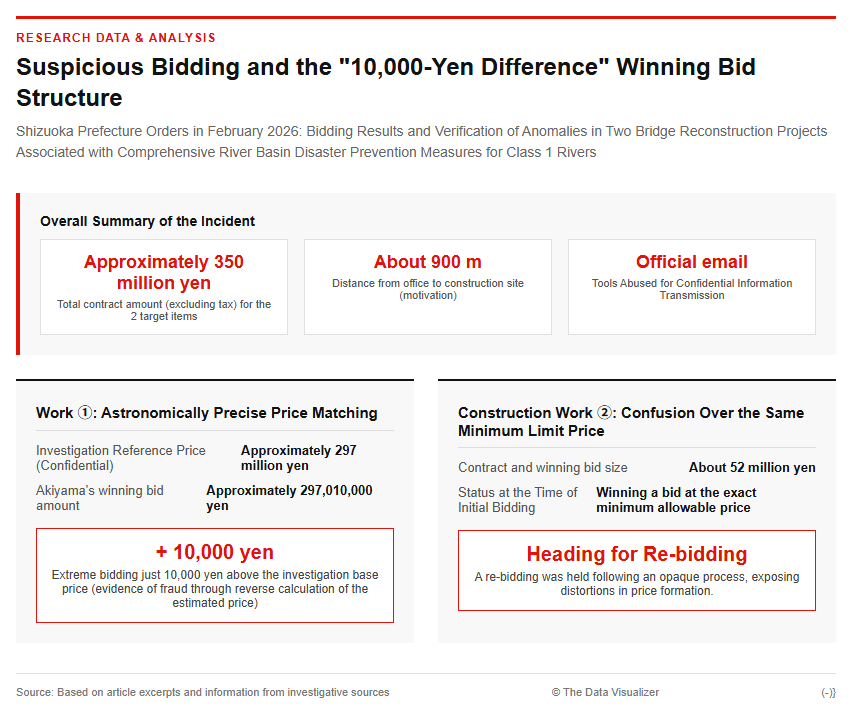
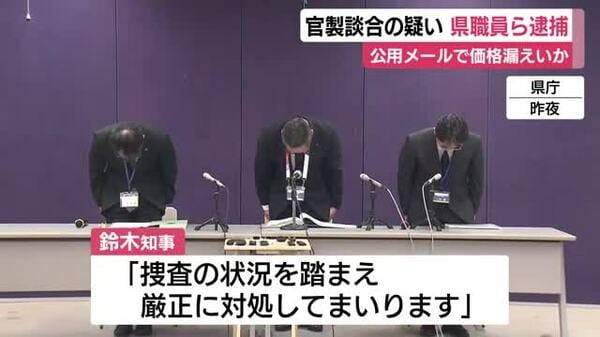
On October 14, 2026, suspicions of rigged bidding surrounding a public works project commissioned by Shizuoka Prefecture sent a major shockwave through both the administration and the construction industry. The Shizuoka Prefectural Police arrested Masaaki Yamamoto (57), head of the 2nd Construction Section of the Construction Division at the Fukuroi Civil Engineering Office under the Shizuoka Prefectural Transport and Infrastructure Department, on suspicion of violating the Anti-Bidding Rigging Act and obstructing public contract competitive bidding, for allegedly leaking non-public estimated prices to a construction company. Simultaneously, two executives of “Akiyama Corporation,” a general construction company headquartered in Iwata City, Shizuoka Prefecture—Director Takae Akiyama (71) and Director Hirokazu Tomita (63)—were also arrested on suspicion of obstructing public contract competitive bidding for receiving the information and improperly interfering with the bidding process. According to investigative sources, Yamamoto is believed to have abused official work emails to transmit confidential information such as estimated prices to the Akiyama side. Yamamoto and Tomita have known each other for about 20 years through public works projects, and such a personal hotline may have become the breeding ground for the improper information leak. In response to the incident, Shizuoka Prefecture Governor Yasutomo Suzuki released a statement saying, “We will deal with this strictly based on the investigative situation,” forcing a re-inspection of the management structure and information security within the prefectural government.
Suspicious Bidding and the Winning Bid Structure with a 10,000-Yen Margin
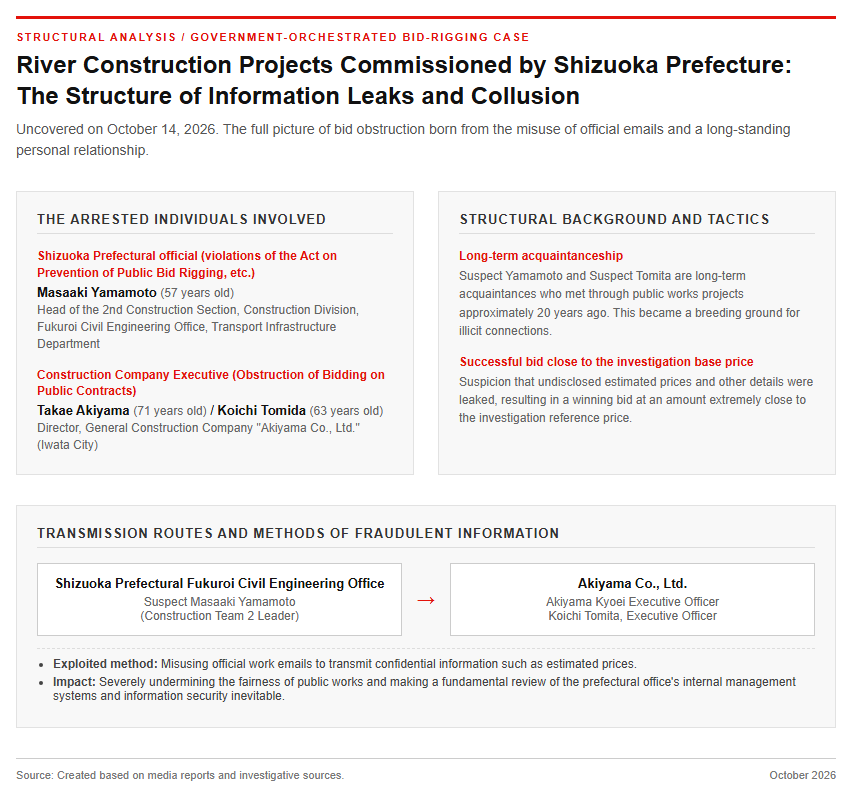
The cases in question involved the bidding for two bridge reconstruction projects associated with comprehensive river basin disaster prevention measures for a Class A river, commissioned by Shizuoka Prefecture in February 2026. The total contract value of the two projects won by the Akiyama side reached approximately 350 million yen (excluding tax). Data on the winning bids uncovered during the investigation revealed extremely unnatural figures. In one of the projects (with a winning bid of approximately 297.01 million yen), the Akiyama side won the contract with astronomical precision, exceeding the undisclosed survey reference price (approximately 297 million yen) by a mere 10,000 yen. In addition, the other project (approximately 52 million yen) was initially won with a bid identical to the minimum restriction price, but followed an opaque process, such as a subsequent re-bidding. During voluntary questioning prior to their arrest, representatives of the contractor stated, “The construction site is only about 900 meters away from our company, and we really wanted to win the contract to save on expenses such as travel and material transportation costs,” deepening suspicions that they pressured prefectural officials into leaking information to secure their own profits and reduce costs. Being able to obtain the estimated price just before the bidding makes it possible to back-calculate the survey reference price and minimum restriction price with extreme accuracy, making this a classic example of illicit price formation through a secret agreement between public servants and contractors.
The Structural Background and Legal Sanctions Behind Government-Led Bid Rigging
Act on Prevention of Delay of Public Contracts Involving Official Intervention and the Mechanism of Penalties
Officially orchestrated bid-rigging, which undermines fairness in public procurement, is a criminal act subject to exceptionally severe legal penalties and administrative dispositions. The act of administrative officials, who act as the ordering party, leaking estimated prices or bid participation information in advance to a specific business entity violates Article 8 of the Act on Prevention of Public Bid-Rigging (Act on Elimination and Prevention of Involvement in Public Bidding-Rigging, etc. and Punishment of Acts Harmful to Fairness of Bidding, etc. by Employees), and is punishable by imprisonment for up to 5 years or a fine of up to 2.5 million yen. Furthermore, offenders may be prosecuted under the offenses of obstruction of bidding/auctions for public contracts or bid-rigging for public contracts stipulated in Article 96-6 of the Penal Code, which carry a penalty of imprisonment for up to 3 years or a fine of up to 2.5 million yen. If it is proven that they accepted benefits such as money or entertainment in exchange for leaking information or providing preferential treatment, the crime of acceptance of bribes under Article 197 of the Penal Code (imprisonment for up to 5 years) and the crime of giving bribes will be additionally applied. Investigations by the Japan Fair Trade Commission are also conducted in parallel, and cease-and-desist orders as well as massive administrative surcharge payment orders are issued against companies for violations of the Antimonopoly Act (unreasonable restraint of trade). Going far beyond mere bid-rigging among contractors, officially orchestrated bid-rigging involving the direct participation of public officials with procurement authority is a malicious structural crime that fundamentally destroys the fair bidding environment for public works funded by the tax revenue of citizens and residents.
Suspension from Bidding and Its Impact on the Construction Industry
The exposure of government-orchestrated bid-rigging deals delivers a severe blow that shakes the very survival of the construction companies involved. This is because, beyond being prosecuted as criminal cases, contracting agencies such as the Ministry of Land, Infrastructure, Transport and Tourism, as well as prefectures and municipalities, immediately impose “suspension from designation” (suspension of bidding eligibility) measures. Receiving a suspension from designation makes it impossible to participate in bids for all public works commissioned by the national and local governments for a certain period. Consequently, exclusion from ongoing bids and the disruption of new contract opportunities lead to a dramatic deterioration in sales and cash flow. Especially for regional construction companies with a high dependence on public works, this frequently invites a loss of credit from financial institutions and the suspension of business transactions, leading directly to management crises. Furthermore, strict legal and economic responsibilities are pursued against the officials on the administrative side as well, including severe disciplinary actions such as dismissal for disciplinary reasons, as well as claims for damages filed by local governments. While the background behind these illegal acts is said to involve regional-based industry structures, the desire to “avoid excessive price competition and stabilize contract awards,” and long-standing customary relationships, such practices are utterly unacceptable in modern times where strict compliance is enforced.
Future Outlook Toward Transparency in Public Procurement
Bidding System Reforms and Lessons Learned Over the Past 30 Years
The bidding system for public works in Japan has evolved through numerous large-scale corruption scandals over the past few decades and the accumulation of corresponding legal reforms. Prompted by the general contractor corruption scandal in 1993, the Cabinet’s approval of an action plan in 1994 promoted the adoption of general competitive bidding for large-scale public works. Subsequently, in 2000, the Act on Promotion of Proper Tendering and Contracting for Public Works, which mandated information disclosure, was enacted, followed by the Act on Prevention of Involvement in Public Works Bid Rigging, etc. in 2002. Furthermore, in 2006, following a domino effect of bid-rigging scandals in which incumbent governors in Fukushima, Wakayama, and Miyazaki prefectures were arrested one after another, criminal penalties to punish public officials themselves (such as imprisonment for up to five years) were introduced into the Anti-Bid-Rigging Act. The conventional “designated competitive bidding” system had a structural flaw: because the administrative side pre-selected participants, it facilitated information exchange and rotational coordination (bid-rigging) among contractors, and easily allowed opaque discretion to come into play. Although institutional reforms have driven the transition toward open “general competitive bidding” as a rule, some local governments and regional offices have maintained outdated operations and lax information management, resulting in corruption being exposed once again, as seen in the recent incident in Shizuoka Prefecture.
Recurrence Prevention and Sustainable Procurement Systems
To eradicate government-led bid-rigging and restore public trust in public works, fundamental, systemic preventive measures that go beyond mere moral appeals like raising ethical awareness are essential. First, government agencies are required to strictly monitor access logs for official emails and internal networks, eliminate the black-box nature of the estimated price calculation process, and strictly enforce regular personnel rotations and contact guidelines within procurement departments. In the operation of bidding systems as well, it is effective to further expand the “comprehensive evaluation bidding system”—which objectively evaluates not just the lowest price, but also a company’s technical capabilities, working environment, and contributions to crime prevention and disaster mitigation—and to use statistical data analysis (forensic investigations) for the early detection of abnormal bidding rates. The construction industry must also introduce compliance programs advocated by the Japan Fair Trade Commission and strengthen whistleblowing systems to build a self-cleaning mechanism that rejects the receipt of illicit information. The establishment of a transparent, fair, and sustainable public procurement system is the only path that guarantees the sound development of the construction industry and the safe infrastructure development of local communities.
Reference Page
- [TV Shizuoka / FNN Prime Online] 3 Prefectural Officials Arrested on Suspicion of Official Bid-Rigging Over River Construction Commissioned by Shizuoka Prefecture, Allegedly Leaking Prices via Official Emails
 静岡県発注の河川工事めぐり官製談合の疑いで県職員ら3人逮捕 公用メールで価格を漏えいか|FNNプライムオンライン静岡県が発注した河川工事の入札をめぐり、事前に予定価格を漏らし特定の業者に落札させた疑いで県の職員など3人が逮捕されました。逮捕されたのは袋井土木事務所の男(57)と建設会社「アキヤマ」の常務取締役の男(71)、取締役の男(63)です。警察...www.fnn.jp
- [Shizuoka Prefecture Official Website] Bidding and Contract Information and Compliance Initiatives
[suspicious link removed]
【#OfficialBidRigging #PublicWorks #ShizuokaPrefecture #BiddingSystem #AntiMonopolyAct #Compliance #ConstructionIndustry】


コメント