On October 15, 2026 local time, Amazon US announced two new models of “Bee,” an AI device that constantly records and remembers daily conversations: “Bee Frontier” and “Bee Eclipse.” Behind this release are the securement of leadership in the consumer AI agent market in the era of generative AI, and the establishment of a technological design that dispels privacy concerns regarding conversational data.
- Introduction and Basic Specifications of Two New Models of the Always-On Recording AI “Bee”
- Features of the Arm-Mounted “Bee Frontier” and Smartphone-Mounted “Bee Eclipse”
- Differences from the Traditional Echo and the Background of Evolution Following the Acquisition Saga
- Conversation Summarization, Task Generation, and Integration with Major Office Tools and Alexa+
- Features and Pricing Structure of the Paid Plan “Bee Pro”
- Robust Protection through On-Device Encryption and Confidential Computing
- The Competitive Landscape of the Wearable AI Market and Future Outlook of Agent Commerce
Introduction and Basic Specifications of Two New Models of the Always-On Recording AI “Bee”
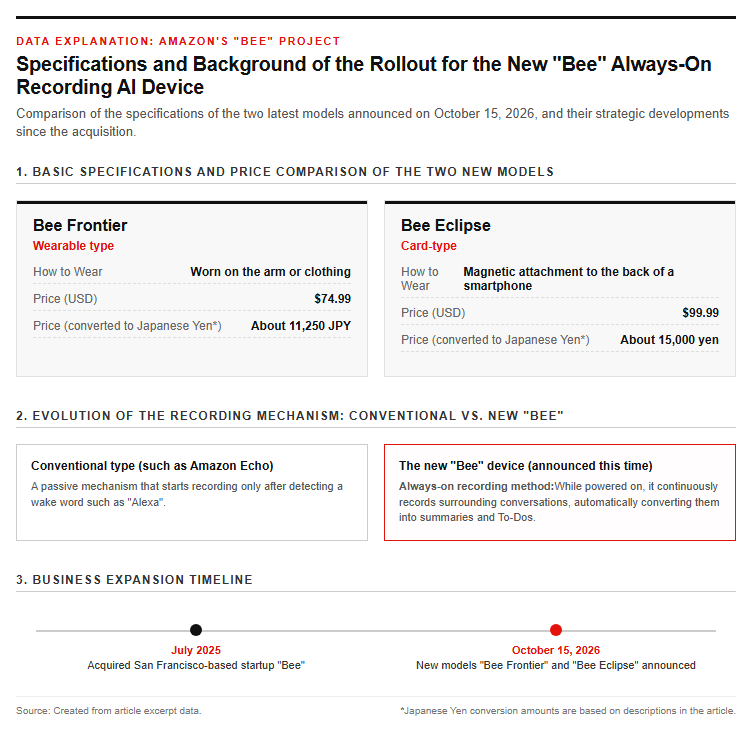
On October 15, 2026 local time, Amazon announced two new models of “Bee,” a personal AI device that constantly records everyday conversations and converts them into summaries and To-Do lists. The newly introduced devices are the “Bee Frontier,” a wearable model attached to the wrist or clothing, and the “Bee Eclipse,” a card-type model that magnetically attaches to the back of a smartphone. Amazon acquired Bee, a startup based in San Francisco, USA, in July 2025, and these new products mark its first major new lineup expansion since the acquisition. While conventional “Amazon Echo” series smart speakers are designed to start recording after detecting a wake word such as “Alexa,” Bee devices fundamentally differ in that they continuously record surrounding conversations while powered on. Prices are set starting at $74.99 (approx. 11,250 yen) for the Bee Frontier and $99.99 (approx. 15,000 yen) for the Bee Eclipse. The device automatically categorizes contextual information obtained from conversations, providing an environment that can be utilized as a digital memory storage area. Please refer to the image below for the device’s appearance and usage concept.
Features of the Arm-Mounted “Bee Frontier” and Smartphone-Mounted “Bee Eclipse”
The two newly announced models are clearly differentiated in terms of wearing style, battery life, and functional characteristics.
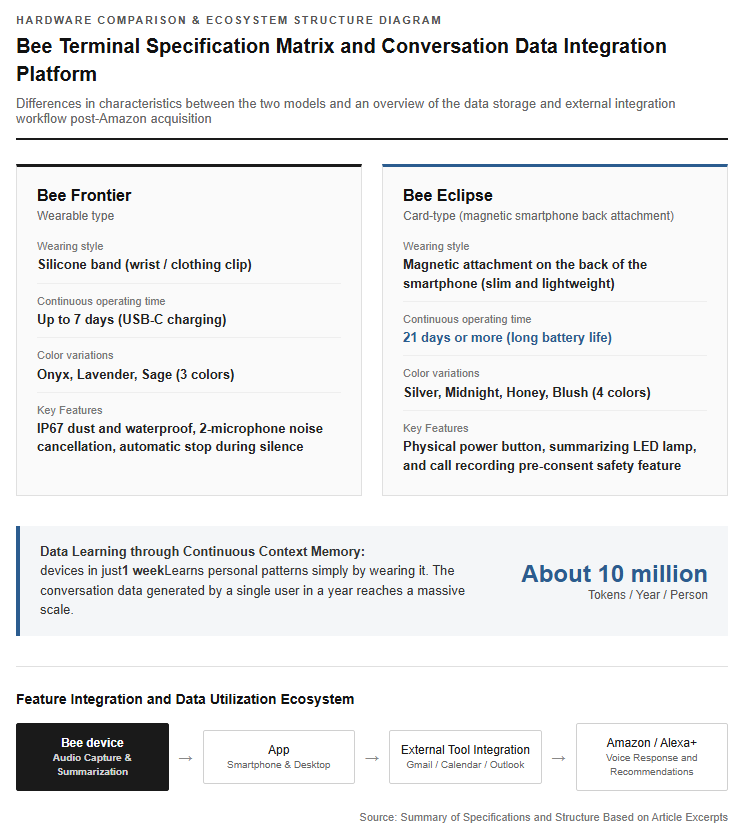
The wearable “Bee Frontier” features a soft silicone band and can be worn by wrapping it around the wrist or attached to clothing with a clip for portability. It is available in three color variations: onyx, lavender, and sage. It features IP67-rated dust and water resistance, and supports up to 7 days of continuous operation via USB-C charging. Equipped with dual microphones featuring noise-canceling capabilities, it can accurately capture necessary audio information even in noisy environments such as crowded restaurants and open-plan offices. It also includes a feature that automatically stops recording after a set period of silence.
Meanwhile, “Bee Eclipse”, which attaches magnetically to the back of a smartphone, is a card-sized device as thin and lightweight as a credit card. Available in four colors—silver, midnight, honey, and blush—it achieves an overwhelmingly long-lasting battery that can be used for over 21 days on a single charge. In addition to being equipped with a physical power button and an LED lamp that lights up during summarization processing, it incorporates a safety feature that prompts users to obtain prior permission from the other party when recording phone calls.
Differences from the Traditional Echo and the Background of Evolution Following the Acquisition Saga
The biggest difference between Amazon’s conventional voice AI product line and the Bee device lies in the shift from one-off voice command responses to “continuous contextual memory.” Whereas conventional Echo devices functioned as remote controls that provided weather updates in response to specific commands, Bee operates as an external memory that accumulates context from subconscious conversations.
According to Steve Korshakoff, founder of Bee, a single user generates approximately 10 million tokens of conversation data per year. By wearing the device for just one week, it is possible to learn a vast amount of facts about a person’s interests, relationships, and daily behavioral patterns. Since its acquisition by Amazon in July 2025, the technical team has focused on building a personal assistant ecosystem that goes beyond a mere voice recording device. By laying the groundwork to organize and leverage scattered everyday conversations as structured data, a new strategy to closely integrate hardware with generative AI services is moving into full swing.
Feature Integration and Utilization Ecosystem of the Monthly Plan “Bee Pro”
Conversation Summarization, Task Generation, and Integration with Major Office Tools and Alexa+
The audio data captured by the Bee device is analyzed in real time by AI and automatically generated as conversation summaries, insights, and actionable to-do lists. The recorded summaries can be viewed not only on the smartphone app but also on a newly offered desktop app. Dedicated templates tailored to specific use cases—such as university lecture notes, medical care plans, and business brainstorming—are provided in advance.
Furthermore, it features seamless integration capabilities with major external office tools. By connecting with Gmail, Google Calendar, and Microsoft Outlook, it automatically extracts tasks mentioned in conversations, drafts follow-up emails, and registers appointments to the calendar. By linking it with the “Alexa+” voice assistant, it also becomes possible to speak to an Echo device at home to recall meeting summaries and tasks via voice. A mechanism has also been established where products brought up in daily conversation are recommended on the Amazon.com homepage and the Bee app. Please refer to the diagram below for an overview of the system’s functional integration.
Features and Pricing Structure of the Paid Plan “Bee Pro”
In introducing Bee, Amazon has adopted a tiered pricing model that combines a free tier and a paid subscription. All users who purchase the device can use conversation summarization, review features, and up to 14 days of conversation memory storage at no additional cost.
Meanwhile, a paid subscription plan called “Bee Pro” has been made available to lift all functional restrictions and fully utilize the ecosystem. The pricing is set at $11.99 per month (approx. 1,800 yen), and a 30-day free trial period is offered to new registrants. By subscribing to Bee Pro, users can enjoy unlimited conversation summarization and daily logging, alongside access to automated to-do suggestions, a personal chat assistant, custom templates, and the desktop app. In addition, external integration features with Alexa+, Amazon.com, and third-party apps are designed to be unlocked exclusively for Bee Pro. This suggests a strategic policy aimed at establishing continuous recurring revenue through software, in addition to one-time revenue from device sales.
Privacy Design That Even Amazon Cannot Decipher and Future Outlook
Robust Protection through On-Device Encryption and Confidential Computing
Privacy protection is the biggest challenge for always-on recording wearable devices. Amazon has built a zero-trust encryption architecture that prevents even its own employees and cloud administrators from accessing users’ conversation data in any way. The audio data itself is processed in real time and then immediately discarded, without being stored on the cloud. The transcribed text data is encrypted using an encryption key stored exclusively on the user’s smartphone device (iPhone/Android).
The backend infrastructure employs a confidential computing environment on AWS EC2 verified by the open-source transparency verification standard “Sigstore”. User devices temporarily release the encryption key only after verifying the code integrity of the cloud environment, and its validity period is limited to seven days. Program deployment privileges are managed by an independent privacy team in a two-tier system, structurally preventing the inclusion of unauthorized code. Additionally, while recording is active, the device’s LED lamp lights up to clearly indicate the recording status to people nearby.
The Competitive Landscape of the Wearable AI Market and Future Outlook of Agent Commerce
The launch of Bee’s new model is further intensifying competition in the rapidly expanding wearable AI device and AI agent market. As competing products such as Meta’s AI smart glasses, Plaud’s card-shaped recording device, and Friend’s AI necklace enter the market, the battle for supremacy in personal hardware is entering a full-scale phase.
In the e-commerce and purchasing markets, “agentic commerce”—where AI agents handle everything from search to payment on behalf of users—is experiencing rapid growth, and it is estimated that the U.S. market alone will expand to $20.5 billion (approx. 3.075 trillion yen) by 2026. Amazon is strengthening its lock-in strategy by using always-listening devices to capture latent purchasing needs from everyday conversations and seamlessly guide users to its own e-commerce platform and Alexa+. Although the release date in Japan remains undecided at this time, the arrival of Bee—combining advanced security design with the automation of daily tasks—will serve as an important milestone that presents the standard image of next-generation personal AI.
Reference page
- [Official Amazon Announcement] Amazon personal AI: Bee Frontier and Bee Eclipse https://www.aboutamazon.com/news/devices/amazon-personal-ai-bee-frontier-bee-eclipse
【#Amazon #Bee #WearableAI #GenerativeAI #AIAgent #Privacy #Alexa】

コメント