On November 17, 2026, U.S. tech giant Google Cloud announced that it will provide early access to its latest cyber defense-focused AI model, “Gemini 4 Carbon for Cyber,” and other technologies to the Japanese government and critical infrastructure operators. The initiative aims to address increasingly sophisticated cyberattacks and the threat of “AI-driven cyber saturation attacks,” as well as Japan’s acute shortage of security talent, comprehensively supporting the strengthening of Japan’s digital infrastructure defense capabilities and workforce development.
- Background of US Google’s Announcement of Support for Japan and Key Points of the Offered Programs
- The Cyber Emergency Crisis Facing Government and Administrative Agencies and the Background of Provision
- Advanced vulnerability auto-remediation capabilities and overwhelming resistance to prompt attacks
- Sovereign Cloud Protecting Domestic Data Sovereignty and Automation of Government Workflows
- AI Adoption Support for SMEs and the 1-Million-Person Talent Development Initiative by 2030
- Key Focus Areas and Expected Results for Building Next-Generation Cyber Defense Networks
Background of US Google’s Announcement of Support for Japan and Key Points of the Offered Programs
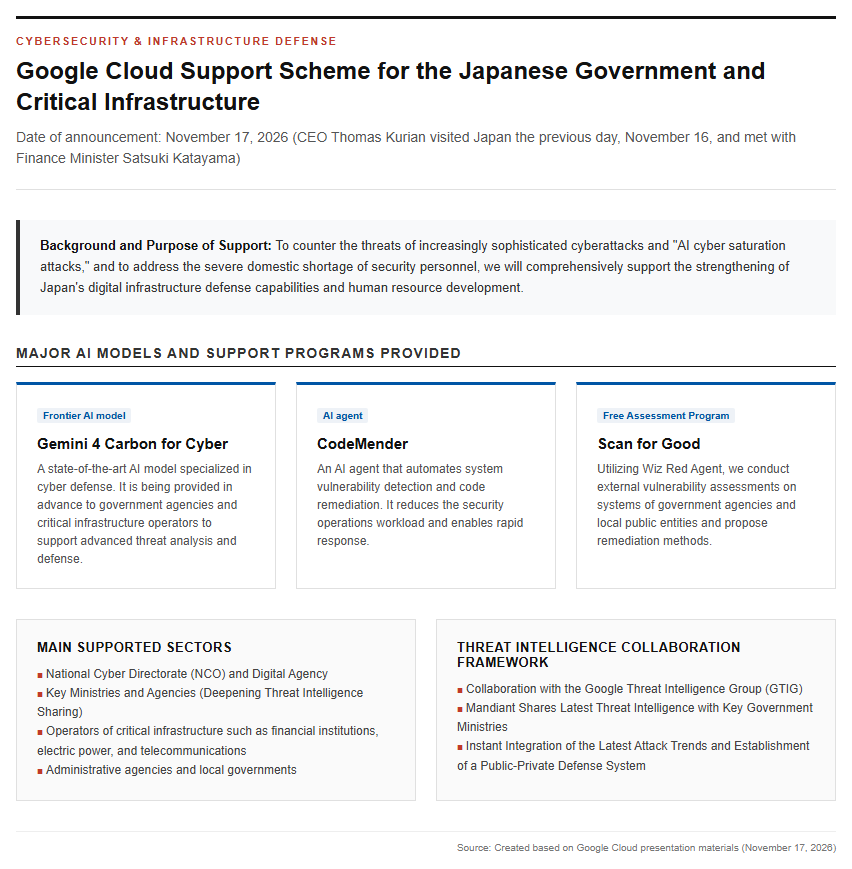
On November 16, 2026, Thomas Kurian, CEO of Google Cloud, visited Japan and met with Finance Minister Satsuki Katayama, communicating the company’s policy to support the strengthening of Japan’s cybersecurity and the adoption of AI. In response to this, the company officially announced a comprehensive initiative the following day, November 17.
At the core of these measures is the priority provision of cutting-edge technology to government agencies—including the National Cyber Office (NCO) launched on July 1, 2025, and the Digital Agency—as well as financial institutions and critical infrastructure operators such as power and telecommunications companies. Specifically, early access will be provided to “Gemini 4 Carbon for Cyber,” a frontier AI model with enhanced cybersecurity capabilities, and “CodeMender,” an AI agent that automates system vulnerability detection and code remediation. In addition, a free program called “Scan for Good” will be introduced for systems in administrative agencies and local governments, using AI-powered “Wiz Red Agent” to diagnose vulnerabilities from the outside and suggest remediation methods. Furthermore, threat analysis organizations “Google Threat Intelligence Group (GTIG)” and “Mandiant” will deepen their collaboration with key ministries and agencies to establish a system for sharing the latest threat intelligence.
The Cyber Emergency Crisis Facing Government and Administrative Agencies and the Background of Provision
The background of this support lies in the rapid sophistication of cyber attacks and the increasing damage within Japan. In the “Recommendations for Drastic Strengthening of Cybersecurity Measures,” compiled on October 20, 2026, by the LDP Policy Research Council’s National Cybersecurity Strategy Headquarters, the frequent occurrence of large-scale personal data leaks and threats to critical infrastructure was positioned as the “eve of a cyber emergency,” expressing a strong sense of crisis. In particular, concerns have been raised about the materialization of “AI-driven cyber saturation attacks,” in which attackers utilize generative AI to automatically search for system flaws and launch simultaneous attacks on a scale that exceeds the defensive side’s response capacity. On November 6, 2026, the government also adopted the “Emergency Cybersecurity Countermeasures Package,” setting out the early detection of vulnerabilities utilizing AI and the securing of specialized personnel as urgent tasks. Because conventional perimeter defense and post-incident response alone cannot cope with threats attacking at machine speed, the importance of building an execution system for active cyber defense led by the National Cyber Directorate, alongside directly incorporating Google’s advanced AI technology into the defensive side, has rapidly increased.
Technical Features and Sovereign Infrastructure of the State-of-the-Art Cyber Defense AI “Gemini 4 Carbon”
Advanced vulnerability auto-remediation capabilities and overwhelming resistance to prompt attacks
The core AI technology provided in advance, “Gemini 4 Carbon,” is a cutting-edge frontier AI model launched by Google on November 11, 2026. The model excels at processing complex multi-step workflows. In particular, “Gemini 4 Carbon for Cyber,” which is optimized for cybersecurity, not only automatically discovers system vulnerabilities and flaws, but also possesses the ability for the AI itself to consistently and autonomously execute the creation of programs (patches) to fix them. In addition, in the “Gray Swan” IPI benchmark test, which measures resistance to prompt injection attacks where AI is manipulated maliciously through external inputs, it demonstrated extremely high robustness with a 0% attack success rate. By utilizing the new “/swarm” feature integrated into the developer tool “Google Antigravity,” a mechanism has also been established where Gemini 4 Carbon acts as a leader to give instructions, and multiple lightweight AI models team up to process tasks concurrently and at high speed.
Sovereign Cloud Protecting Domestic Data Sovereignty and Automation of Government Workflows
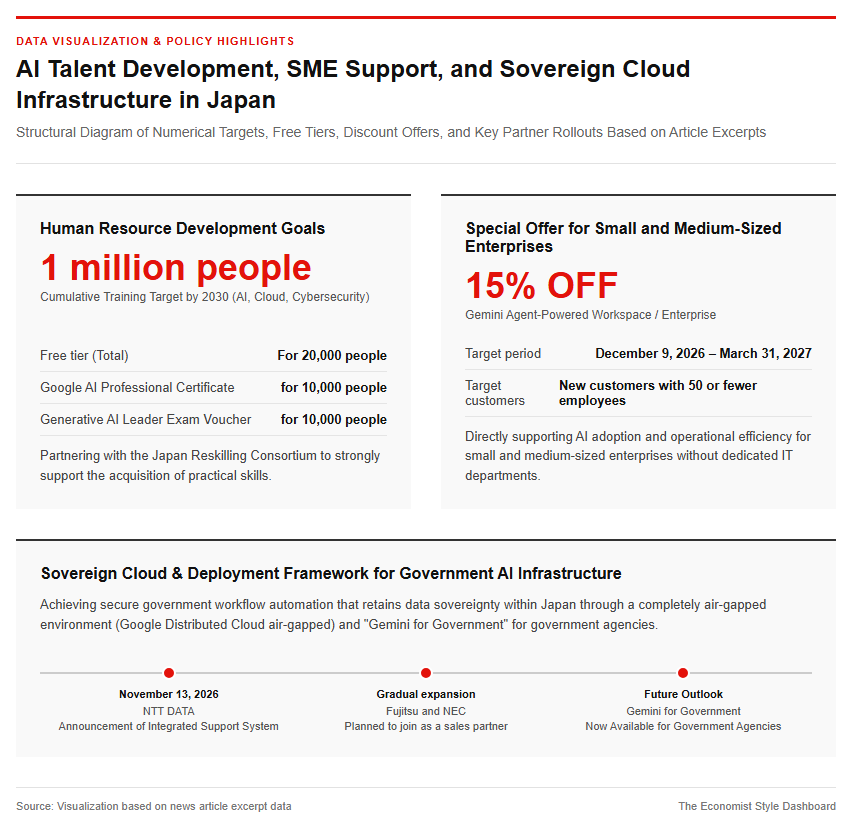
In parallel with efforts to strengthen cyber defense capabilities, infrastructure development is underway to securely manage highly confidential data and intellectual property. Google Cloud is expanding its domestic availability of “Google Distributed Cloud Air-Gapped,” a sovereign cloud solution that enables the use of cloud and AI in a completely non-internet-connected environment. On November 13, 2026, domestic partner NTT DATA announced that it has established a comprehensive support system spanning from implementation to operation, and Fujitsu and NEC Corporation are also scheduled to join as sales partners. This will enable the safe utilization of AI while keeping data operations and sovereignty within Japan. Furthermore, the rollout of “Gemini for Government”—an AI infrastructure tailored for government agencies that supports domestic data processing—is scheduled to begin sequentially. National and local governments are expected to automate workflows such as administrative procedures and document creation while ensuring data security, leading to improved convenience in services for residents.
Human Resource Support Aiming to Develop 1 Million People by 2030 and Its Impact on Future Society and Industry
AI Adoption Support for SMEs and the 1-Million-Person Talent Development Initiative by 2030
Facing a labor shortage driven by a declining birthrate and aging population, as well as a severe shortage of IT and security professionals, Japanese society has been presented with powerful support measures from both the aspects of human resource development and operational efficiency. Google Cloud, in collaboration with domestic partners, has set a goal to train a cumulative total of 1 million AI, cloud, and cybersecurity professionals by 2030. To encourage the acquisition of practical skills, it will provide a total of 20,000 free opportunities in collaboration with the Japan Reskilling Consortium: 10,000 free access accounts for the “Google AI Professional Certificate” and 10,000 exam vouchers for the official certification “Generative AI Leader.” Meanwhile, to support AI adoption by small and medium-sized enterprises (SMEs) that lack dedicated IT departments, a special offer will also be launched providing a 15% discount on Google Workspace equipped with Gemini agents and Gemini Enterprise for new customers with 50 or fewer employees, running from December 9, 2026, to March 31, 2027.
Key Focus Areas and Expected Results for Building Next-Generation Cyber Defense Networks
As the implementation of this initiative progresses, Japan’s cyber defense posture will make a full-scale transition from passive manual monitoring to AI-driven “machine-speed automated defense.” With the arrival of the “AI vs. AI” era where both attackers and defenders make full use of AI, a major focus moving forward will be whether the government’s National Cyber Directorate, key ministries and agencies, and private companies can share threat information in real time and significantly reduce the time from early diagnosis to the application of security patches. In addition, the widespread adoption of sovereign cloud infrastructure that satisfies strict data sovereignty will serve as a secure foundation for government agencies and critical infrastructure to accelerate their cloud migration. If the training initiative to create one million specialized professionals by 2030 bears steady fruit, it is strongly expected to eliminate the digital divide among domestic companies, build robust resilience in cyberspace, and contribute to Japan’s sustainable economic growth and the establishment of digital security.
Reference page
- 【Google Cloud Official Blog: Announcing New Initiatives to Strengthen Cybersecurity in Japan and Accelerate AI Adoption and Talent Development】https://cloud.google.com/blog/ja/products/gcp/announces-initiatives-to-strengthen-cybersecurity-and-accelerate-ai
- [Google Cloud Official Site: AI Threat Defense] https://cloud.google.com/security/ai-threat-defense
【#GoogleCloud #Cybersecurity #Gemini #ArtificialIntelligence #SovereignCloud #NationalCyberDirectorate #AITalentDevelopment】

コメント