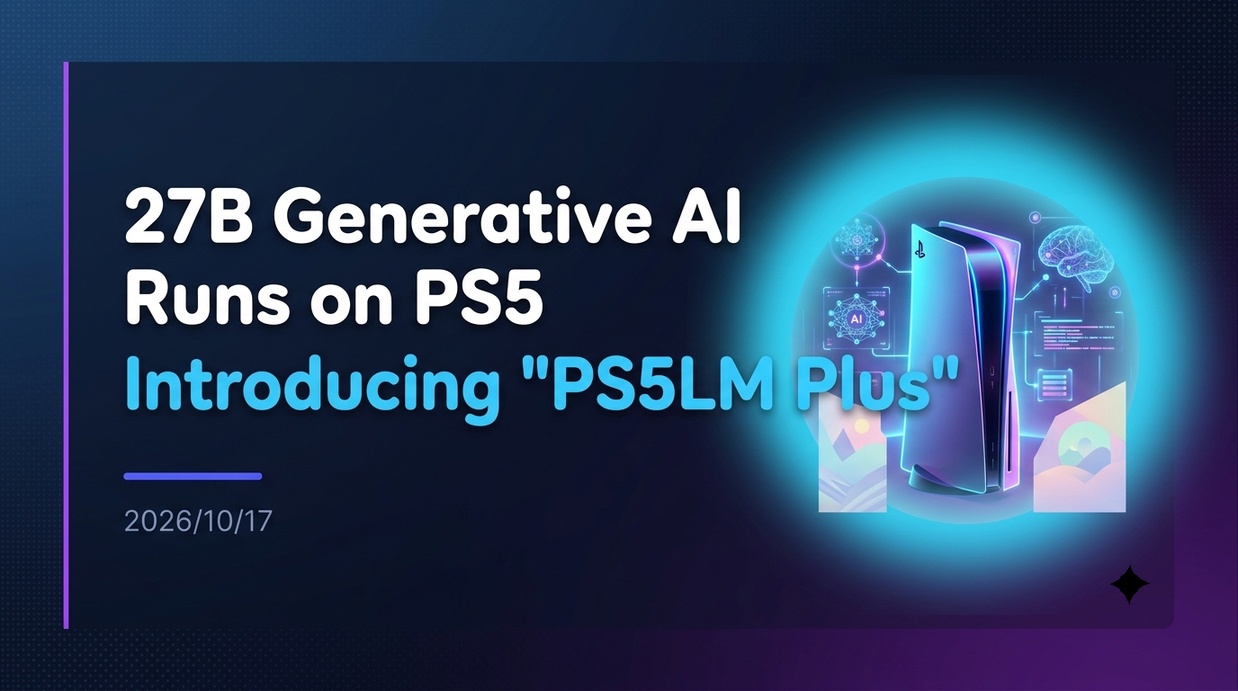
An open-source technology called “PS5LM Plus” has emerged, capable of running a 27-billion-parameter large language model on a modified PlayStation 5. By leveraging the console’s graphics performance and high-speed memory bandwidth, it achieves high-speed AI inference in a local environment.
- Key points of the event where a 27B large LLM ran on a jailbroken PS5
- The Technological Innovations Behind the PS5’s Hardware Architecture and Its GPU-Driven Performance
- Massive Model Compression and Memory Optimization via Quantization Technology
- Setting up a Home AI Server and Generation Speeds of Various Open Models
- Prerequisites for Operation and Current Technical Limitations
- Future Developments and Key Points of Edge AI Utilizing Gaming Consoles
Key points of the event where a 27B large LLM ran on a jailbroken PS5
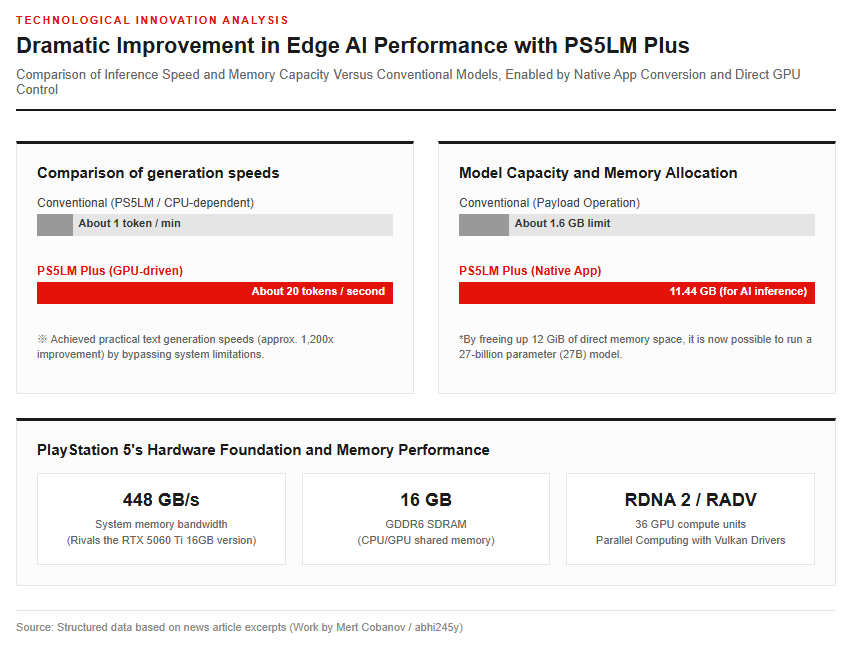
In October 2026, an innovative achievement was reported: the GPU of the home video game console PlayStation 5 (PS5) was harnessed to run “Qwen 3.8 27B,” a large language model (LLM) featuring 27 billion parameters. The initial project “PS5LM,” released by developer Mert Cobanov, ported the LLM execution environment “llama.cpp” to the PS5. However, because it originally operated as a CPU-dependent auxiliary program (payload), processing speeds were limited to roughly 1 token per minute, and the manageable model size was restricted to about 1.6GB. In contrast, a derivative version called “PS5LM Plus,” developed by abhi245y, changed the program’s launch format to a native console application. This breakthrough bypassed system software restrictions, enabling direct control over the rendering GPU and high-capacity memory. As a result, it achieved a practical text generation speed of approximately 20 tokens per second, even while running a massive 27-billion-parameter AI model. This attempt to transform an off-the-shelf gaming console into an advanced edge AI device is drawing intense interest from engineers around the globe as a development that points to new possibilities for hardware utilization.
The Technological Innovations Behind the PS5’s Hardware Architecture and Its GPU-Driven Performance
The reason the PS5 was able to execute advanced AI inference lies in the fact that its internal structure is very similar to a general PC architecture. The PS5’s main processor employs an SoC that integrates an AMD 8-core, 16-thread “Zen 2” CPU and an “RDNA 2”-based GPU equipped with 36 compute units. Furthermore, as system memory shared by the CPU and GPU, it is equipped with 16GB of GDDR6 SDRAM boasting an extremely high bandwidth of 448GB/s. This memory bandwidth is comparable to that of the NVIDIA GeForce RTX 5060 Ti (16GB version), a mid-to-high-end GPU for PCs. In PS5LM Plus, parallel computing is executed on the GPU via the AMD Vulkan driver “RADV,” which was ported for the PS5 by volunteers. While traditional payload operations only granted a memory allocation of about 6GiB and blocked GPU access, turning it into a native application successfully freed up 12GiB of direct memory space, of which 11.44GiB was collectively secured for AI inference on the GPU. The configuration diagram below illustrates how the rendering pipeline inside the PS5 was reconstructed into an AI inference pipeline.
Massive Model Compression and Memory Optimization via Quantization Technology
To fit the large-scale AI model “Qwen 3.8 27B,” which has 27 billion parameters, within the limited memory of the PS5, advanced data compression technology was essential. If the 27B model were maintained in the standard 16-bit floating-point (FP16) format, the weight data alone would require a capacity of about 54GB, making it physically impossible to accommodate even on the PS5, which has a total memory of 16GB. Therefore, PS5LM Plus introduced “quantization” technology, which converts the model’s parameter values to around 2-bit to drastically reduce the amount of information. Through this quantization process, the overall model data size was dramatically reduced to between approximately 6.8GiB and 9.2GiB. The design allocates the model weights to a 11.44GiB GPU-reserved region, while assigning the remaining memory space as a KV cache region to hold conversational context information. Actual verification results showed that even with a long context length of 64k set, it was able to continue outputting long texts of over 7,775 tokens while maintaining a stable generation speed of 19.7 tokens per second. By trimming down the data size to the absolute limit in exchange for a drop in accuracy, the operation of a large-scale AI within the memory constraints of a home gaming console was achieved.
The Practicality and Future Outlook of the PS5LM Plus
Setting up a Home AI Server and Generation Speeds of Various Open Models
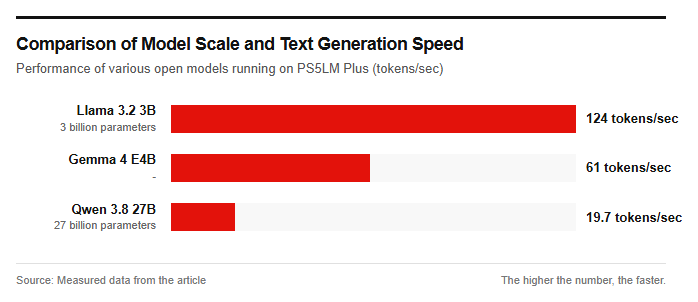
PS5LM Plus is designed not simply to run AI models, but to function as a local AI server within the home network. A dedicated dashboard is displayed on the TV screen to visualize the model loading status and operational state, and users can send questions directly to the AI from the browser of a smartphone or PC connected to the same network. Furthermore, it is equipped with an external connection interface compatible with the APIs of OpenAI and Anthropic, making it possible to send requests to the model on the PS5 from various existing AI tools. The operating speed varies significantly depending on the scale of the model being implemented. While the 27-billion-parameter “Qwen 3.8 27B” achieves a speed of approximately 20 tokens per second, extremely fast text generation has been confirmed for the smaller “Gemma 4 E4B” at approximately 61 tokens per second, and the 3-billion-parameter “Llama 3.2 3B” at approximately 124 tokens per second. The graph below shows a comparison of generation speeds by model scale.
However, since a certain waiting time occurs in prompt processing for reading long input instructions or files, it is necessary to use them selectively according to the purpose of the conversation.
Prerequisites for Operation and Current Technical Limitations
When implementing the PS5LM Plus, it is important to keep in mind that there are several stringent prerequisites and technical risks involved. To run this system, it is necessary to apply a jailbreak process—which enables the execution of unofficial programs—to a PS5 console with a system software version between 7.00 and 13.60. Consoles that have been jailbroken are not only void of the manufacturer’s warranty, but also carry the risk of security vulnerabilities and the danger that the device may fail to boot up properly. Furthermore, because playing the latest game titles on the PS5 requires keeping the system software updated to the latest version at all times, a jailbroken console with updates halted makes it extremely difficult to use the device for its original gaming purpose. On the technical front, there are also limitations such as reduced response accuracy due to 2-bit quantization and initial response delays that occur when inputting long texts. At present, rather than offering convenience-oriented features for average users, it is largely an experimental project by tech enthusiasts and researchers pushing the limits of the hardware.
Future Developments and Key Points of Edge AI Utilizing Gaming Consoles
The achievement of this PS5LM Plus is of extremely high significance in that it has proven that the graphic processing power and high-speed memory possessed by home video game consoles can be repurposed into general-purpose edge AI computing resources. It has demonstrated the possibility of building a local AI environment by utilizing widespread console hardware, without the need to purchase dedicated AI accelerators or expensive graphics boards. Going forward, if further progress is made in software-level optimization and the improvement of quantization algorithms, it will open the path to keeping game consoles resident as private AI hubs within the home, applying them to the secure processing of personal information and smart home control without relying on external servers. Furthermore, in the field of game development, it is expected to have a ripple effect on technologies that locally process autonomous conversation generation for NPCs (non-player characters) and dynamic storyline development without going through the cloud. Although not an official Sony feature, such attempts to rediscover the latent potential of hardware will continue to provide important implications for the future design philosophy of console devices and the development of the edge AI ecosystem.
Reference page
【#GenerativeAI #PS5 #LocalLLM #PS5LM #TechInnovation】

コメント