The free 3D pose creation tool “SetPose,” which requires no login, is attracting attention among digital illustration creators. This is driven by the growing demand for digital support for accurate human drawing and the growing interest in “safe reference materials” that avoid copyright risks associated with the rise of generative AI.
- A new browser-based standard available without login
- Advanced character creation achieved through intuitive controls
- Advances in digital technology overcoming the constraints of physical models
- SetPose’s Standout Position Among Various Similar Apps
- Transparency in training data gives creators peace of mind
- The Boundary Between Tracing and Imitation: How to Use the Right Auxiliary Tools
- Professional extensions offered by paid plans
- The Nature of Design in the Era of Technological Integration and AI Symbiosis
A new browser-based standard available without login
According to a report on June 27, 2026, the 3D drawing doll tool “SetPose,” which runs on a web browser, is attracting creators’ attention. The biggest feature of this tool is that it’s not only free to use, but you don’t need to register an account or log in at all. Users can instantly manipulate 3D models and use them as references for drawing simply by accessing the site. An app version is also available on Google Play, and as of the last update on June 11, 2025, it has recorded over 100,000 downloads.
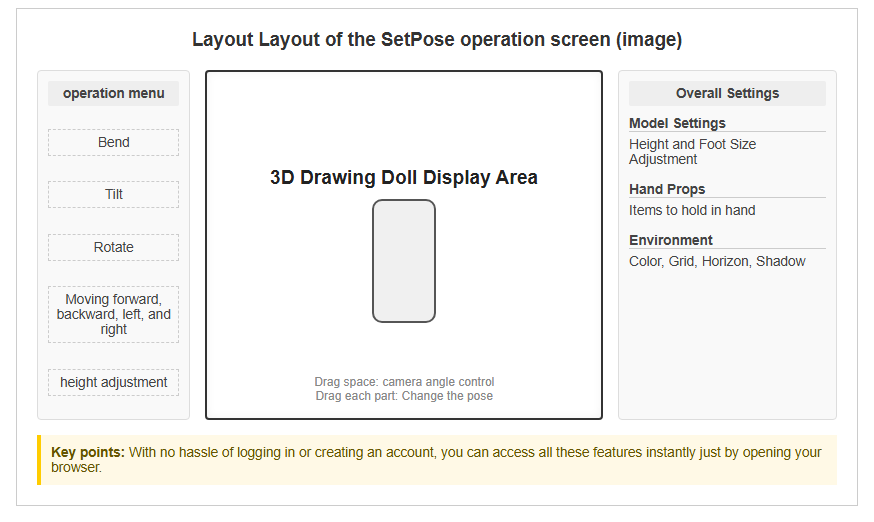
While many traditional 3D posing apps typically required account creation for data storage and advanced features, SetPose is designed with convenience as the top priority—”ready to use whenever needed.” Drawing precise bone structures and anatomical proportions from memory alone is a major challenge for artists of all skill levels. SetPose removes these physical limitations and the cost barriers of expensive wooden models, offering a more flexible and creative drawing experience at an initial cost of about 0 yen. Please refer to the following operation screen.
Advanced character creation achieved through intuitive controls
SetPose’s operation system is very intuitive, designed to be easy to use even for beginners without 3D software knowledge. You can change poses simply by dragging and dropping each part of the 3D drawing doll placed in the center of the screen. The control panel features three main movement selectors: “Bend,” “Tilt,” and “Rotate,” allowing fine-tuning of the model along various axes. Additionally, by dragging through space, you can freely change the camera angle, making it easy to check even compositions with complex perspectives.
Even free users can choose from four models, including the initial “Basic model,” and instantly apply 83 preset poses. From here, you can move your joints further to get closer to your ideal pose. Furthermore, from the prop menu, you can add environmental objects such as chairs, stairs, barbells, and bicycles to the scene, allowing you to create concrete materials to depict interactions between characters and objects. You can also set the items the model holds in both hands, allowing you to strike a pose, which feels like a story, right in the browser.
Comparison with existing creative support tools and the significance of digital drawing dolls
Advances in digital technology overcoming the constraints of physical models
The significance of utilizing 3D models in creative settings lies in overcoming the “gravitational limitations” and “range of motion” that physical drawing puppets. Even dynamic action poses that wooden drawing dolls can’t stand on their own, or compositions that appear floating in midair, can be accurately simulated in digital spaces, including the setting of the horizon and shadows. With SetPose, you can adjust the model’s height and foot size from the settings, as well as toggle the horizon display and grid ON/OFF.
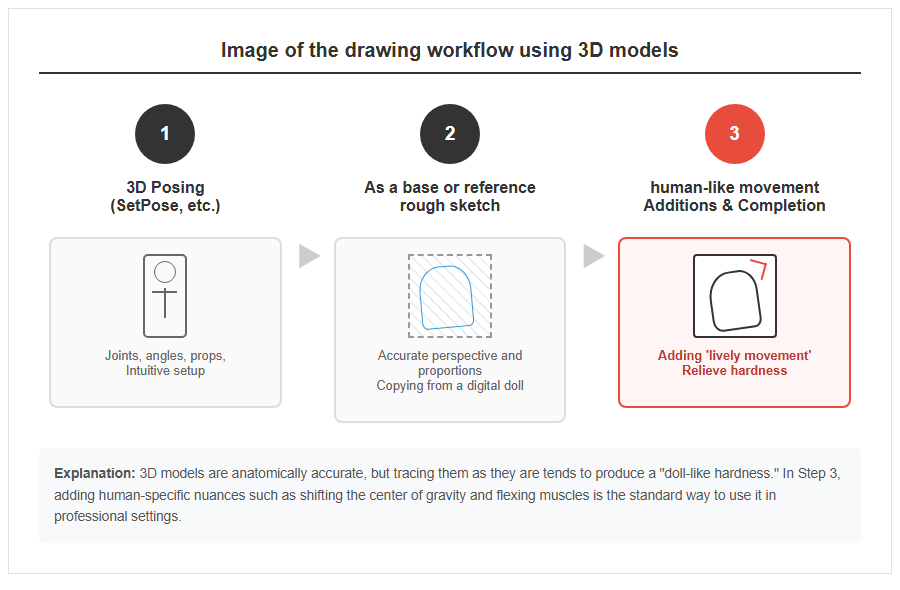
The spread of these digital tools has dramatically changed the way we access drawing materials since the 2020s. In the past, you had to take selfies or buy specialized pose collections, but now you can create your ideal angle in just a few seconds. However, some point out that tracing 3D dolls directly results in stiff and unnatural movements due to differences in body size. Therefore, in professional settings, it is recommended to place the 3D model beside the screen for reference, while adding human-like “living movements” to the final line art. The diagram below shows an image of the drawing process using a 3D model as a reference.
SetPose’s Standout Position Among Various Similar Apps
There are already well-established apps in the 3D posing tool market, such as ‘Magic Pauser,’ ‘Easy Pauser,’ and ‘ArtPose.’ For example, the “Magic Pauser” is widely used by beginners who want to practice drawing without buying drawing dolls, to professionals who want to check angles of multiple figures. Additionally, Celsys’s “CLIP STUDIO PAINT” has built-in 3D drawing figures within the software, allowing them to be placed directly on the drawing screen.
Compared to these competing tools, SetPose’s advantage lies in balancing its overwhelming lightweight weight with the expandability of the “SetPose Pro” plan. SetPose’s paid plans start at about $7 (about 1,100 yen) per month, with annual contracts costing $48 (about 7,700 yen) and one-time plans costing $199 (about 32,000 yen). By registering for the Pro version, the number of preset poses increases to 275, and six special models such as skeletons, bodybuilders, dogs, and horses are added. The fact that basic functions are not restricted to a specific account and can be accessed from any device via a web browser suits the modern nomadic production style.
The Ethics and Value of 3D Tools in Creative Activities in the AI Era
Transparency in training data gives creators peace of mind
In recent years, there have been frequent controversies surrounding “AI tracing” using generative AI in illustration creation. For example, in April 2026, it was discovered that the opening sequence of a popular anime contained generative AI footage, resulting in an unprecedented situation where the footage was replaced. The problem with AI-generated images is that their training data may include unauthorized works by others, making the rights of the output images unclear. For this reason, using AI as material itself carries the risk of backlash.
In contrast, 3D modeling tools like SetPose are provided by developers with clearly stated licenses, making the rights relationships clear. It is generally believed that the poses of 3D models themselves do not incur copyright, but in the case of AI, there is concern about “laundering the rights of original artwork.” The SetPose model is provided by developer August van de Ven, allowing users to confidently trace or reference its shape. This “transparency of rights” is the main reason why 3D tools are being reevaluated during the heyday of AI.
The Boundary Between Tracing and Imitation: How to Use the Right Auxiliary Tools
The use of 3D models is not plagiarism, but rather as ‘materials’ to assist with drawing. From a legal perspective, poses and compositions of the human body are realms of ideas and cannot be monopolized by any particular individual. However, online debates continue over whether AI tracing is bad but 3D tracing is better. This difference comes down to the degree of human contribution in the production process and the legitimacy of the references.
When using SetPose, users manipulate joints themselves to create intended lighting and angles. This process involves the creative act of selecting creators. On the other hand, having AI load someone else’s drawing and extracting only poses can easily provoke emotional backlash if the original creator dislikes being learned. The Patent Office’s research report (March 2025) also states that there are many negative opinions regarding the protection of designs autonomously created by generative AI, emphasizing the need for human involvement. Mastering 3D tools as an extension of “your own eyes and hands” has become the ethical creative standard in the AI era.
Future Developments and Focus: Evolving Posing Technology
Professional extensions offered by paid plans
SetPose plans to expand into more specialized creative fields going forward. The premium plan “SetPose Pro,” priced at $20 per month (about 3,200 yen), offers not only still image posing but also adding animations and import/export 3D files. This allows you to bring the poses you create into other 3D editing software and game engines. It also supports programmatic control APIs, further enhancing its role as a tool for developers.
Furthermore, upcoming tech updates are expected to add facial expressions and implement detailed hairstyle customization features. Currently, many 3D models are inorganic and close to mannequins, but by making them closer to more concrete character designs, it is expected that the efficiency of concept art creation in planning and sales promotions will improve dramatically. In fact, interviews with domestic companies are also considering ways to utilize the product by combining image generation AI with 3D data and checking products with a 360-degree rotating viewer.
The Nature of Design in the Era of Technological Integration and AI Symbiosis
With advances in science and technology, the boundaries between 3D pose creation tools and AI are also changing. In the future, it is predicted that “interactive 3D posing,” where 3D models strike specific poses based on text instructions, as well as intuitive posture control through input using brain activity and eye trackers, will become possible. As pointed out in the Japan Patent Office’s report, a major issue going forward will be how to protect designs with AI-assisted involvement under the Design Act.
In the legal system discussions scheduled for March 2027, more in-depth consideration is expected to be conducted on whether AI-generated designs should be excluded from the citation (grounds for rejection). The “tamper-proof record of the production process” provided by tools like SetPose may serve as strong evidence proving that your creations are based on human intent rather than AI-generated automaton. 3D posing technology will evolve beyond mere drawing assistance tools into a crucial foundational technology for protecting creators’ rights in the AI era.
[#SetPose #3Dモデル #イラスト制作 #デジタルイラスト #AIイラスト #著作権 #科学技術 #3Dデッサン人形]

コメント