Global YouTuber Felix Kjellberg launched his self-hosted AI workspace “Odysseus” on May 31, 2026, with the goal of protecting his privacy and competing against major tech companies. This project aims to reclaim data sovereignty by allowing users to run AI on their own hardware, and has attracted explosive attention, earning tens of thousands of stars on GitHub immediately after its launch.
- The shocking release of “Odysseus” by PewDipai
- The importance of data sovereignty advocated by ‘Local First’
- Multifunctionality as an all-around workspace
- Lowering the barriers to entry: “Cookbook” and hardware management
- The reality of privacy and security vulnerabilities
- Next-generation workflows pioneered by self-hosted AI
The shocking release of “Odysseus” by PewDipai
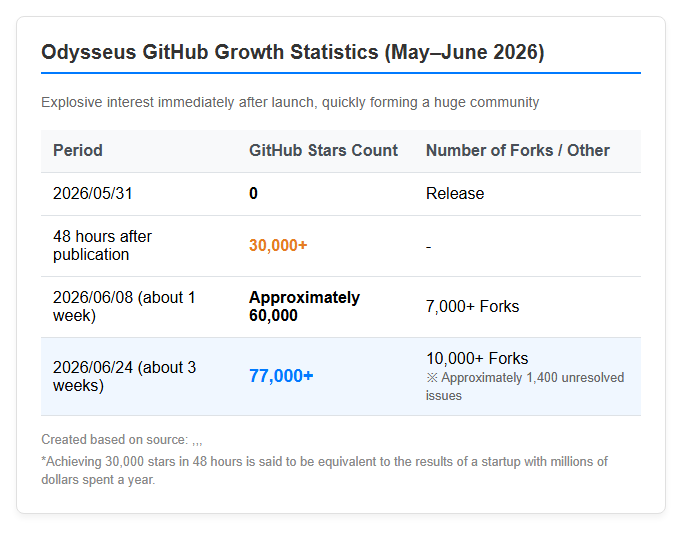
On May 31, 2026, PewDipai, one of the creators with the most followers in the world, released a YouTube video titled “MY trillion $Dollar Project is finally OUT!” and released its self-developed AI workspace, “Odysseus.” This project is available on GitHub as open source software under the MIT license and recorded an astonishing initial launch, earning over 30,000 stars within just 48 hours of launch. At the time of its release, PewDipai declared that “the battle against major tech companies has begun,” advocating for the creation of an AI environment that does not rely on cloud services provided by specific companies. About three weeks after its launch, GitHub surpassed 77,000 stars and more than 10,000 forks, growing into an unusually large community for an individual development project. Please refer to the diagram below.
。
The importance of data sovereignty advocated by ‘Local First’
At the core of Odysseus are three philosophies: local-first, privacy-first, and no telemetry. In traditional cloud-based services like ChatGPT and Claude, input prompts and uploaded document data were typically sent to corporate servers and used for future model training. In contrast, Odysseus is designed to prevent conversations from leaking outside by connecting local models running on users’ own computers. PewDive warns that the more you share your information with AI, the more useful AI becomes, but at the same time, it means handing over a part of yourself to a giant tech company. This project is positioned as a practical solution to reclaim individual data sovereignty, which has been lost at the expense of convenience, back into the hands of users.
Technical Features and Attempts at Practical Application
Multifunctionality as an all-around workspace
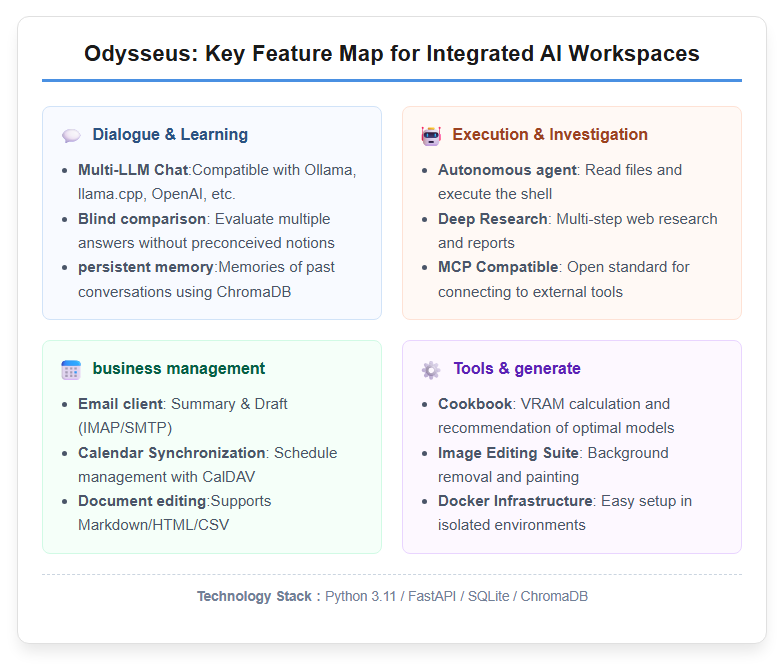
Odysseus is not just a chatbot, but is designed as an integrated workspace to complete daily tasks and creative tasks. Key features include Agent Mode for autonomously performing tasks, “Deep Research” that integrates multiple web sources to generate reports, and an email client that can connect via IMAP/SMTP. The agent function is based on OpenCode, allowing you to execute shell commands, read and write files, and access the web. Additionally, the Deep Research feature applies technology from Alibaba’s Tongyi DeepResearch, allowing AI to handle complex investigations. Additionally, it comes with an editing suite featuring image generation, background removal, and inpainting, as well as calendar synchronization, all of which can be managed on a single screen—its biggest strength. Please refer to the diagram below.
。
Lowering the barriers to entry: “Cookbook” and hardware management
To address the biggest barrier for local AI—”which models run on your own PC”—Odysseus offers a unique solution called “Cookbook.” This is a recommendation engine based on llmfit, developed by GitHub developer Alexs Jones, which automatically scans the user’s hardware, calculates VRAM (video memory) capacity, and suggests the optimal model. You can download from over 270 model catalogs with one click and support quantization formats such as GGUF, FP8, and AWQ. The developer, PewDipai himself, has tested it on a high-performance rig costing about $41,000 with eight RTX 4090 GPUs, and with the Cookbook, regular gaming PC users can choose the optimal model for their environment. The entire system is built with Python 3.11 and FastAPI, and by using Docker, the effort required to build the environment is significantly reduced.
Challenges Faced and Future Outlook
The reality of privacy and security vulnerabilities
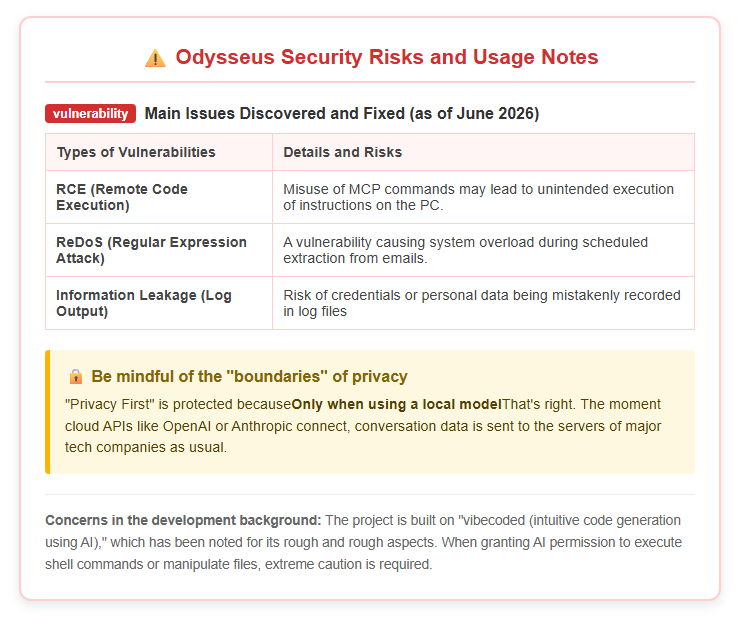
It is important to note that the privacy protection provided by Odysseus is limited to using local models. The moment you connect to OpenAI or Anthropic’s API for convenience, the data is sent back to those companies’ servers, and the promise of privacy is lost. Additionally, this project has been described as “vibecoded,” meaning it was rapidly built by having AI write code, and security flaws inherent in its development methods have also been pointed out. In the early version, vulnerabilities such as remote code execution (RCE) for MCP (Model Context Protocol) commands, ReDoS vulnerabilities in scheduled extraction from emails, and credential leakage risks were discovered in logs. Many of these issues have been addressed sequentially after community feedback, but due to the nature of tools that grant file access to AI agents, careful security management is still required when using them. Please refer to the diagram below.
。
Next-generation workflows pioneered by self-hosted AI
The emergence of Odysseus is more significant than a technological innovation, as it is a “political act” that presented the concept of AI self-hosting to millions of ordinary users. Local AI, which had previously remained a hobby for engineers and a few enthusiasts, has been pushed into the general public by the influence of global influencers. Going forward, as integration of the latest lightweight and high-performance models like Google Gemini and Gemma 4 advances, it is possible to deliver experiences comparable to cloud services on your device. Currently, GitHub has nearly 1,400 issues, and active community maintenance is ongoing. This move to nurture “AI for oneself” that is not controlled by any particular company suggests a new form of AI utilization, where AI evolves from a mere tool into a “partner” with a unique role.
[#AIワークスペース #Odysseus #ピューディパイ #ローカルLLM #オープンソース #プライバシー #セルフホスト #データ主権]
コメント