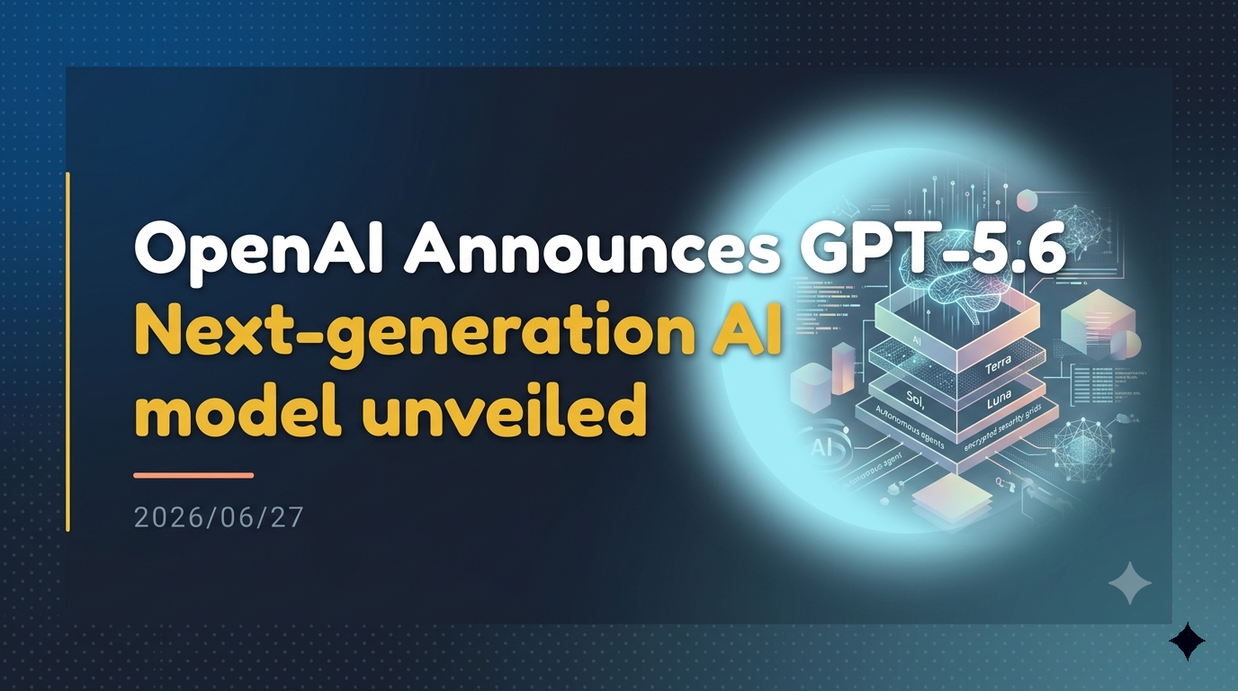
OpenAI announced its next-generation AI model, GPT-5.6, and has begun a limited release to certain partner companies at the request of the U.S. government. Behind this are security concerns arising from AI evolving into agents with autonomous execution capabilities, as well as aggressive pricing strategies aimed at reclaiming market share.
- Background of Limited Preview Launches and Government Intervention
- Three model lineups reorganized by ability
- The ‘Hands-on Execution’ that enables browser operation and visual replication
- Context of 1.5 million tokens and advanced inference mode
- Strategic pricing that outpaces competing models
- IPO Delay and Massive Impact on the Investment Market
- National Security and the Normalization of ‘Pre-Release Reviews’
- Schedule and Technical Hurdles for Public Offering
Background of Limited Preview Launches and Government Intervention
On June 26, 2026, OpenAI officially announced the next-generation large language model series, the GPT-5.6 series. However, breaking the previous practice of immediate public release, this time the preview is being offered limited to about 20 “trusted partners” at the strong request of the U.S. government (Trump administration). While availability to general users is expected within a few weeks, this phased release raises serious security concerns.
U.S. government authorities are wary of the risks of the advanced reasoning abilities of cutting-edge AI and the misuse of expertise in cybersecurity and biology. In particular, government agencies such as the Office of the National Cyber Directorate have led the introduction of a process to pre-evaluate the model’s capabilities before publication. CEO Sam Altman expressed concern that such government intervention should not become the long-term standard, but currently expressed a cooperative stance, stating that this is the “strongest path.” During the limited preview period, the government will operate a system where each customer individually approves access permissions.
Three model lineups reorganized by ability
GPT-5.6 introduced a new naming system and hierarchical structure to help users optimize the balance of intelligence, speed, and cost according to their needs. The lineup consists of three models: Sol, Terra, and Luna. The top-tier “Sol” is smarter and more efficient than the previous flagship GPT-5.5, while remaining price-stable—the highest-performing model in OpenAI’s history.
Meanwhile, the balanced “Terra” maintains performance comparable to GPT-5.5 while cutting costs in half, making it easy to implement in everyday business operations. Luna is a fast, low-cost model specialized for large-scale batch processing and simple tasks, pursuing overwhelming cost performance in API usage. By clearly dividing the model by role, companies and developers can now select the optimal “intelligence level” for specific projects. Please refer to the diagram below.
Evolution into AI Agents and Dramatic Improvements in Practical Capabilities
The ‘Hands-on Execution’ that enables browser operation and visual replication
The biggest feature that sets GPT-5.6 apart from conventional models is its ability to operate the computer itself through “Agent execution.” Within the developer community, this evolution is described as “AI getting the hand.” Specifically, the browser opens automatically, allowing agents to autonomously perform physical operations such as clicking, text input, and page transitions.
Furthermore, it was equipped with powerful “visual replication capabilities.” This allows AI to seamlessly execute the entire process—from website design proposals and image data to generating executable source code (such as React or SVG 3D objects) and saving them to the desktop. While traditional AI was a “tool that provided answers,” GPT-5.6 has evolved into an “agent that completes actual tasks.” This dramatic improvement in capabilities holds the potential to fundamentally rewrite workflows for creative roles and engineers.
Context of 1.5 million tokens and advanced inference mode
In terms of technical internal specs, GPT-5.6 has recorded astonishing figures. The context window has been expanded by nearly 50% from the traditional 1 million tokens to 1.5 million tokens, enabling the handling of larger codebases, thousands of pages of documents, and multi-stage complex workflows all at once. Additionally, token processing efficiency has improved by 10% to 15%, allowing more tasks to be completed within the same budget.
The flagship “Sol” model introduced new inference modes: “max” and “ultra” modes. Max mode addresses scientific analysis and mathematical problems requiring deeper logical thinking, while Ultra mode dynamically generates and utilizes multiple sub-agents within the model, accelerating complex projects in parallel. On advanced benchmarks such as Terminal-Bench 2.1 and ExploitBench, it has achieved scores that surpass competitors like Anthropic’s models, with just one-third of the token consumption.
Intensifying price competition and its spillover effects on the market
Strategic pricing that outpaces competing models
With the launch of GPT-5.6, OpenAI has launched a “price war” to monopolize industry share. In response to Anthropic’s biggest competitor, Anthropic’s “Claude Fable 5,” which had raised its reputation with high engineering capabilities, GPT-5.6’s token price was set at a highly strategic level—about one-third of Fable 5. The specific API price is $5 for input and $30 output per 1 million tokens for the top-tier “Sol,” Along with the revamped prompt cache function, the goal is to significantly reduce effective costs.
Behind this pricing strategy is the aim to lock corporate customers onto its own platform at the cost of cutting profit margins, thereby weakening the brand power of other companies’ high-end models. By securing a performance advantage while overwhelmingly outperforming competitors in terms of cost, OpenAI aims to solidify its leadership in the enterprise AI market. In the market, there is also a view that this aggressive pricing is squeezing the revenues of other AI vendors and accelerating the industry-wide elimination.
IPO Delay and Massive Impact on the Investment Market
Alongside technological advancements, OpenAI’s management decisions are shaking global financial markets. The company has begun considering postponing its initial public offering (IPO) scheduled for 2026 to 2027 to maintain its target valuation of $1 trillion (approximately 161.8 trillion yen). CEO Sam Altman has rejected proposals that fall even slightly below the $1 trillion valuation, and this bullish stance has spread through the market.
Following this report, the stock price of SoftBank Group, OpenAI’s major investor, plummeted by more than 13% at one point on the Tokyo market on June 26, causing its market capitalization to lose about 1.2 trillion yen in a single day. SoftBank Group has invested over $65 billion cumulatively in OpenAI, and the market’s disappointment was great, as it had hoped for unrealized gains from the IPO. Amid growing concerns over massive losses in AI development and delays in recovering investments, OpenAI’s IPO strategy has become a key factor shaping overall sentiment among tech stocks. Please refer to the diagram below.
A New Era of AI Governance and Future Prospects
National Security and the Normalization of ‘Pre-Release Reviews’
The release model of GPT-5.6 clearly demonstrated that cutting-edge AI has transformed from a “convenient app” to a “national security object.” This time, the U.S. government’s direct intervention in the public release schedule and the restriction of limited previews to about 20 companies set a significant precedent for the AI industry. Until now, the release of new models was left to corporate discretion, but now they are shifting to operations based on coordination with the government, that is, involving “pre-release reviews.”
This move is linked to the case of Anthropic, which was previously regulated, signaling the dawn of an era where AI is managed as a strategic national resource based on nationality and usage purposes. OpenAI argues that such access restrictions should not become a long-term standard, but the development of legally enforceable voluntary frameworks is underway, and balancing regulatory compliance with development speed will become a new competitive advantage for companies.
Schedule and Technical Hurdles for Public Offering
The opening of GPT-5.6 to general users is scheduled to take place within a few weeks, following safety evaluations during the preview period. OpenAI is working with governments and industry to establish a repeatable evaluation process for future model releases. As usage records by early limited partners accumulate, it is expected that concrete results in cyber defense and business automation will be reported.
On the other hand, the developer community has expressed a somewhat skeptical perspective. As indicated by the version number 5.6, this is a minor update aimed at the true next-generation model GPT-6, which will reach trillions of parameters. While there are voices eagerly awaiting a true model-level breakthrough, the impact of the implementation of this “Agent Execution Capability” on practical operations is immeasurable. The process of AI becoming integrated into social infrastructure as a ‘working colleague’ rather than just a ‘tool for answering’ will continue to accelerate.

」_en.png)
コメント