While SK hynix is considering memory production in the United States, such as utilizing Intel’s factories or building a NAND plant, challenges regarding semiconductor industry collaboration and economic security among Japan, the U.S., and South Korea are coming to the surface. Coupled with U.S. tariff pressures, disparities in subsidies across countries, and stock market fluctuations driven by caution over AI investments, the restructuring of supply chains is underway.
- Utilization of Intel Factories and Establishment of HBM Back-end Processing Hubs
- US Pressure and Equipment Delivery Issues at the Dalian, China Plant
- Rapidus’s Next-Generation 2nm Mass Production and International Consortium
- The Subsidy Disparity and the Divergence in Economic Security Between Japan and the U.S.
- Market Risks Seen in Skepticism Toward AI Investment and the KOSPI Plunge
- Future Outlook and Restructuring of the Global Supply Chain
Utilization of Intel Factories and Establishment of HBM Back-end Processing Hubs
South Korean semiconductor giant SK Hynix is considering the direct production of memory semiconductors in the United States for the first time through cooperation with US-based Intel. Specifically, plans have emerged to lease a portion of a massive 4,046,856-square-meter semiconductor campus owned by Intel in Ohio, USA, or to establish a joint venture (JV) in collaboration with major cloud service providers. The Ohio plant is a large-scale hub capable of accommodating up to eight fabs. Intel initially anticipated an investment on the scale of $100 billion, but construction was postponed due to the company’s poor financial performance, aligning the interests of both parties. Additionally, SK Hynix is already proceeding with the construction of an advanced packaging facility for High Bandwidth Memory (HBM) in West Lafayette, Indiana, investing approximately $3.87 billion (approx. 600 billion yen). This Indiana plant is projected to begin commercial production of the next-generation HBM4E product in the latter half of 2029, with plans to incrementally increase annual wafer production capacity. Securing a front-end (wafer fabrication) base in addition to the local back-end (packaging) facility in the US would complete a vertically integrated supply system. Please refer to the figure below.
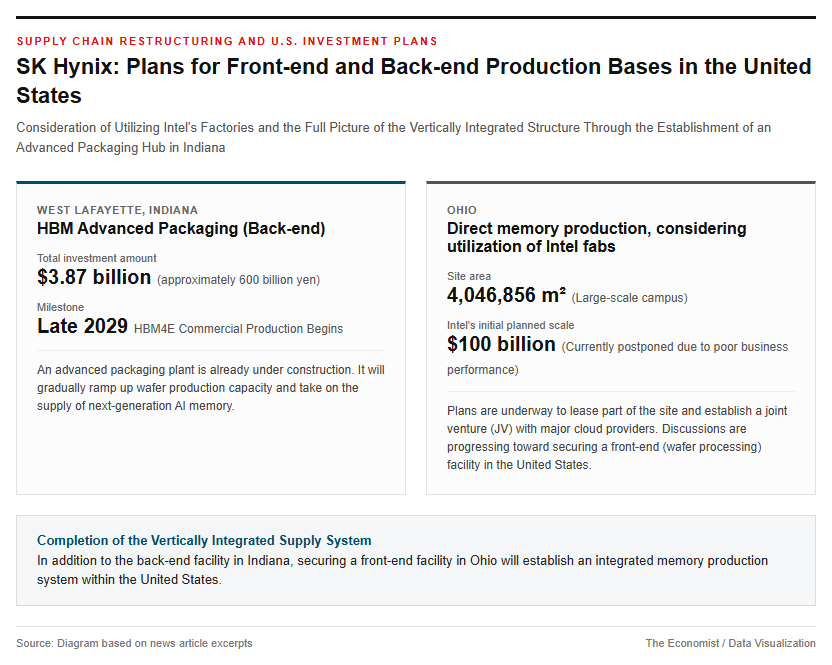
This series of investment plans is positioned as a crucial strategic move to meet the surging demand for artificial intelligence (AI) while responding to the expectations of the local market, which has strongly called for the establishment of an advanced memory supply chain within the United States.
US Pressure and Equipment Delivery Issues at the Dalian, China Plant
Behind SK hynix’s rapid promotion of front-end and back-end investments in the United States lies strong trade pressure from the US administration. US Commerce Secretary Howard Lutnick has warned that overseas semiconductor manufacturers in South Korea, Taiwan, and elsewhere could face tariffs of up to 100% if they do not significantly expand their production capacity within the US, forcing the company to avoid the risk of high tariffs. Furthermore, Solidigm, a US subsidiary under SK hynix, is considering building a new NAND flash memory plant in northern New York State. Solidigm was established in 2020 when SK hynix acquired Intel’s NAND business for $9 billion, but it is currently engaged in high-stakes negotiations with US authorities regarding the production environment at its Dalian plant in China. Specifically, the company is reportedly presenting the acquisition of permission from the US Department of Commerce to import and install US-made manufacturing equipment from Lam Research, Applied Materials, and KLA into Mod B—an unused space at the Dalian plant—as a condition for building the new US factory. Because the US government has been tightening export controls on semiconductor equipment to China from a national security perspective, the company is seeking a balance between maintaining operations at its Chinese hub and making new capital investments in the US. Meanwhile, South Korea’s Ministry of Trade, Industry and Energy has indicated its stance on conducting rigorous legal reviews under the Industrial Technology Protection Act regarding the transfer of production overseas, as HBM and advanced DRAM technologies are designated as “National Core Technologies,” requiring the company to carefully navigate between corporate decisions and the defense of its home country’s technology.
The Landscape of Japan-U.S. Semiconductor Industrial Policies and International Collaboration
Rapidus’s Next-Generation 2nm Mass Production and International Consortium
Rapidus, Japan’s next-generation semiconductor project, was established in August 2022 and is rapidly advancing the construction of its first plant (IIM-1) and the establishment of an advanced manufacturing infrastructure at Chitose Bibi World in Chitose City, Hokkaido. Rapidus has set a goal to establish mass production for advanced logic semiconductors with a process node of 2nm or less by March 2027, and in July 2025, it successfully prototyped and verified the operation of 2nm-node Gate-All-Around (GAA) transistors. Rather than developing the technology independently from scratch, the company has adopted an international collaborative framework by licensing 2nm technology from the U.S. IBM Albany NanoTech Complex, participating in the core partner program of Belgium’s international research organization imec, and leveraging EUV lithography technology and advanced pilot lines. Additionally, it has successively announced joint developments with global companies such as Canada’s Tenstorrent, as well as U.S.-based Synopsys and Cadence Design Systems. On the financial front, in addition to investments from 32 private companies including Toyota Motor, Sony Group, and SoftBank, the company has received massive financial support and investment totaling over 1 trillion yen from the Japanese government, the Ministry of Economy, Trade and Industry (METI), NEDO, and IPA. In February 2026, an additional public-private investment of 267.6 billion yen was announced, establishing a structure in which the government becomes the largest shareholder and holds a veto-wielding golden share. Rapidus is not merely aiming for the “revival of Hinomaru semiconductors,” but has become a critical hub responsible for diversifying supply chains among Japan, the U.S., and Europe to address geopolitical risks.
The Subsidy Disparity and the Divergence in Economic Security Between Japan and the U.S.
As the competition for dominance in the semiconductor industry intensifies, disparities in government incentive policies are having a major impact on companies’ site selection. South Korea’s subsidy system is capped at a maximum of 30 billion won (approximately $23 million) per project, amounting to less than 0.1% of fab investment costs that reach tens of trillions of won. In contrast, under the CHIPS Act, the U.S. government has provided approximately $458 million—equivalent to 12% of the total investment—as a direct subsidy for SK Hynix’s Indiana plant, while the Japanese government has provided extremely generous subsidies ranging from 35% to 49% of installation costs for TSMC’s Kumamoto plant, Micron, and others. This gap in incentives is a key factor driving South Korean companies to consider investments in the U.S. and Japanese markets.
On the other hand, a “gap” also exists in the stances regarding economic security policies between allies Japan and the United States. Against the backdrop of “inter-system competition” aimed at curbing the growth of China’s semiconductor industry as a whole, the U.S. is tightening comprehensive and irreversible regulations against China, encompassing both technology and personnel. In contrast, although Japan tightened export controls on 23 items such as film deposition and lithography equipment in July 2023, it prioritizes the maintenance of the free trade system and the economic rationality of its domestic companies, operating under its own framework that does not single out specific countries. Japan’s exports of semiconductor manufacturing equipment to China account for roughly 40%, and the country continues to make delicate adjustments to avoid delivering an excessive blow to its domestic industry while maintaining security cooperation.
Semiconductor Market Fluctuations and Medium- to Long-Term Outlook
Market Risks Seen in Skepticism Toward AI Investment and the KOSPI Plunge
While global semiconductor production increases and capital investments are rapidly progressing, growing doubts in the market regarding the sustainability of artificial intelligence (AI)-related investments are causing severe turbulence in financial markets. On October 15, 2026, South Korea’s Seoul stock market benchmark, the Korea Composite Stock Price Index (KOSPI), plummeted 7.57% from the previous day to 5,554.22, marking a low of about six months. During trading hours, the decline temporarily expanded to 9.29%, triggering a circuit breaker that temporarily halted trading for 20 minutes. Semiconductor giants Samsung Electronics’ stock price plummeted by 9.5% and SK Hynix’s by 11.1%, with net selling by foreign investors reaching the scale of 3.6 trillion won (approximately 420 billion yen). Along with expectations of additional interest rate hikes driven by US inflation indicators, doubts on the real economy side—specifically whether massive investments in AI infrastructure will lead to actual revenue growth—are considered factors that dragged down stock prices. Furthermore, structural supply concerns have also emerged. According to a research report compiled by Bank of America (BofA), it has been pointed out that SK Hynix’s new production capacity up to 2028 may remain at just one-sixth of the original plan. This is due to a combination of factors, including temporary production gaps accompanying the scrap-and-build of older-generation plants, the prolongation of new plant construction periods to 10 years, and unready infrastructure such as power and water resources. In addition, in the United States, a class-action lawsuit has been filed against Samsung, SK Hynix, and Micron regarding coordinated production cuts and price fixing of legacy DRAM citing the transition to HBM, thereby expanding legal risks as well.
Future Outlook and Restructuring of the Global Supply Chain
The global semiconductor industry is facing both uncertainties of avoiding geopolitical risks and cyclical market fluctuations, reaching a phase where mid-to-long-term restructuring is essential. Threats of up to 100% tariffs by the Trump administration in the U.S. and demands for local production are transforming the structure of the semiconductor manufacturing supply chain, which has traditionally relied on Asia. SK Hynix’s plan to lease an Intel fab in the U.S., the construction of Solidigm’s NAND plant, and the development of an HBM packaging facility in Indiana are attempts to complete a vertically integrated manufacturing base on U.S. soil. Meanwhile, in Japan, centered around Rapidus’s 2nm mass production plan, efforts are underway to establish an advanced logic manufacturing base domestically through partnerships with major overseas technology partners such as IBM and imec. Please refer to the figure below.
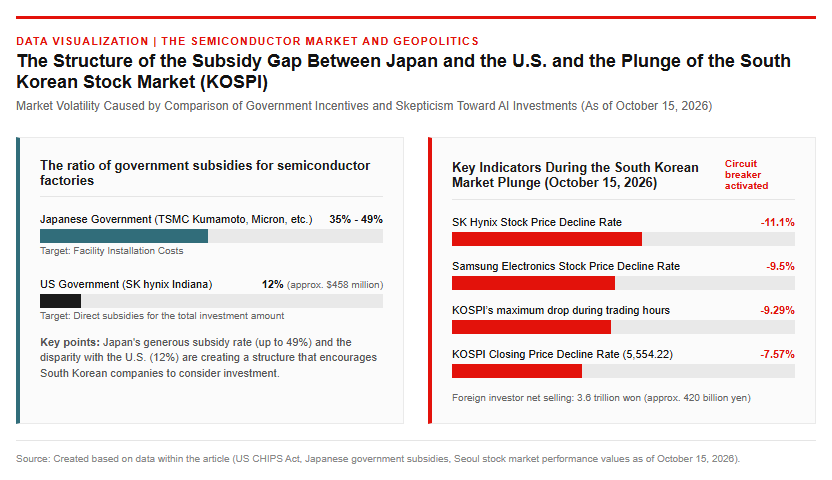
As points of focus moving forward, first is the balance between the South Korean government’s screening of “national core technologies” and overseas investment by companies, raising the question of whether international competitiveness can be maintained while preventing technology leakage. Second is the continuity of massive subsidies provided by various governments and the speed at which practical bottlenecks—such as prolonged factory construction and shortages of power and infrastructure—are resolved. Third is the progress of the monetization of AI investments in the market and the adjustment of production capacity by various companies toward stabilizing supply and demand for memory. How to build a resilient and flexible decentralized supply chain while deepening economic security cooperation among allied nations holds the key to the future stability and sustainable growth of the global economy.
Reference Page
- [Rapidus Official Website] https://www.rapidus.inc/
[#Semiconductors #SKHynix #Rapidus #EconomicSecurity #AIInvestment #SupplyChain #USEconomy]
コメント