Christoph Fouke, CEO of ASML, a major Dutch semiconductor manufacturing company, expressed strong concern and criticism over the EU’s direct intervention in the semiconductor supply chain and the exercise of emergency authority. Behind this is a pressing concern that enforcing protectionist policies amid insufficient industrial infrastructure in the region could actually undermine the international competitiveness of European companies.
- Business rigidity caused by control by emergency authority
- The slogan “Europe First,” which does not reflect the realities of the European market
- Investment speed and licensing delays lag behind those in Asia
- EUV Production Expansion Plan to Meet AI Demand and Transformation as an Investor
- A dual strategy seen in the US-led participation in Pax Silica
- Protecting Champion Companies and Fostering Regional Supply Chains
- The temperature gap between the US and Europe over China regulations and the direction of supply chains
Business rigidity caused by control by emergency authority
The European Commission’s European Technology Sovereignty Package, announced on June 3, 2026, includes Chips Act 2.0, which includes powers to enforce supply adjustments in emergencies. In response, ASML CEO Christophe Fouke issued a clear warning to refrain from direct government monitoring and intervention in the supply chain. Mr. Fouke asserts that the semiconductor supply chain is too complex to be managed or operated by organizations like committees. Please refer to the diagram below.
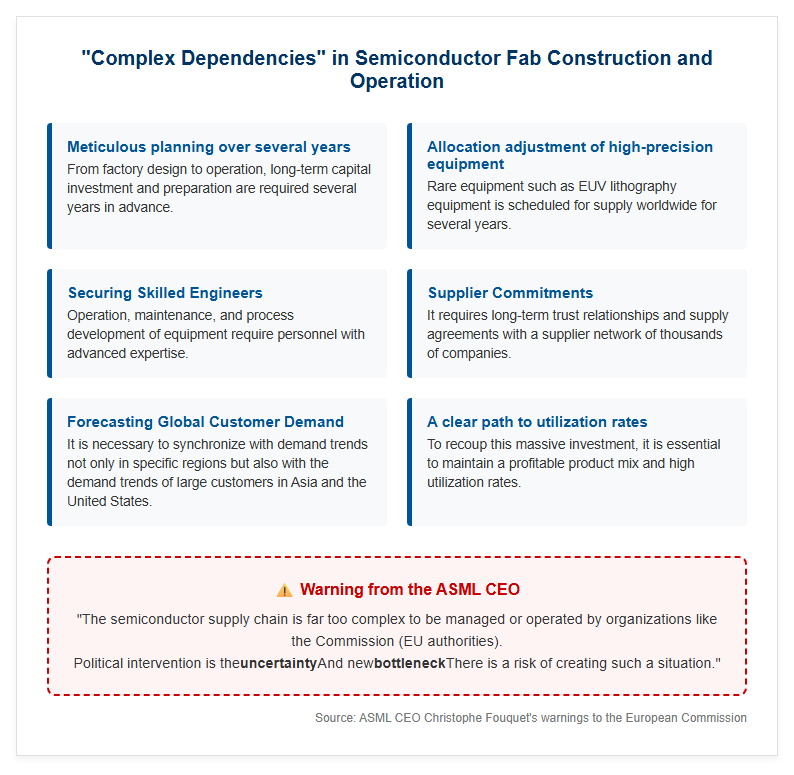
In particular, for the extreme ultraviolet (EUV) lithography equipment essential for cutting-edge chip manufacturing, ASML is the sole supplier worldwide, and its allocation has been scheduled for several years based on long-standing plans with foundries worldwide and customer demand. They argue that politically driven attempts to manipulate the destination of these devices could create uncertainty for chipmakers who require long-term timelines and massive capital investments, potentially becoming bottlenecks that slow down investment that Europe originally wants. Replacing free market adjustments with administrative controls risks stagnating, rather than accelerating the construction of Europe’s AI economy.
The slogan “Europe First,” which does not reflect the realities of the European market
Some EU member states, especially France, are promoting the introduction of Buy European clauses in public procurement, which prioritize the purchase of European products. However, while Mr. Fouquet praised this philosophy as admirable, he pointed out the harsh reality that Europe currently lacks competitive regional products that should be prioritized for purchase. Currently, Europe accounts for only 1% of ASML’s total sales. In contrast, the Asian market accounts for 80% of total sales, and this extreme imbalance places ASML in a strategically vulnerable position. Please refer to the diagram below.
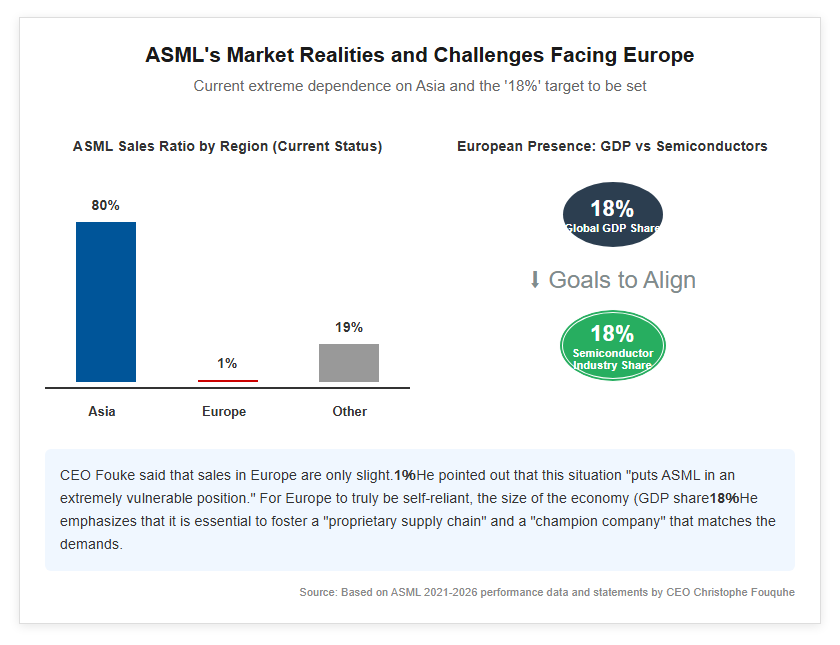
While the essence of business lies in close collaboration with customers, many of its major clients—TSMC, Samsung, Intel—have manufacturing bases concentrated in Asia and the United States, so ASML is physically drawn to those regions. If Europe truly aims for independence, it argues that rather than adopting ineffective protectionist slogans, it is first to nurture many champion companies across the semiconductor pipeline and implement concrete measures to raise Europe’s share of the global semiconductor industry to 18%, which matches its current GDP share.
[Management and Strategy Background] Institutional barriers and geopolitical decisions hindering growth
Investment speed and licensing delays lag behind those in Asia
Mr. Fouke analyzes that what hinders the expansion of the semiconductor industry in Europe is more complex bureaucracy and institutional barriers than a lack of political will. A concrete example cited is the overwhelming difference in the time required to build factories. Due to land use regulations and complicated licensing procedures, it takes about four years to build a new semiconductor factory in Europe. This is a significantly longer and fatal delay in the semiconductor industry, where the speed competition is fierce compared to major regions in Asia. Please refer to the diagram below.
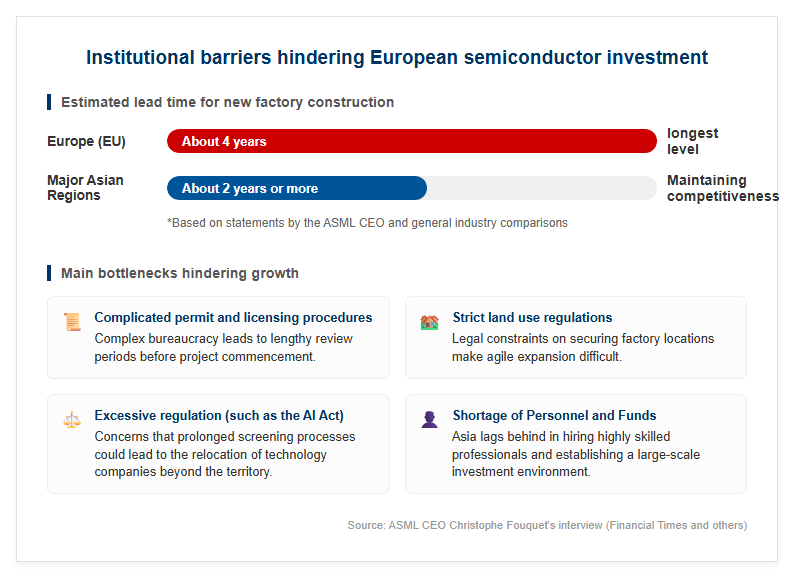
Furthermore, the European environment is a factor limiting companies’ growth in terms of hiring highly specialized talent, employee training, expanding local supplier networks, and securing financing mechanisms. Regarding the EU’s AI regulation (AI Act), ASML points out that the lengthy review process is one of the barriers preventing technology companies from expanding. To prevent promising startups from relocating abroad due to regulations, they emphasize that creating a more business-friendly and agile development environment is more urgent than the establishment of emergency authorities.
EUV Production Expansion Plan to Meet AI Demand and Transformation as an Investor
While geopolitical frictions persist, demand for advanced semiconductors driven by the AI boom remains robust. ASML has raised its full-year sales forecast for 2026 from 34 to 39 billion euros to 36 to 40 billion euros (approximately 42 to 47 billion dollars). To address this, the company has announced plans to increase the production capacity of its flagship EUV equipment to 60 units in 2026, a 25% year-on-year increase, and to 80 units in 2027. We will continue to expand our business near Feldhofen, where our headquarters in the Netherlands are located, and plan to increase production of the latest EUV equipment by 50% just this year.
Moreover, ASML is strengthening its role as a strategic investor supporting the European technology ecosystem, going beyond mere equipment manufacturers. To date, we have made strategic investments in the French AI development company Mistral and the German optical equipment giant ZEISS. This is part of a voluntary initiative to strengthen supply chains within the region and enhance technological autonomy across Europe. Mr. Fouke emphasizes that these privately led investments and partnerships benefit not only companies but the interests of Europe as a whole.
A dual strategy seen in the US-led participation in Pax Silica
On June 23, 2026, the Dutch government made a dramatic announcement of its official participation in Pax Silica, a US-led AI supply chain alliance. This is a multilateral cooperation mechanism that brings together minerals, infrastructure, and advanced equipment necessary for AI chip manufacturing under U.S. security assets. With the Netherlands joining South Korea and Japan, the US-led technical barrier against China has become even more formidable. However, this announcement coincides with the Dutch Trade Minister’s visit to Washington to oppose the new U.S. export control plan, the MATCH Act, highlighting a complex dual strategy. Please refer to the diagram below.
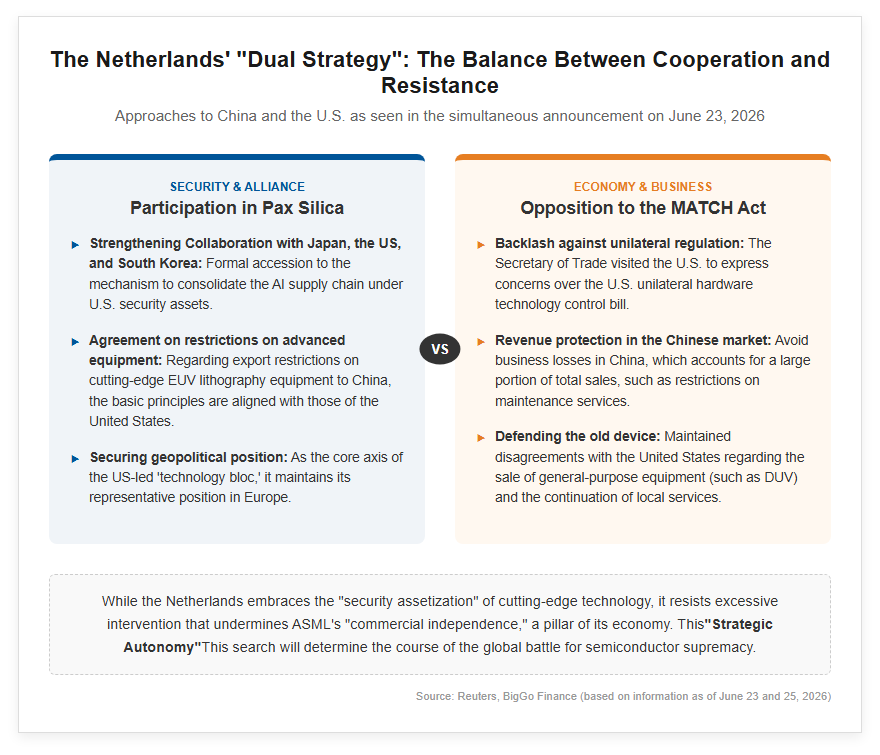
Although the Netherlands and ASML have agreed on basic principles with the United States regarding export restrictions on cutting-edge equipment, they still have disagreements regarding maintenance services and sales scope for older equipment. The Netherlands faces a very difficult steering wheel, balancing its economic intention to minimize sales losses in the Chinese market and its geopolitical decision to maintain cooperation with the United States and ensure economic security. China strongly opposes this move, arguing that the U.S. hegemonic actions violate international trade rules and undermine the stability of global supply chains.
[Future Outlook] Rebuilding the European Semiconductor Ecosystem and Key Issues
Protecting Champion Companies and Fostering Regional Supply Chains
The future focus will be on how the EU can protect and nurture existing champion companies like ASML. CEO Fouke has repeatedly stated that protection is more important than government intervention for Europe to maintain global leadership. Specifically, there is a need to create a more attractive and competitive investment environment that can counter massive public support such as the US CHIPS Act and China’s Big Fund. ASML has maintained its advantage by building its own coexistence and co-prosperity network (technology salons) through partnerships with Carl Zeiss and utilizing open innovation through imec, but the key is whether this can be expanded as an ecosystem across Europe.
The new European semiconductor-related bill, scheduled to be presented by summer 2025, is considering more flexible funding for chip design and capital investment. Harnessing the vitality of the private sector while understanding the needs of major companies like ASML, while avoiding excessive control, is the only way to balance Europe’s technological autonomy with economic prosperity. Attention is focused on how Mr. Fouke’s advice will be reflected in policy, and how Europe can build effective supply chains that are independent of Asia and the United States.
The temperature gap between the US and Europe over China regulations and the direction of supply chains
The medium- to long-term focus is the alignment between the U.S.-led containment of China and ASML’s commercial interests. By joining Pax Silica, the Netherlands has strengthened its commitment to security, but for ASML, completely abandoning the huge economic incentive of the Chinese market is not easy. How much European countries will align with unilateral regulatory proposals like the Match Act being discussed in the U.S. Congress will be a major variable going forward. If regulations tighten, there is a risk that independent manufacturers such as SMEE (Shanghai Microelectronics) will rapidly grow domestically in China, potentially reducing ASML’s dependence on lithography equipment in the future.
Furthermore, the cooperation framework formed by the Japan-US-Europe alliance of volunteer countries is important not only to strengthen regulations but also to realize the extent of synergy in the joint development and standardization of next-generation technologies (devices below 2nm and high NA EUV). As geopolitical boundaries become clearer, how will the advanced international division of labor within the semiconductor industry be redefined? Whether ASML can maintain its exclusive leadership at its core will determine the outcome of the global battle for semiconductor supremacy.
コメント