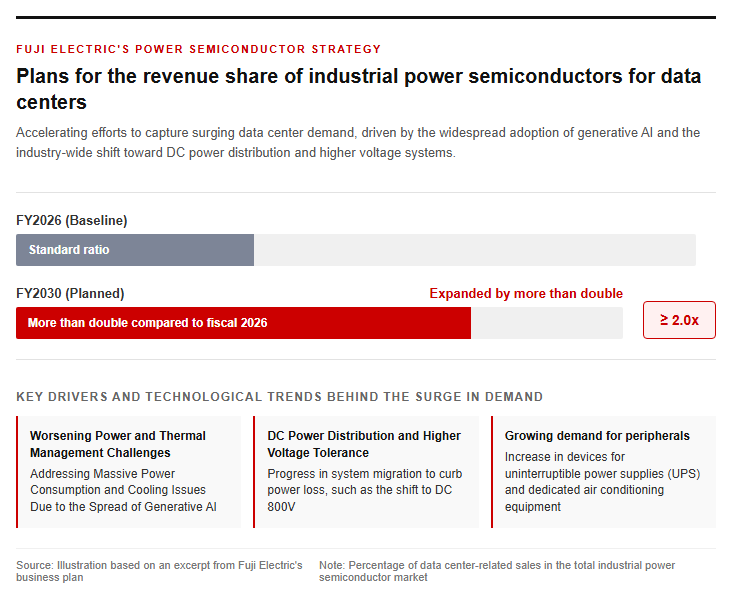
Fuji Electric has revealed plans to significantly ramp up its capture of data center demand in its power semiconductor business, more than doubling the proportion of related sales in its industrial power semiconductors by fiscal 2030 compared to fiscal 2026. The backdrop to this includes the growing severity of power consumption and thermal management issues in data centers accompanying the spread of generative AI, as well as trends toward higher withstand voltages and DC power distribution.
- The Aim Behind Doubling the Data Center Share in Industrial Power Semiconductors
- Strengths and Track Record in Providing Comprehensive Power Supply Infrastructure
- Ejector Cooler and Energy-Saving Technology Achieving 85% Power Consumption Reduction
- Expanding Overseas Production Base Capacity and Building a Global Supply Chain
- Miniaturization and Lower Loss of SiC Power Semiconductors via 3D Wiring Structures
- The Restructuring Movement of Domestic Power Semiconductors and the Mid-to-Long-Term Growth Scenario
The Aim Behind Doubling the Data Center Share in Industrial Power Semiconductors
Fuji Electric has positioned capturing demand for data centers as its highest priority in its industrial power semiconductor business, and has decided on a policy to significantly increase its sales composition ratio. Specifically, the company plans to more than double the proportion of data center-related sales in its industrial power semiconductor revenue by fiscal 2030 compared to fiscal 2026. With the widespread adoption of generative AI and cloud services, large-scale data centers are being constructed one after another around the world, making the stable supply of power and the optimization of energy efficiency required to operate server clusters an urgent task. The company is poised to meet rapidly expanding market demand by accelerating the full-scale mass production of its 8th-generation Insulated Gate Bipolar Transistors (IGBTs) and the sample shipments of medium-capacity modules. As the transition progresses from conventional AC power distribution to low-power-loss DC power distribution (such as DC 800V systems) and high-voltage systems, demand for highly efficient power semiconductors for Uninterruptible Power Supplies (UPS) and air conditioning equipment is surging. By supplying its own devices for these equipment types, Fuji Electric is drawing up a strategy to improve profitability not only at the component level, but across the entire system. This is a proactive move amid dramatic changes in the industry structure.
Strengths and Track Record in Providing Comprehensive Power Supply Infrastructure
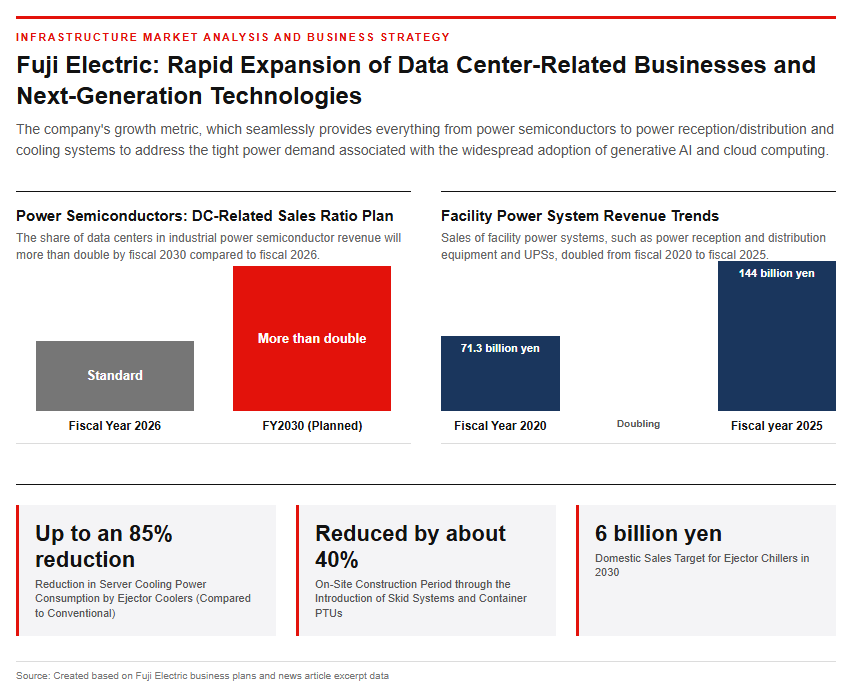
The biggest reason Fuji Electric is demonstrating its strengths in the data center market lies in its comprehensive system integration capability, which allows it to propose all the equipment necessary for power supply in a single package. The company has established a system that can cover the entire facility infrastructure under one roof, ranging from extra-high and high-voltage power receiving and distribution equipment—from power reception to transformation and distribution—to uninterruptible power supplies (UPS) that secure emergency power, switchboards (electrical panels), and even air conditioning and water-cooled equipment work, extending through to construction and maintenance. The company’s facility power supply system sales are projected to double from 71.3 billion yen in fiscal 2020 to 144 billion yen in fiscal 2025, and for fiscal 2026, the company plans to achieve approximately 100 billion yen in sales specifically for data centers. This represents a rapid growth of about 5.2 times compared to fiscal 2020. Furthermore, in response to customer needs for shortening on-site construction periods, the company provides solutions that reduce construction time by approximately 40% by introducing skid systems and containerized powertrain units (container PTUs) that factory-pre-assemble equipment in advance. In the data center industry, where construction speed dictates profitability, this strong on-site execution capability and the comprehensive power of its product lineup serve as a major barrier to entry, strongly driving the expansion of new orders.
Next-Generation Cooling Technology and Expansion of Overseas Production Systems
Ejector Cooler and Energy-Saving Technology Achieving 85% Power Consumption Reduction
Roughly 30% to 40% of a data center’s power consumption is dedicated to server cooling, and with the increasing heat generation of AI chips, thermal management has become the biggest bottleneck. To address this challenge, Fuji Electric has developed a water-cooled “ejector chiller” that repurposes advanced energy-saving and cooling technologies cultivated over many years in its vending machine business. This system employs a mechanism that compresses the refrigerant using waste heat recovered from the server’s semiconductor chips, making it possible to produce chilled water without operating the compressors required by conventional air-cooled systems or general chiller equipment. Through this world-first technological approach, the company has succeeded in reducing the power consumption required for server cooling by up to 85%. Garnering significant market attention as a device that contributes to the dramatic improvement of PUE, a power efficiency metric for data centers, the company has set a domestic sales target of 6 billion yen for 2030. Amid a globally accelerating shift toward liquid and water cooling to ensure the stable operation of high-density GPU servers, Fuji Electric aims to establish a solid position in the cooling sector by promoting cross-selling to its existing power distribution equipment customers. The configuration diagram below shows an implementation image of the cooling system.
Expanding Overseas Production Base Capacity and Building a Global Supply Chain
To meet the global rush for data center construction, Fuji Electric is rapidly expanding its production capacity for power distribution equipment both domestically and overseas. Domestically, the company is strengthening production lines for switchboards and power supply equipment at its Kobe and Tsukuba factories, transformers at the Chiba factory, and switchgear at the Kawasaki factory. However, it has also taken steps to reorganize its bases in Southeast Asia to capture overseas demand. It has announced a capital investment to establish a new switchboard production building at the Malaysia factory of its Singapore-based subsidiary, Fuji SMBE. Construction of the new production building is scheduled to begin in June 2026, with operations expected to start in October of the same year. Through this investment, the switchboard production capacity at the plant will be increased 1.5-fold, while the expansion of cranes and testing equipment will quadruple the production capacity for skid systems and containerized PTUs compared to conventional levels. By establishing a system to deliver high-quality power distribution equipment compliant with IEC standards in a timely manner to the Southeast Asian and Australian markets, the company aims to expand its share in the global market. Overall, the company plans to increase its overseas switchboard production capacity to approximately 2.5 times the fiscal 2024 level by fiscal 2027, creating a robust framework to absorb demand on a global scale.
Technological Innovation and Prospects for Industry Restructuring in Power Semiconductors
Miniaturization and Lower Loss of SiC Power Semiconductors via 3D Wiring Structures
Fuji Electric is vigorously advancing the development and mass-production investment of next-generation power semiconductors using silicon carbide (SiC). The company has announced a collaboration with DENSO to strengthen the production of SiC power semiconductors and is currently promoting a joint investment totaling 211.6 billion yen (including up to 70.5 billion yen in certified subsidies from the Ministry of Economy, Trade and Industry). It plans to proceed with capacity expansion at the Aomori Plant and establish a mass-production system using 8-inch wafers. Furthermore, on the technological front, it has developed a breakthrough three-dimensional wiring structure that achieves miniaturization and lower loss in power semiconductor modules. This is a technology that eliminates conventional connection structures using wires or clips and instead connects three-dimensionally using printed circuit boards and conductive pins. As a result, it has achieved the following innovative performance improvements.
- Reduced product volume by approximately 50% compared to conventional models
- Reduced internal circuit wiring inductance by approximately 70%
- Reduced switching losses by approximately 50%
- Improves durability against thermal deformation in wiring joints, extending joint lifespan by approximately five times
This technology is scheduled to be applied sequentially to the company’s power semiconductor modules starting in fiscal 2026. It will serve as a key technology that contributes not only to downsizing inverters and extending the cruising range of electric vehicles, but also to high-efficiency power supplies for data centers and energy conservation in industrial equipment.
The Restructuring Movement of Domestic Power Semiconductors and the Mid-to-Long-Term Growth Scenario
In the global power semiconductor market, overseas players—led by Germany’s Infineon Technologies, along with the US’s onsemi and Europe’s STMicroelectronics—dominate the top spots. According to Yole Group’s 2025 revenue rankings, Japanese players include Mitsubishi Electric in 4th place, Fuji Electric in 5th, Toshiba in 6th, and ROHM in 8th. However, it is not easy for Japanese manufacturers to stand against major overseas giants on an individual basis. Amid this backdrop, movements toward industry restructuring are intensifying in complexity, with three companies—Mitsubishi Electric, Toshiba, and ROHM—starting basic agreements and discussions toward the integration of their power semiconductor businesses. While pursuing its own independent growth path, Fuji Electric is demonstrating its unique identity as a total energy solutions company encompassing everything from power distribution equipment to cooling systems and power semiconductors. The power supply issue for AI data centers is not limited to mere device supply problems, but is directly linked to the sustainability of regional power grids and the entire infrastructure. A major key to achieving Fuji Electric’s record-high profit targets for fiscal year 2026 (sales of 1.275 trillion yen, operating profit of 142.5 billion yen) will be how effectively it can monetize its tripartite strengths in power, cooling, and power semiconductors in the global market.
Reference Page
- [Expansion of Overseas Switchboard Production Capacity to Strengthen the Data Center Business] https://www.fujielectric.co.jp/about/news/detail/1205808_4830.html
- [Developed a Three-Dimensional Wiring Structure that Achieves Miniaturization and Lower Loss in SiC Power Semiconductors, Contributing to Extended EV Cruising Ranges] https://www.fujielectric.co.jp/about/news/detail/1205845_4830.html
【#FujiElectric #PowerSemiconductors #DataCenters #AIInfrastructure #EnergySavingTechnology #SiC #SemiconductorRestructuring】


コメント