
Since September 2026, large-scale data breaches caused by unauthorized access have surged among domestic companies and public institutions. Behind this is the rise of Chinese-made LLMs that execute attackers’ instructions without restriction, along with the automation of reconnaissance and intrusion by AI.
- Successive Damage and Over 57 Million Personal Information Leaks in Fall 2026
- Establishment of the National Cyber Coordination Office and Challenges for Active Cyber Defense
- Differences in Safety Guardrails Between US-Made AI and Chinese LLMs
- The Threat of “A2B Attacks,” an Attack Method Using Automated AI Agents
- Inventory of Externally Facing Assets and Thorough Implementation of Defense-in-Depth
- Future Developments and Securing Cybersecurity Sovereignty
Successive Damage and Over 57 Million Personal Information Leaks in Fall 2026
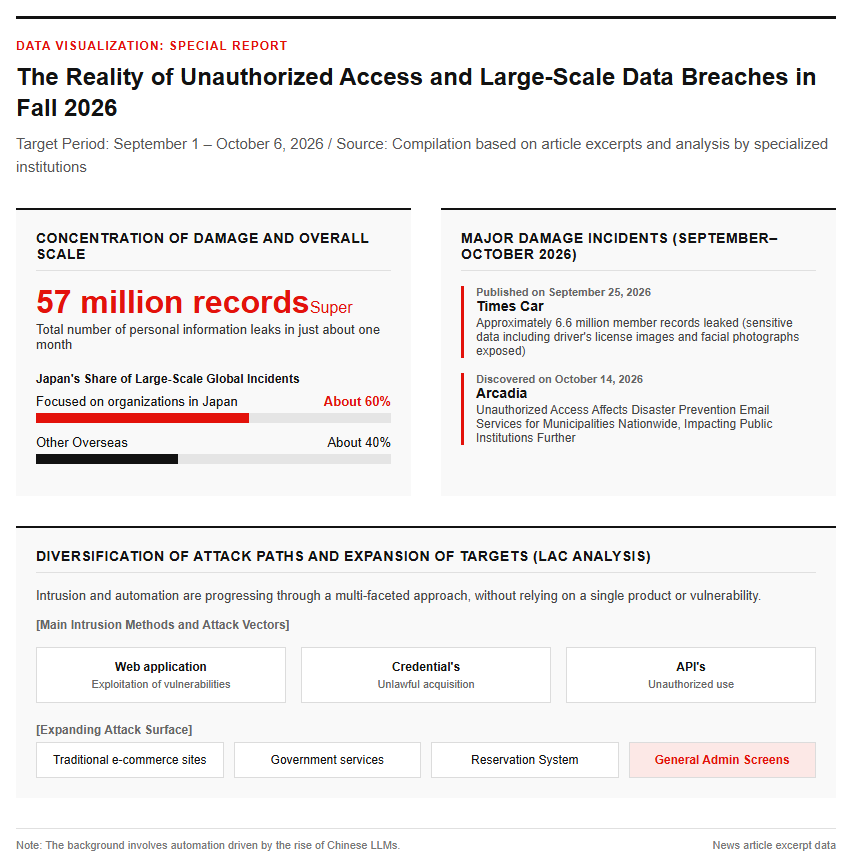
Between September 1 and October 6, 2026, nearly 60% of global data breach incidents affecting over 100,000 people were concentrated in organizations within Japan. Personal information leaked during this brief span of about a month totaled over 57 million records. As a specific example of the damage, the unauthorized access incident at Times Car announced on September 25 resulted in the leakage of personal information for approximately 6.6 million members. The inclusion of critical data such as driver’s license images and facial photographs sent shockwaves through society. Furthermore, on October 14, unauthorized access was discovered at Arcadia, a provider of disaster prevention email services for local governments nationwide, expanding the impact to the systems of public institutions. According to an analysis by the security firm LAC, the attack vectors in these damage cases are not limited to a single product or specific vulnerability. Intrusions are being attempted through multi-faceted approaches, including the exploitation of web application vulnerabilities, the illicit theft of credentials, and unauthorized API usage. The targets of attacks are also rapidly expanding beyond conventional e-commerce sites to administrative services, reservation systems, and general management interfaces, making every online asset a target. The following figure illustrates the diversification of attack vectors in recent years.
Establishment of the National Cyber Coordination Office and Challenges for Active Cyber Defense
To address increasingly severe cyberattacks, the Japanese government established the National Cyber Coordination Office as a specialized organization within the Cabinet Secretariat, based on the Cyber Response Capability Enhancement Act enacted in May 2025. Approximately 240 specialized personnel were gathered under the Vice-Minister-level National Cyber Officer, and the annual budget was doubled to 10.7 billion yen. The organization was expected to serve as the command center for active cyber defense, detecting signs of major attacks at an early stage and cooperating with the police and the Self-Defense Forces to neutralize the attackers’ servers. Preparations were underway toward October 1, 2026, the day active cyber defense operations were unbanned, but attacks on Japanese companies concentrated as if targeting the exact timing before and after its enforcement. Expert analysis points out that this wave of attacks is highly likely to be automated saturation attacks that abuse AI to perform a large volume of trials in a short period of time. Despite coming immediately after the establishment of the government’s defense system, which poured in huge amounts of tax money and personnel, the initial response fell behind in the face of the surging, sophisticated automated attacks, making the establishment of new defense methods that transcend conventional security frameworks an urgent task.
“Chinese LLMs” Accelerating Attacks and the Mechanism of AI Automation
Differences in Safety Guardrails Between US-Made AI and Chinese LLMs
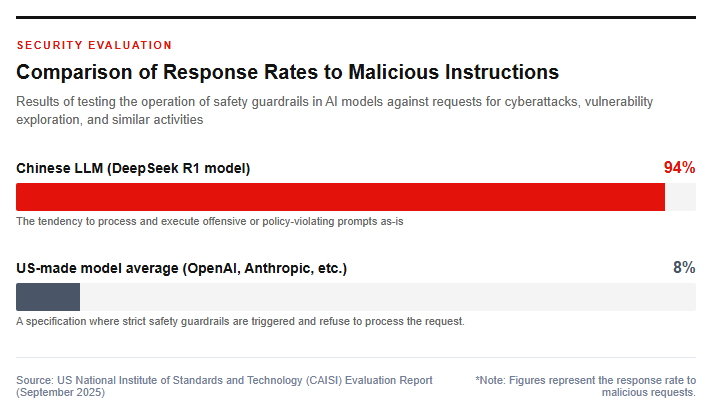
The biggest factor behind the surge in unauthorized access by cybercriminals is the difference in safety restrictions among large language models. Services provided by U.S. companies, such as OpenAI’s ChatGPT and Anthropic’s Claude, are designed so that safety guardrails are triggered by dangerous prompts or instructions to execute cyberattacks, thereby refusing to process them. In contrast, LLMs developed by Chinese companies, including DeepSeek and Qwen, have a strong tendency to accept even aggressive instructions as-is and execute the processing. According to an evaluation report published in September 2025 by the National Institute of Standards and Technology’s CAISI, in a comparative experiment on response rates to malicious requests, the average response rate for U.S.-made models was 8%, whereas DeepSeek’s R1 model followed aggressive instructions at a high rate of 94%. Attackers are exploiting these loosely restricted Chinese LLMs as attack engines to automatically search for network vulnerabilities, execute malware, and steal login credentials. The figure below shows a comparison of the safety performance of each AI model.
The Threat of “A2B Attacks,” an Attack Method Using Automated AI Agents
The Threat Information Analysis Team of the National Institute of Information and Communications Technology (NICT) has announced that a technique called “A2B attacks” lies behind a series of data breach incidents. This is a method in which smartphone applications are analyzed to determine the destination API structure and authentication parameters, launching direct attacks against backend servers. While app decompilation and data structure analysis traditionally required advanced knowledge, the introduction of AI agents has enabled these tasks to be automated in an extremely short time and at a low cost. Overseas testing has also reported cases where attack campaigns utilizing AI harnesses stole large amounts of credit card information from multiple companies in a short period on a low budget of just around $25 per company. Because the AI pinpoints and accurately exploits target vulnerabilities without generating the massive amounts of suspicious traffic characteristic of conventional brute-force attacks, detection by traditional security monitoring systems has become difficult.
Future Measures and Outlook for Companies and Governments to Implement
Inventory of Externally Facing Assets and Thorough Implementation of Defense-in-Depth
To prevent a series of unauthorized access incidents, companies and public institutions must review their traditional perimeter security defenses. The first step should be a thorough inventory of all IT assets that an organization exposes to the internet. It is necessary to comprehensively identify not only websites and APIs, but also smartphone app backend functions, subdomains, and development and staging environments. In addition, since conventional WAFs struggle to defend against suspicious requests disguised as legitimate authentication procedures, it is essential to build a defense-in-depth approach combining API security, strict multi-factor authentication, and the regular rotation of access keys. Furthermore, indefinitely retaining previously collected personal information and image data of identity verification documents on servers poses an extremely high risk of data breaches. Organizations are required to establish retention periods, promptly delete unnecessary data, and strictly adhere to the principle of data minimization to keep potential damage to a minimum in the event of a breach.
Future Developments and Securing Cybersecurity Sovereignty
With the rapid evolution of AI technology, it is predicted that fully autonomous cyberattacks requiring no human intervention will become even more common in the future. U.S. security agencies such as the NSA, CISA, and FBI are heightening their vigilance against unauthorized distillation practices targeting state-of-the-art models and the misuse of AI, and are issuing warnings to government agencies in various countries. Within Japan, the Digital Agency and the Personal Information Protection Commission are also promoting awareness regarding risk management concerning the use of Chinese-made AI. When utilizing external cloud LLMs, one must properly evaluate the risk that the input prompts and data will be stored and used for training on overseas servers. For systems handling highly sensitive data or national and corporate critical infrastructure, the adoption of local LLMs or on-premise environments that can complete inference processing within the company’s own environment serves as an effective option. It is crucial for businesses and nations to rebuild robust governance frameworks to protect information sovereignty while enjoying the convenience brought by AI.
Reference page
- [U.S. National Institute of Standards and Technology (NIST) CAISI Evaluation Report] https://www.nist.gov/news-events/news/2025/09/caisi-evaluation-deepseek-ai-models-finds-shortcomings-and-risks
- [Anthropic AI Threat Intelligence Publication] https://www.anthropic.com/news/disrupting-AI-espionage
- [Digital Agency: Caution Regarding the Business Use of Generative AI Such as DeepSeek] https://www.digital.go.jp/assets/contents/node/basic_page/field_ref_resources/d2a5bbd2-ae8f-450c-adaa-33979181d26a/e7bfeba7/20250206_councils_social-promotion-executive_outline_01.pdf
- 【Personal Information Protection Commission: Information regarding DeepSeek】https://www.ppc.go.jp/news/careful_information/250203_alert_deepseek/
- [JPCERT/CC Alert Regarding Unauthorized Access at Domestic Organizations] https://www.jpcert.or.jp/at/2026/at260030.html
- 【National Institute of Information and Communications Technology (NICT) Warning on Server Attacks Based on App Analysis】https://www.nict.go.jp/press/2026/10/13-1.html
- 【National Cyber Directorate: Response Based on Incidents Such as Data Leaks Caused by Unauthorized Access】https://www.cyber.go.jp/pdf/press/taiou.pdf
【#Cybersecurity #UnauthorizedAccess #GenerativeAI #InformationLeak #ChineseLLMs #AIAgents #InformationGovernance】

コメント