
OpenAI has released a new, free image classification tool designed to detect child sexual abuse material (CSAM), including AI-generated images. This move comes amid a sharp surge in synthetic abuse images driven by the proliferation of generative AI, creating an urgent need for countermeasures against novel content that cannot be caught by traditional hash-matching methods.
- OpenAIによるCSAM検出AIツールの無償公開
- Identification of New and Synthetic Content through Visual Feature Analysis
- An architecture fusing CLIP and a multilayer perceptron
- Effectiveness of a 48% Reduction in Review Targets and Precision Fluctuations by Evaluation Environment
- 24-Hour Account Suspension and Redirection to a Dedicated Support Desk
- Future Outlook and Security and Regulatory Challenges Faced by Platform Operators
OpenAIによるCSAM検出AIツールの無償公開
On November 16, 2026, U.S.-based OpenAI announced “OpenAI CSAM Image Classifier,” a new image classification AI that detects AI-generated Child Sexual Abuse Material (CSAM), and began offering it free of charge via API to vetted organizations. AI-related CSAM reports submitted to CyberTipline, the reporting hotline of the National Center for Missing & Exploited Children (NCMEC), surged to approximately 400,000 in 2025, marking an explosive increase from about 67,000 the previous year. While perceptual hashing technology—which matches digital fingerprints against databases of known images—has been the mainstream approach for traditional photo-based CSAM countermeasures, a serious challenge existed in that newly created synthetic images generated by AI do not exist in databases and thus cannot be detected. Partnering with specialized organizations such as NCMEC, Tech Coalition, and ROOST, OpenAI has stepped forward to build a new line of defense to fill this technological void. Please refer to the overview diagram below.
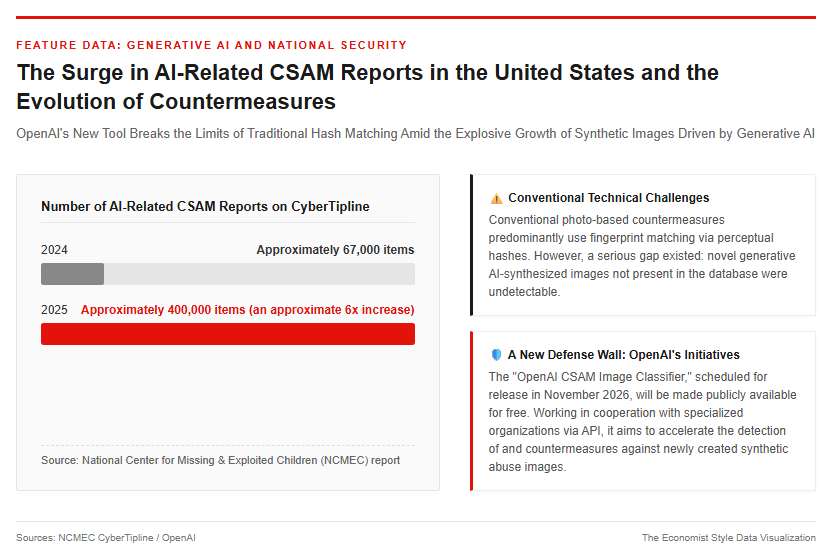
Identification of New and Synthetic Content through Visual Feature Analysis
The greatest technical feature of the newly announced classifier is that it does not rely on known images in a database, but instead analyzes the visual characteristics of the image itself to determine suspected CSAM. The system scores and outputs signs of sexual abuse contained within the images, selecting materials that human moderators should prioritize for review. Furthermore, this tool is the world’s first widely available CSAM classifier to feature a dedicated signal for evaluating suspected AI-generated content. This makes it possible to distinguish between images of real children and AI-generated synthetic images, dramatically streamlining the analysis and reporting workflows of law enforcement agencies and moderation teams. It supports various still image formats and demonstrates high detection capabilities even against newly created deepfakes and generative AI images. Please refer to the figure below for the components.
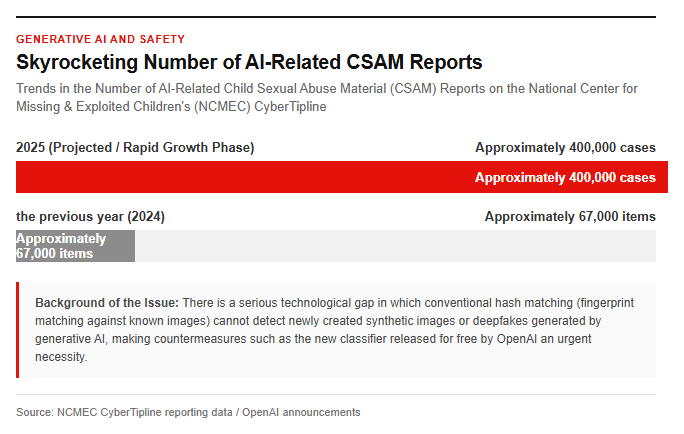
Technical Specifications and Verification Performance of the New Image Classifier
An architecture fusing CLIP and a multilayer perceptron
According to the released model card, the new classifier employs a deep learning architecture that combines OpenAI’s internal image encoder, “CLIP,” with a three-layer multi-layer perceptron (MLP). The mechanism works by having the image encoder convert input images into multidimensional numerical representations, while the MLP calculates classification scores. It was designed with a consideration for the balance between detection performance on unknown data and processing speed. The scores output by the API are of two types: “Suspected CSAM” and “Suspected AI-generated CSAM,” with the default decision thresholds set at 0.996324 for suspected CSAM and 0.90 for suspected AI-generated content. Furthermore, images sent to the classifier API are not retained on the servers, nor are they reused for model retraining or evaluation, thereby ensuring privacy protection and security. The overall structure of the model is as shown in the image below.
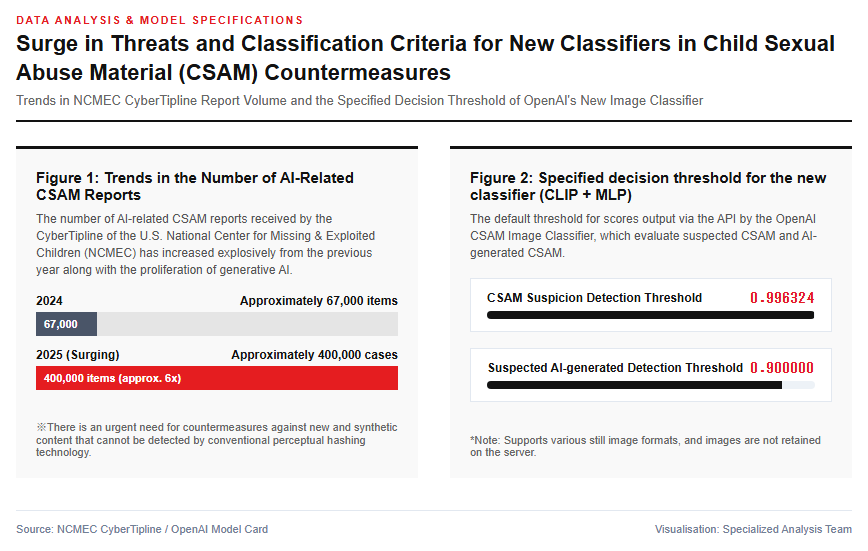
Effectiveness of a 48% Reduction in Review Targets and Precision Fluctuations by Evaluation Environment
According to OpenAI’s initial estimates, the introduction of the new classifier reduces the volume of images requiring manual review by 48%, while identifying the same number of abusive images as existing detection tools. In addition, the proportion of flagged images that actually contain abusive content (precision) has approximately doubled compared to conventional methods. In tests conducted by partner company fal, an AI platform, 72% of high-confidence flags were confirmed to be new CSAM (Child Sexual Abuse Material), and verification with SafetyKit showed that the detection rate for illustrations and anime reached 90%. On the other hand, the model card also clearly notes discrepancies in accuracy depending on the evaluation environment. While the precision in offline evaluations was 99.1%, online evaluations using actual ChatGPT traffic saw precision drop to 29.8%. The recall rate for images of infants and toddlers remained at just 49.3%, and video frame verification has not been conducted. For these reasons, it is considered essential not to determine CSAM based on the score alone, but rather to combine it with review by trained humans.
Intervention Measures in ChatGPT and Their Ripple Effects on Society and Businesses
24-Hour Account Suspension and Redirection to a Dedicated Support Desk
Simultaneously with the release of the classifier, OpenAI has introduced powerful intervention features for general ChatGPT users. When it detects inputs or instructions attempting to seek content depicting children sexually, it displays a warning that such content can be harmful and illegal, regardless of whether it is AI-generated. The affected conversation is immediately ended and hidden, and the user’s account is suspended from access for 24 hours. Even during the suspension, guidance to support hotlines is displayed on the warning screen, directing users to free counseling and support organizations co-developed with specialized organizations such as Protect Children and the Lucy Faithfull Foundation. Rather than simply banning accounts permanently right away, the system is designed to deter harmful behavior by incorporating a temporary suspension and professional intervention. In the event of repeated violations, measures such as extending the suspension period, permanent account closure, and reporting to the NCMEC and law enforcement authorities will be executed.
Future Outlook and Security and Regulatory Challenges Faced by Platform Operators
OpenAI’s initiative goes beyond a mere feature addition, representing a structural turning point in content moderation and regulatory compliance for the AI era. In Europe and the United States, obligations for platform operators to monitor and remove illegal content are rapidly being strengthened through regulations such as the European Digital Services Act (DSA), the UK Online Safety Act, and the US Take It Down Act. For companies operating services equipped with image posting, image generation, and chat features, conventional safety measures that rely solely on hash matching have already reached their limits. Moving forward, the implementation of feature-extraction classifiers capable of handling AI-generated images and the establishment of human review systems will be essential. However, discussions regarding the risk of false positives within Japan’s unique anime and illustration culture and the boundaries of freedom of expression are ongoing, requiring continued close attention to technological adoption and regulatory trends.
Reference page
- [OpenAI Official Announcement: Strengthening the fight against online child sexual abuse with new tools and support] https://openai.com/index/strengthening-online-child-safety/
- [OpenAI CSAM Image Classifier Model Card] https://deploymentsafety.openai.com/csam-image-classifier
- [OpenAI Help Center: Child sexual abuse material CSAM warnings and account suspensions in ChatGPT] https://help.openai.com/en/articles/20001637-child-sexual-abuse-material-csam-warnings-and-account-suspensions-in-chatgpt
- 【OpenAI Developer Guide: CSAM guidance】https://developers.openai.com/api/docs/guides/csam-guidance
[#OpenAI #CSAM #ImageClassifier #ChatGPT #SafetyMeasures #GenerativeAIRegulation]

コメント