According to a recent 2026 survey, the zero-click rate on Google Search has reached 68.01%, revealing a rapid decline in traffic to external websites. This trend is driven by the widespread adoption of AI Overviews—which provide generative AI answers directly on the search results page—along with structural changes in search designed to keep users within the platform.
- The Reality That 68% of Google Searches End Without External Clicks
- How the Introduction of AI Overviews Accelerates Changes in Search Behavior
- The Drastic Decline in Website Traffic and the Structural Crisis Facing Specific Industries
- The UK CMA’s Mandating of the Right to Refuse Service and the Expansion of Antitrust Regulation
- Transition from Traditional SEO to Zero-Click Marketing and GEO
- Securing proprietary channels and future developments/key points
The Reality That 68% of Google Searches End Without External Clicks
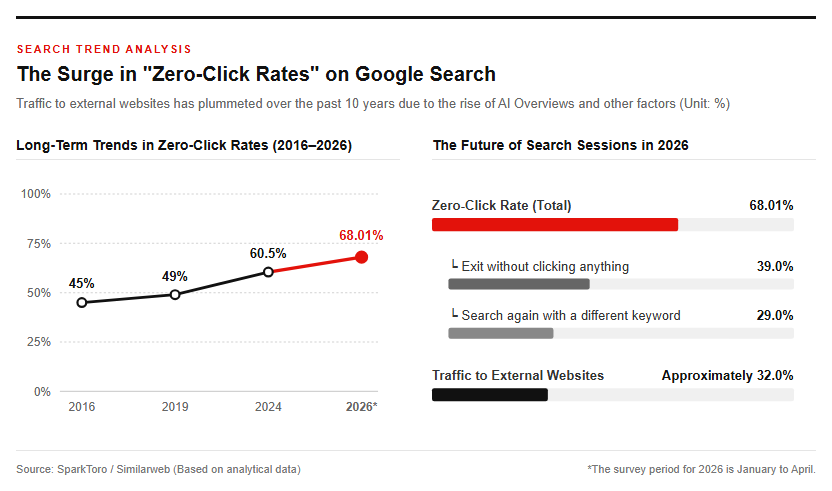
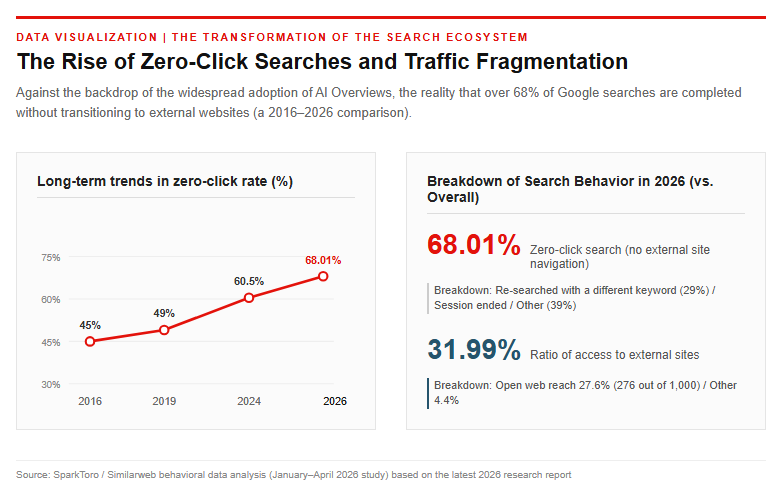
According to an analysis of Similarweb behavioral data by audience research firm SparkToro, it has been revealed that 68.01% of U.S. Google searches between January and April 2026 ended without navigating to an external site. The proportion of search users accessing external websites remained at a mere 32% of the total, with clicks reaching the open web dropping to 276 per 1,000 searches (approximately 27.6%). The remaining 39% ended their sessions without clicking on anything, while 29% performed another search by entering different keywords into the search bar. The zero-click rate has continued to accelerate, going from 45% in 2016 to 49% in 2019, and 60.45% in 2024, recording a 23-point increase over the past decade. The two-year period from 2024 to 2026, in particular, has shown the most rapid growth to date. As the user behavior of obtaining necessary information entirely on the search results page has become mainstream, this highlights the current reality that search engines are transforming from gateways to websites into the very places where content is consumed. Please refer to the figure below.
How the Introduction of AI Overviews Accelerates Changes in Search Behavior
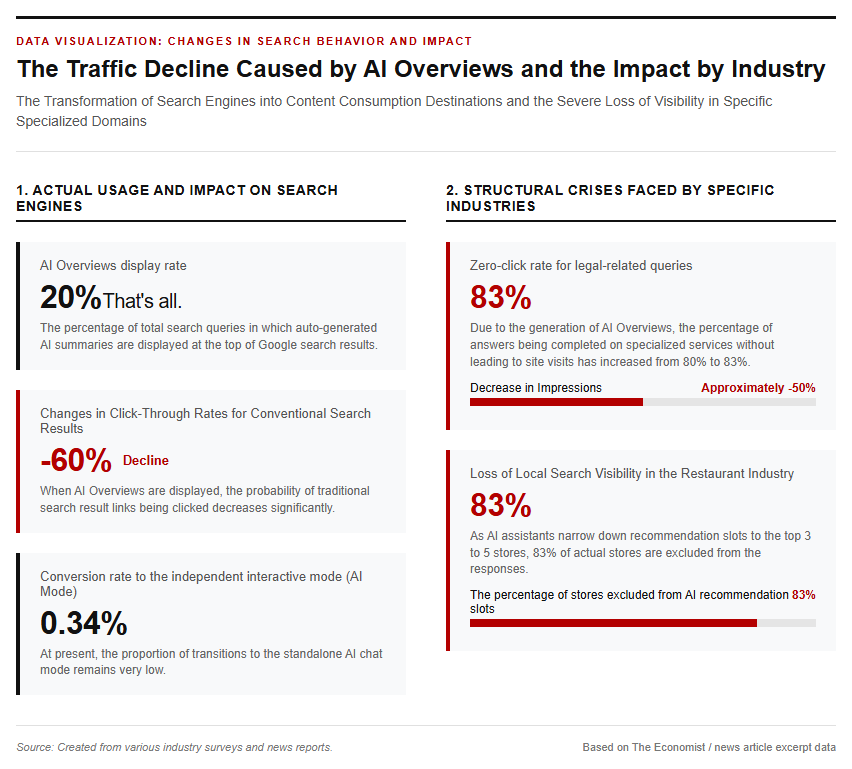
The biggest factor behind the surge in zero-click searches is the rise of AI Overviews, an AI-generated summary feature placed by Google at the very top of search results. AI Overviews appear in over 20% of all search queries, and it has been confirmed that when this feature is displayed, the click-through rate for traditional search results drops by approximately 60%. Meanwhile, the transition rate to AI Mode—a standalone conversational search mode—remains at just 0.34%, indicating that the primary driver of the increase in zero-click searches at this stage is the AI summaries embedded within regular search results. Google explains that while the AI features reduce short, confirmation-oriented bounce clicks, the quality of clicks that actually transition to sites is improving. However, because mechanisms that encourage re-searching and the use of related services within the platform reinforce advertising revenue and its proprietary ecosystem, it is business-structurally difficult to reverse this trend. As a result, a major decoupling is rapidly underway, in which traffic is being substantially stripped away from content providers such as publishers and general websites. Please refer to the figure below.
Impact on Media and Industry, and Trends in Legal Regulation and Rights Protection
The Drastic Decline in Website Traffic and the Structural Crisis Facing Specific Industries
The rise in zero-click rates is delivering a direct blow to the customer acquisition foundations of media outlets and companies that have relied on search traffic. The impact is particularly pronounced in industries such as specialized B2B services, legal, hospitality and travel, and the food and beverage sector. For example, in legal-related queries, the generation of AI Overviews has driven zero-click rates from 80% to 83%, resulting in cases where impressions for legal professionals and specialized services have dropped by approximately 50%. Furthermore, in local searches for the restaurant industry, AI assistants narrow down recommendation slots to the top 3 to 5 establishments, creating a phenomenon where 83% of actual restaurants are excluded from AI responses and lose their visibility. For media companies, articles are consumed only through summaries rather than being read thoroughly, leading to a loss of advertising revenue and membership acquisition opportunities. In exchange for the consumer convenience of saving time from visiting countless websites, the risk of invisibility is expanding, where content creators bear the costs and labor while receiving no return.
The UK CMA’s Mandating of the Right to Refuse Service and the Expansion of Antitrust Regulation
In response to the unauthorized use of content by AI search and the resulting decline in visitor traffic, regulatory authorities around the world are moving to establish global legal regulations. In June 2026, the UK Competition and Markets Authority (CMA) introduced the world’s first opt-out regulation enabling news organizations to block the use of their content in Google’s AI search. The regulation explicitly states that refusing inclusion in AI search will not negatively impact standard search rankings, while also mandating clear attribution links and the right to opt out of AI training use. Similarly, in Japan, the Japan Fair Trade Commission finalized plans in December 2025 to launch a factual investigation into IT companies for the unauthorized use of news articles and unjustly low compensation, viewing these practices as potential violations of the Antimonopoly Act. The Japan Newspaper Publishers and Editors Association is also strongly demanding usage based on prior consent and legal amendments, marking a full-scale international shift toward protecting content rights holders from excessive lock-in by platform companies. Please refer to the figure below.
New Web Strategy in the Age of AI Search
Transition from Traditional SEO to Zero-Click Marketing and GEO
Webmasters and marketers facing the disappearance of search traffic are required to transition from traditional SEO (Search Engine Optimization) to new strategies for the AI era. Rather than making direct traffic to a site the sole purpose, the importance of zero-click marketing and GEO (Generative Engine Optimization)—which generate awareness and attitude changes by being accurately cited within AI answers—is increasing. To be chosen by AI, the transmission of highly reliable primary information signals, such as the preparation of FAQ structured data, machine-readable specifications, and the optimization of Google Business Profiles, is essential. Because mere definitions and thin explanatory articles are easily summarized and compressed by AI and thus prone to being weeded out, the creation of irreplaceable content—such as original research data, practical verification by experts, and community building—determines the value of a website. There is an urgent need to review evaluation criteria that chase only traffic volume and to implement measures that serve as a receptacle for multi-source verification.
Securing proprietary channels and future developments/key points
Going forward, it will become even more important to diversify channels for building direct relationships with users through touchpoints other than Google. Having independent distribution channels that are unaffected by platform algorithm changes—such as e-mail newsletters, paid newsletters, membership communities, official apps, and podcasts—will dictate business sustainability. Furthermore, as the role of search engines transforms from an intermediary to a publisher that directly presents content, close attention is being paid to the outcomes of platform liability lawsuits in the EU and Germany, as well as negotiations regarding compensation for AI model training data. Companies are advised to break away from pageview-dependent advertising models and establish new KPIs, such as tracking brand Share of Voice within AI answers and membership registration rates. Establishing unique expertise and trust in the changing information discovery process is the focal point of future web strategies.
Reference Page
- 【SparkToro Report: Google Zero Click Searches To Open Web Fall To 27.6%】https://www.seroundtable.com/google-zero-click-searches-fall-41475.html
[#AISearch #ZeroClick #SEO #AIOverviews #GenerativeAI #DigitalMarketing #Copyright #Google]


コメント