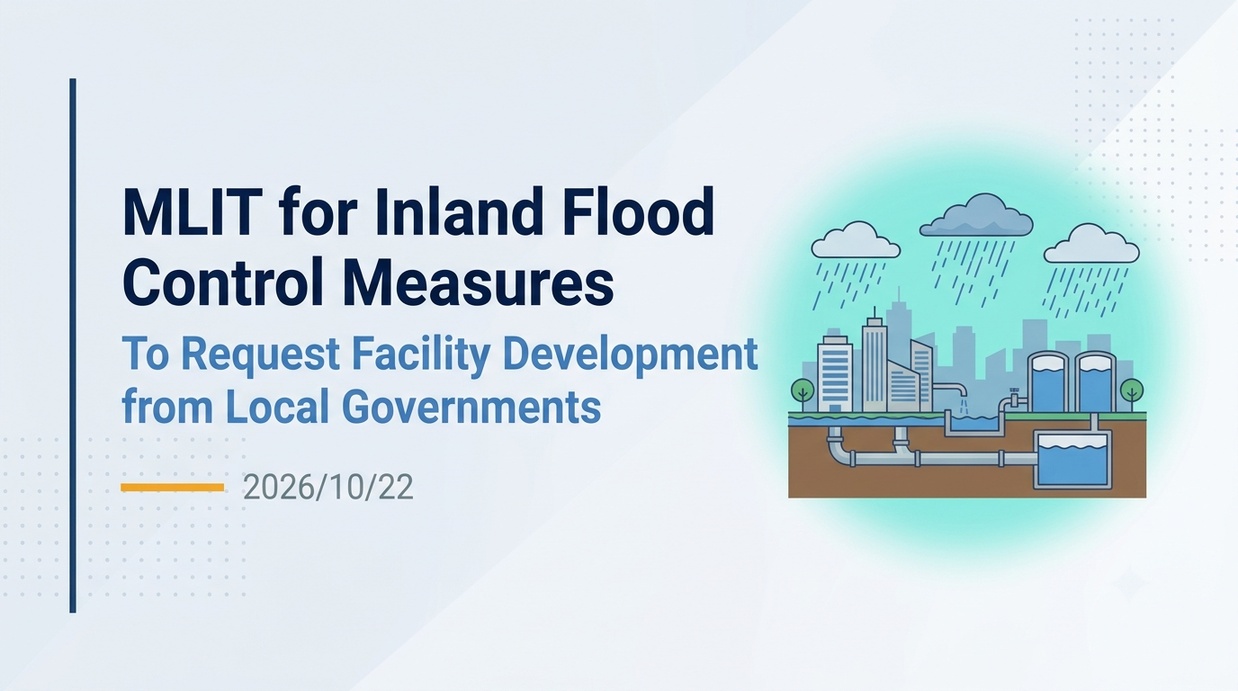
The Ministry of Land, Infrastructure, Transport and Tourism has decided to request local governments to strengthen the development of drainage and storage facilities to cope with maximum-class torrential rain. The background to this policy is the increasing severity of localized heavy rains in recent years and the growing risk of internal flooding, which has caused successive damage in urban areas.
- Outline of Requests to Address Maximum-Class Torrential Rain of 100 mm per Hour
- The Limits of Drainage Systems Due to Urbanization and the Current State of Disaster Risks
- Non-Structural Measures Supporting the Revised Flood Control Act and Evacuation Warning Systems
- Financial Support and DX Utilization as Seen in the FY 2026 Local Public Finance Measures
- Challenges Viewed from Advanced Municipalities’ Initiatives and Judicial Decisions
- Proactive Disaster Prevention Anticipating Climate Change and Future Focus Areas
Outline of Requests to Address Maximum-Class Torrential Rain of 100 mm per Hour
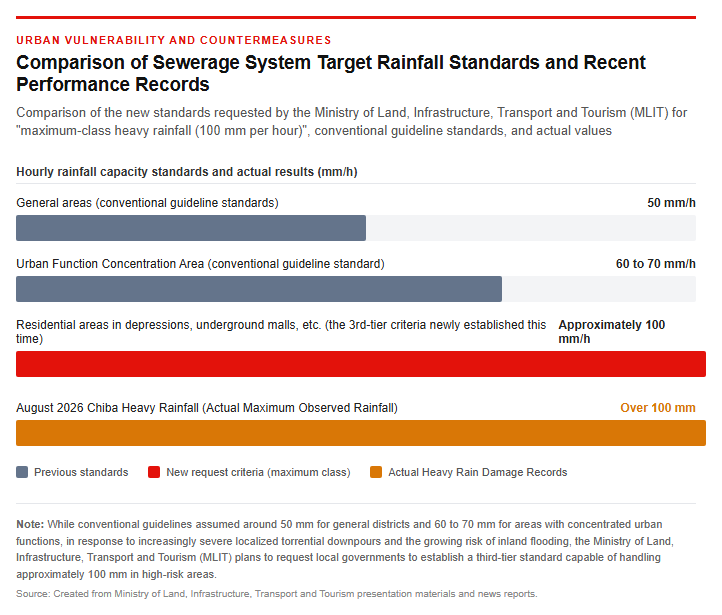
In October 2026, Japan’s Ministry of Land, Infrastructure, Transport and Tourism (MLIT) began making arrangements to urge local governments to strengthen the development of drainage and storage facilities aimed at mitigating damage from internal flooding, which occurs when rainwater overflows into urban areas. Previously, national guidelines set sewer system standards requiring the capacity to drain rainfall of roughly 50 millimeters per hour in general districts, and about 60 to 70 millimeters per hour in areas with concentrated urban functions. Under the new request, a third-tier standard will be established to handle hourly rainfall of approximately 100 millimeters, targeting high-risk areas identified by local governments such as depressions in residential neighborhoods and underground shopping malls. Specific measures are expected to include promoting sewer system development, as well as installing and expanding rainwater storage facilities and drainage pumps. The creation of a national subsidy program to cover these costs is also under consideration. This policy will be presented at an expert committee meeting scheduled for October 22, 2026.
The strengthening of countermeasures comes amid a recent series of damages caused by extreme torrential rains. In the Chiba heavy rain event that occurred in August 2026, intense rainfall with a maximum hourly precipitation exceeding 100 millimeters was observed, causing widespread flooding in urban areas and road underpasses. This situation resulted in fatalities as well as serious damage, such as numerous vehicles becoming immobilized. As short-duration localized heavy rains increase due to the impact of climate change, preparations for heavy downpours exceeding conventional planning scales have become an urgent necessity. The following image is an illustration showing the mechanism of inland flooding in urban areas.
The Limits of Drainage Systems Due to Urbanization and the Current State of Disaster Risks
Behind the frequent occurrence of inland flooding are changes in land use associated with advancing urbanization. With urbanization, forests, agricultural land, and paddy fields have decreased, while houses, parking lots, and asphalt-paved roads have increased, significantly reducing the land area that allows rainwater to infiltrate into the ground. As a result, a structural issue has become entrenched where a large volume of rainwater flows directly into the sewerage system in a short period, exceeding drainage capacity and causing inundation. Furthermore, when heavy rains raise river water levels, drainage sluice gates often have to be closed to prevent downstream overflows, making it impossible to discharge urban rainwater into rivers and frequently exacerbating flooding.
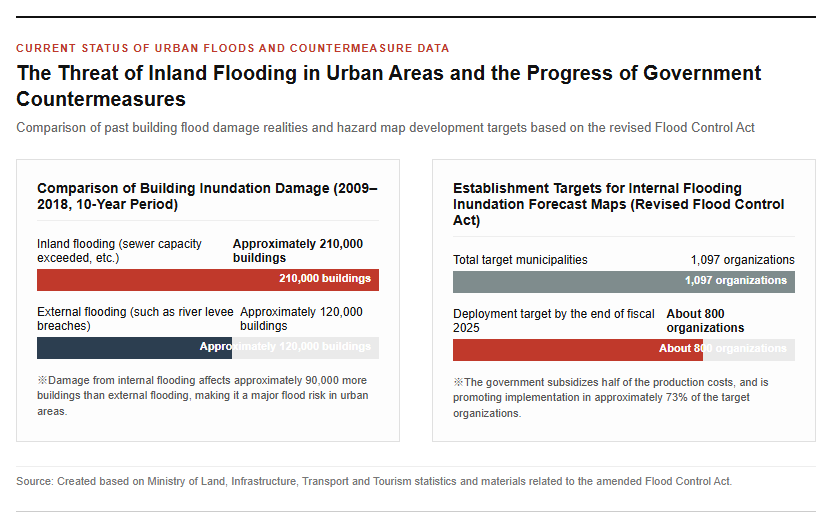
According to statistics from the Ministry of Land, Infrastructure, Transport and Tourism, over the 10-year period from 2009 to 2018, approximately 210,000 buildings were flooded due to inland flooding. This is about 90,000 more than the building damage caused by external flooding resulting from river levee breaches and other factors, confirming that inland flooding has become a major flood risk in urban areas. During the 2019 East Japan Typhoon, flood damage caused by inland flooding occurred in 135 municipalities across 15 prefectures, with the number of damaged houses nationwide exceeding 30,000. To maintain urban disaster prevention functions, it is essential to integrally enhance the functions of sewerage systems and retention facilities, going beyond conventional river improvements.
Advancements in Institutional and Financial Frameworks and Technological Innovation
Non-Structural Measures Supporting the Revised Flood Control Act and Evacuation Warning Systems
Along with hard measures such as facility improvements, efforts are underway to expand soft measures that encourage prompt evacuation behavior by residents. Under the revised Flood Control Act enacted in 2021, all local governments and other entities implementing sewer-based flood control measures are required to create internal flood inundation assumption maps corresponding to the maximum anticipated rainfall. The national government has established a system to subsidize half of the creation costs, and is strengthening support with the goal of having approximately 800 organizations nationwide complete the preparation by the end of fiscal 2025 out of the 1,097 eligible bodies. These area maps serve as foundational data for internal flood hazard maps, contributing to the sharing of flood risks for each region.
Also, as part of strengthening the warning and evacuation system, operational improvements for meteorological disaster information and the dissemination of timelines are underway. In the meteorological disaster information system starting from 2026, a 5-stage alert level system will be clarified: Level 2 requires confirming evacuation actions, Level 3 requires early evacuation of vulnerable people such as the elderly, and Level 4 requires all residents to evacuate from dangerous places. Furthermore, the construction of diverse evacuation and disaster prevention systems tailored to each phase is progressing, such as encouraging individuals to create “My Timelines” to organize their evacuation actions in chronological order, and promoting the formulation of Business Continuity Plans (BCPs) in companies. The correspondence between alert levels and evacuation actions is as shown in the figure below.
Financial Support and DX Utilization as Seen in the FY 2026 Local Public Finance Measures
To support inland flood countermeasures implemented by local governments, the government is working to expand financial measures. According to the outline of the FY2026 local public finance measures published by the Ministry of Internal Affairs and Communications, the implementation period for the Emergency Natural Disaster Prevention Measures Municipal Bonds has been extended by five years until FY2030. These municipal bonds feature a 100% allocation rate, with 70% of the principal and interest repayment covered by ordinary local allocation tax measures. Targeted facilities include the development of rainwater storage and infiltration facilities, stormwater storage pipes, rainwater pumps, sluice gates, and culverts, creating a framework that strongly supports disaster prevention and mitigation efforts through independent local projects.
Furthermore, inspection and repair systems for sewer pipes are also being strengthened from the perspectives of aging infrastructure countermeasures and disaster prevention. In response to the results of the nationwide special priority survey to be conducted in fiscal 2025, repair costs for sewer pipes requiring countermeasures will be added to the scope of sewer project bonds, and 21% to 49% of the principal and interest redemption will be covered by ordinary local allocation tax measures depending on population density. In addition, special local allocation tax measures (up to 25% of project costs) will be implemented as a two-year time-limited measure starting in fiscal 2026 for outsourcing costs related to inspection and investigation that utilize technologies listed in the water and sewerage DX technology catalog, such as drone-based surveys inside sewer pipes and satellite-based water leak detection.
Effectiveness of Measures and Prospects for Sustainable Flood Control
Challenges Viewed from Advanced Municipalities’ Initiatives and Judicial Decisions
As a prime example of dramatically reducing flood damage through the implementation of stormwater retention facilities, we can look at the initiatives undertaken by Yatsushiro City, Kumamoto Prefecture. In the city’s Kogakanmachi district, torrential rains in July 2012 caused severe damage, flooding approximately 50 hectares. Utilizing national subsidies, the city constructed an underground stormwater retention basin boasting a capacity of 7,100 cubic meters (equivalent to about 16 25-meter swimming pools), which began operations in July 2021. As a result, when the area was struck by heavy rainfall exceeding 50 millimeters per hour in August of the same year, flood damage in the district was reduced to zero, demonstrating the high effectiveness of this physical infrastructure. Furthermore, the development of green infrastructure and stormwater retention and infiltration facilities utilizing parks and athletic grounds is accelerating across the country.
On the other hand, there are also cases where delays in flood control measures and river management have led to legal disputes. In a lawsuit regarding the torrential rain disaster of July 2002 in the Otani River basin of Gifu Prefecture (Gifu District Court ruling on February 26, 2009), the flaws in river management were challenged concerning flood damage caused by water overflowing from a spillway. Based on past heavy rainfall records and a 50-year probability river improvement plan (the Aikawa Improvement Project Overall Plan), the court recognized that phased improvements were being carried out under financial, technical, and social constraints, and dismissed the claims on the grounds that transitional safety had been ensured. This ruling serves as an example demonstrating that there are limits to river improvement works and emphasizing the importance of comprehensive flood control measures, such as sewage system development and the installation of retention facilities.
Proactive Disaster Prevention Anticipating Climate Change and Future Focus Areas
Anticipating increased rainfall and the frequent occurrence of short-duration torrential downpours associated with climate action, inland flood control is shifting its course from traditional post-disaster prevention of recurrent disasters to medium- to long-term proactive disaster mitigation. An expert panel convened by the Ministry of Land, Infrastructure, Transport and Tourism advocates for revising comprehensive rainwater management plans formulated by local governments into climate-change-adapted models, taking into account the impacts of climate change including uncertainties. Moving forward, the key will be initiatives in integrated areas that combine hard measures through facility development with soft measures, such as the dissemination of flood-prone area maps and the provision of real-time information.
Future focal points include securing financial and technical foundations in small and medium-sized municipalities and promoting regional consolidation. Amid growing concerns over declining utility revenues and shortages of specialized staff due to population decline, fiscal 2026 will see the launch of new financial measures—such as special local public enterprise management improvement bonds—designed to support the integration of utility operations and the optimal placement of facilities across multiple municipalities. In addition, the adoption of AI-powered real-time pump operation control and digital data-based rainfall analysis is expected to advance. The national government is expected not only to expand national subsidies, but also to take the lead in building a sustainable urban disaster prevention system through technical assistance and the development of specialized talent.
Reference Page
- 【Ministry of Land, Infrastructure, Transport and Tourism: Recommendations on Promoting Urban Flood Control Measures Using Sewerage Systems in Light of Climate Change】https://www.mlit.go.jp/mizukokudo/sewerage/content/001402868.pdf
- 【Ministry of Land, Infrastructure, Transport and Tourism: Guidelines for Formulating Comprehensive Stormwater Management Plans (Draft)】https://www.mlit.go.jp/mizukokudo/sewerage/content/001728942.pdf
- 【Japan Meteorological Agency: Improvements to Meteorological Disaster Prevention Information】https://www.jma.go.jp/jma/kishou/know/bosai/keiho-update2026/pdf/outline_info2026.pdf
- [Ministry of Internal Affairs and Communications: Overview of Local Government Financial Measures for FY 2026, etc.][suspicious link removed]
[#MinistryOfLandInfrastructureTransportAndTourism #InlandFlooding #HeavyRainfallCountermeasures #SewerageDevelopment #LocalFinanceMeasures #DisasterPreventionAndMitigation #ClimateChangeAdaptation]

コメント