At an expert panel meeting held on October 19, 2026, the Ministry of Land, Infrastructure, Transport and Tourism decided to establish separate categories for scheduled LTL (less-than-truckload) freight transport (tokuzumi) and light motor freight transport businesses (light cargo) under the fair cost system for trucks. The aim is to develop standards tailored to operational realities that differ from conventional chartered transport, thereby making logistics structural reform and the improvement of drivers’ working conditions effective.
- Key takeaway: Decided on a policy to separately establish regular-route trucking and light cargo.
- Clarification of calculation methods according to transport modes and maintenance of vehicle type classifications
- Introduction of Binding Force Under the New Truck Law and the Transition from Standard Freight Rates
- Design of a Monitoring and Guidance System for Light Cargo Transport Not Subject to the Permit Renewal System
- Transparency in the basis of calculation and efficiency incentives demanded by the Ministry of Economy, Trade and Industry and shippers
- Future outlook and points of focus: Toward the compilation of recommendations within the year and full implementation in 2028
Key takeaway: Decided on a policy to separately establish regular-route trucking and light cargo.
At the 4th Expert Committee Meeting for Setting Appropriate Costs held on October 19, 2026, the Ministry of Land, Infrastructure, Transport and Tourism (MLIT) presented specific directions regarding the categorization for setting appropriate costs in the truck transportation business. While the conventional standard freight rate system targeted only chartered transport (charter services) in the general motor truck transportation business, the new appropriate cost system has established a policy to independently set appropriate costs for special loaded cargo transport (Tokuzumi) and the light motor vehicle cargo transport business (light cargo), separate from chartered transport. Tokuzumi business is a complex transportation service that integrates trunk-line transport with cargo sorting work at intermediate terminals, in addition to collection and delivery operations such as pickup and drop-off. Therefore, it was determined that applying the calculation method for chartered transport, which calculates operating costs on a per-vehicle basis, as-is is inappropriate, and that unique calculation standards that separately account for terminal operation costs and the like are necessary. Meanwhile, regarding the light cargo transport business, concerns have been raised that if price regulations were imposed only on general cargo, shippers aiming for cost reductions would switch their orders to light cargo operators; thus, a policy was formulated to include it in the scope for setting appropriate costs from the perspective of preventing market distortion.
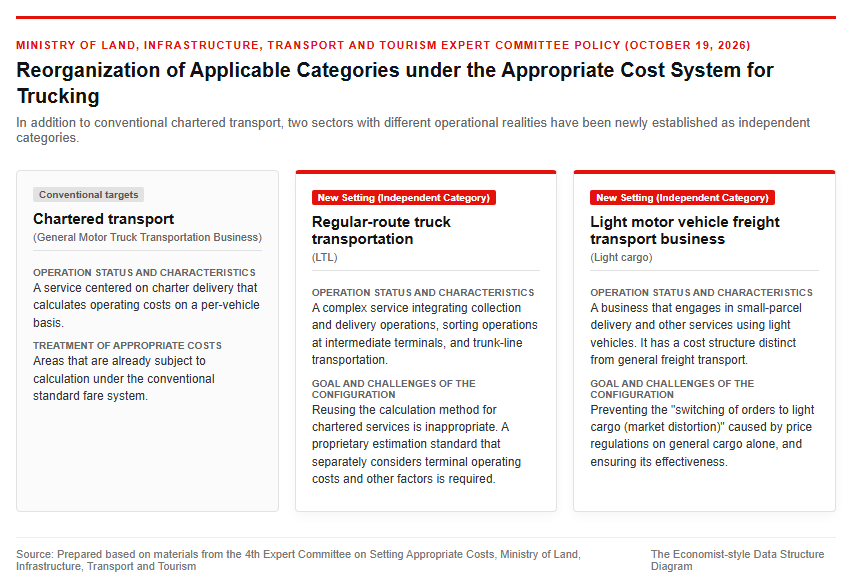
Clarification of calculation methods according to transport modes and maintenance of vehicle type classifications
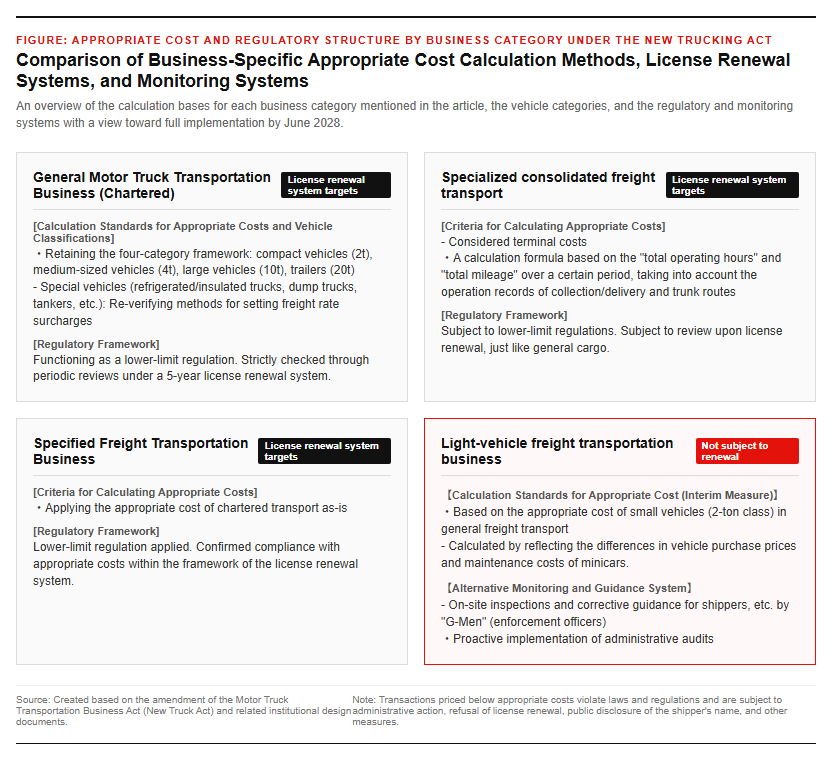
As for the detailed calculation methods for each category in the system design, regarding Tokuzumi (consolidated trucking), calculation formulas based on total operating hours and total mileage over a certain period—taking into account terminal costs and operation records for collection/delivery and trunk-line transportation—are being considered. For the light cargo transport business, since there is currently a lack of sufficient statistical data to accumulate and analyze individual cost data, a proposal has been presented as an interim measure to calculate costs based on the appropriate cost of small vehicles (2-ton class) in general freight, reflecting the differences in vehicle purchase prices and maintenance costs for mini-vehicles. In addition, for the specified motor vehicle transport business, it was decided that the appropriate cost for chartered transport would be applied as-is. Regarding the vehicle classifications for general freight (chartered transport), it has been confirmed that the basic framework of four classifications—small vehicles (2-ton class), medium vehicles (4-ton class), large vehicles (10-ton class), and trailers (20-ton class)—used in conventional standard freight rates will be maintained. Furthermore, for special vehicles such as refrigerated/freezer trucks, dump trucks, and tank trucks, the method for setting freight rate surcharges relative to standard vehicles is being re-examined, and reviews are underway to revise the calculation rules so that they do not diverge from the realities of transport operations.
Legal Background and Linkage with the “Freight Transport Business License Renewal System”
Introduction of Binding Force Under the New Truck Law and the Transition from Standard Freight Rates
This series of recent developments is based on the Act for Partial Revision of the Trucking Business Act (commonly known as the New Trucking Act) and the Act on the Promotion of the Establishment of Systems for Ensuring the Proper Operation of the Trucking Business (collectively known as the Two Trucking Compliance Acts), both promulgated in June 2025. Under the conventional standard freight rate system, the government merely issued public notices serving as guidelines for transaction prices without any legally binding force. As a result, it failed to prevent price squeezing and unfair low-rate dumping competition by shippers and primary contractors, acting as a contributing factor that left drivers’ long working hours and low-wage conditions unaddressed. In contrast, the appropriate cost under the new system functions as a strict lower-limit regulation that legally prohibits contracts and transactions at prices below the notified level. If a business operator continues to contract at freight rates below the appropriate cost, it will constitute a clear violation of the law. Not only will they be subject to administrative dispositions, but they will also face the risk of having their business license renewal rejected under the five-year freight transportation business license renewal system, which will be fully implemented by June 2028. Furthermore, corrective measures—such as focused guidance, recommendations, and the public disclosure of company names by the Truck and Logistics G-Men—will be strictly enforced against shippers and primary contractors who commit violation-causing acts by forcing unjustifiably low freight rates.
Design of a Monitoring and Guidance System for Light Cargo Transport Not Subject to the Permit Renewal System
One of the major points of discussion in this system design is the institutional consistency between the freight transportation business license renewal system and the various business categories. General motor truck transportation business operators and their affiliated “tokuzumi” (regular-route LTL) operators are directly subject to the five-year license renewal system, and under this framework, compliance with appropriate costs is strictly checked during periodic reviews. However, light-vehicle freight transportation businesses are not legally included in this license renewal system, presenting the challenge that legal compliance cannot be confirmed through renewal reviews. To address this institutional loophole, the Ministry of Land, Infrastructure, Transport and Tourism has outlined a policy to comprehensively develop measures to ensure the fulfillment of appropriate costs in the light-vehicle sector. Specifically, a monitoring and guidance system centered on the following three measures is currently under consideration.
- Strengthening direct on-site inspections and corrective guidance for shipper companies and primary contractors by truck and logistics G-men
- Proactive Implementation of Administrative Audits for Light Cargo Transport Operators and Crackdown on Violations
- Introduction of a mechanism to verify appropriate payment status to subcontractors during the business permit renewal for general freight motor carriers that subcontract operations to light cargo carriers.
This is aimed at ensuring effective fair trade practices even in the light-cargo transport industry, which is exempt from the permit renewal system.
Reactions of Shippers and Relevant Ministries, and Future Schedule
Transparency in the basis of calculation and efficiency incentives demanded by the Ministry of Economy, Trade and Industry and shippers
At the fourth review meeting, the results of hearings conducted by the Ministry of Economy, Trade and Industry and the Ministry of Agriculture, Forestry and Fisheries targeting shipper companies and various industry associations were reported. Many shipper organizations express support for the policy of introducing a fair cost system itself, from the perspective of building a sustainable logistics framework and securing drivers. However, on the other hand, they are concerned that the system may carry strong legal binding force with penalties imposed for violations, and they strongly demand the establishment of clear standards for practical operations. In particular, the Ministry of Economy, Trade and Industry asserted that costs (expenses) essential for safe operations should be strictly distinguished from freight rates, which constitute the operator’s profit, and raised doubts, from a corporate accounting perspective, about including investment capital sources in costs. Furthermore, there is a call for the provision of objective and highly transparent calculation rules that allow shippers to accurately verify whether their ordering prices match the fair costs. Additionally, to avoid a vicious cycle in which efforts to improve logistics efficiency—such as reducing cargo-waiting times and improving loading rates—result in decreased mileage and operating hours, which in turn lowers the calculated fair cost amount and reduces operators’ revenues, discussions are taking place regarding the necessity of designing a system where the fruits of efficiency efforts are passed on to both shippers and transport operators.
Future outlook and points of focus: Toward the compilation of recommendations within the year and full implementation in 2028
Deliberations by the government and relevant ministries toward the full-scale introduction of the appropriate truck cost system are entering their final phase. On October 27, 2026, the Ministry of Land, Infrastructure, Transport and Tourism held the 2nd Logistics Policy Promotion Stakeholder Meeting, reporting on the status of issue organization by the expert review committee and the policy for initiatives during the intensive monitoring month by the Truck and Logistics G-Men. In the expert review committee, ahead of the final compilation scheduled for December, an interim framework outlining the overall system is expected to be presented at the next meeting. The government aims to fully implement the appropriate cost system by June 2028, which is within three years from June 11, 2025—the date of the law’s promulgation—and is rushing to finalize calculation formulas and formulate guidelines. For transport operators, building a system to accurately understand their own operating costs has become indispensable, while for shipper companies, reviewing ordering processes and contract clauses, and strengthening governance centered on Chief Logistics Officers (CLOs) have become urgent tasks. The greatest focus moving forward will be whether the appropriate cost system does not merely result in increased cost burdens, but rather leads to structural reform of the entire logistics industry and the establishment of a sound market environment.
Reference Page
- [Ministry of Land, Infrastructure, Transport and Tourism Press Release] https://www.mlit.go.jp/report/press/tokatsu01_hh_001044.html
[#TruckProperCost #MinistryOfLandInfrastructureTransportAndTourism #LTL #LightCargo #Logistics2024Problem #NewTruckLaw #LogisticsEfficiency]


コメント