Capcom Co., Ltd. has announced that unauthorized access occurred to its “CAPCOM ID” membership service, resulting in the leak of approximately 11.77 million pieces of user information worldwide. This incident reflects the growing complexity of customer data management, accumulated through years of advancing digital transformation, alongside the threat of increasingly sophisticated cyberattacks.
- Key point of the incident: Leak of over 11.77 million account information records
- Breakdown of leaked data and the actual damage caused by unauthorized modifications
- Response flow from unauthorized access detection to access blocking
- 2020年的ランサムウェア攻撃と旧型機器を狙った脆弱性
- Strengthening the SOC and XDR Framework through Collaboration with External Experts
- Future Developments and Security Protection Measures Users Should Take
Key point of the incident: Leak of over 11.77 million account information records
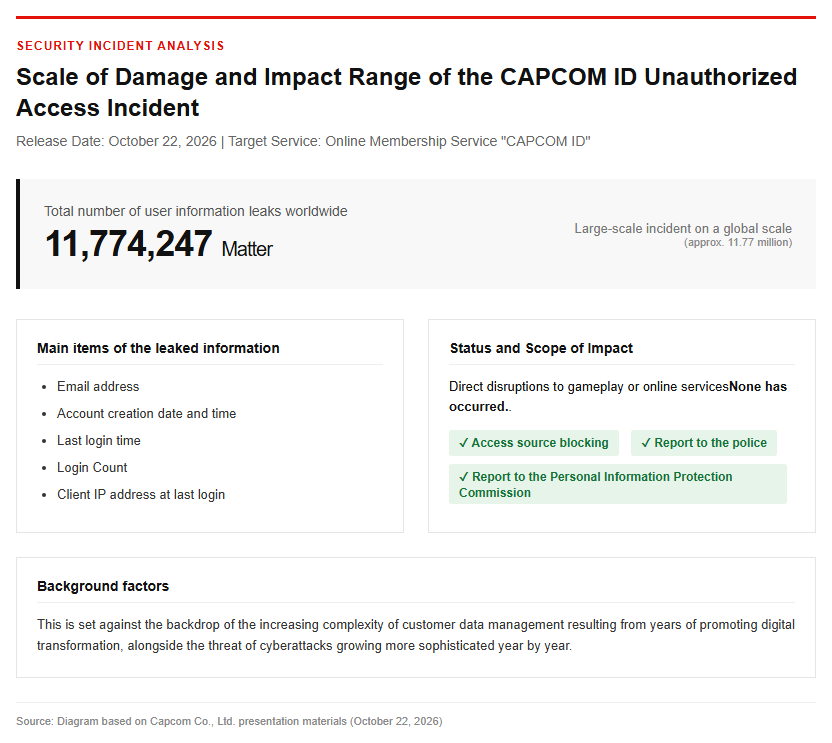
On October 22, 2026, Capcom Co., Ltd. announced that its online membership service, “CAPCOM ID,” was subjected to unauthorized access by a third party, resulting in a user information leak. The confirmed leaked information totals 11,774,247 items worldwide.
The targets included email addresses registered to CAPCOM IDs, as well as system-specific identification information such as account creation dates and times, last login times, login counts, and client IP addresses at the time of last login. This was an attack targeting online accounts that serve as the foundation for gameplay and services, resulting in damage on a global scale.
The company blocked the access source immediately after the incident came to light and has completed reports to the police and the Personal Information Protection Commission. It has been explained that no direct disruptions have occurred to currently provided game titles or online services themselves, but public interest is growing as an incident involving large-scale user data.
The figure below summarizes the scale of damage and the scope of impact.
Breakdown of leaked data and the actual damage caused by unauthorized modifications
Of the 11.77 million-plus account information records leaked this time, the majority are limited to identifying information such as email addresses and system logs, but for some users, damage involving more detailed personal information and unauthorized account operations has been confirmed.
Specifically, profile information such as date of birth, gender, country/region, and nickname was leaked for 43 accounts in total. Furthermore, 196 accounts suffered unauthorized changes to their login passwords.
Meanwhile, Capcom emphasizes that it has not confirmed any leaks of the encrypted passwords set by users themselves or any leakage of credit card information. Because payment processing relies on an outsourced system, the company is structured in a way that does not store card information internally. For the 196 accounts with illegally modified settings, the company immediately took emergency measures to reset their passwords.
Background of the Discovery and Its Structural Relationship with Past Cyber Attack Incidents
Response flow from unauthorized access detection to access blocking
This incident came to light after Capcom’s system operations team discovered traces of unauthorized access on the CAPCOM ID management server on October 19, 2026.
Upon detecting suspicious traffic, the company immediately blocked the relevant access routes and took emergency measures to prevent the damage from spreading externally. After confirming the unauthorized access on the same day, an expert team began analyzing system logs and investigating to determine the scope of the impact.
The following day, October 20, the scale of the leaked data and the detailed extent of the damage became clear, and preparations were advanced to report to the relevant authorities and make a public announcement. The company has been sequentially notifying users who may have been affected, while also establishing a dedicated help desk to handle inquiries and working to prevent secondary damage.
2020年的ランサムウェア攻撃と旧型機器を狙った脆弱性
This is not the first time Capcom has suffered a major cyber incident. In November 2020, the company was hit by a custom-made ransomware attack by an attacker group calling itself “Ragnar Locker,” which resulted in the encryption of files on its internal network and the leak of personal information for 15,649 individuals.
An investigation into the cause of the 2020 incident revealed that a spare legacy VPN device remaining at the North American subsidiary served as the intrusion path. The vulnerabilities in the legacy equipment, which had been left in place as an emergency measure to cope with the increased communication load accompanying the spread of COVID-19, were exploited by attackers.
Attack methods targeting gaps in perimeter-based security and legacy infrastructure share structural commonalities with this recent unauthorized access incident. As attacks become increasingly sophisticated and diversified, maintaining the security of network perimeters and authentication infrastructure across the entire group, including overseas locations, has become a major challenge.
The Evolution of Capcom’s Security Measures and Future Outlook
Strengthening the SOC and XDR Framework through Collaboration with External Experts
Since the 2020 incident, Capcom has been vigorously working to rebuild its company-wide security system. It has established a “Security Oversight Committee” composed of external experts such as university professors and lawyers, and is working to strengthen governance based on the PDCA cycle.
On the technical front, in addition to the company-wide deployment of EDR for the early detection of suspicious endpoint behavior, we have established an XDR-based SOC structure that constantly monitors multiple domains, including the cloud and network. Furthermore, in the development department, the implementation of a Privileged Access Management (PAM) solution has enabled the obfuscation of privileged access and greater transparency in server management.
In recent years, we have been promoting multi-layered defense incorporating cutting-edge technologies, such as the use of generative AI to help streamline threat detection and the introduction of cloud-based sandboxes in development environments. However, as systems become more complex, the difficulty of completely preventing sophisticated attacks has also become apparent.
Future Developments and Security Protection Measures Users Should Take
Capcom has announced that, to prevent future occurrences, it will leverage the insights gained from the investigation to completely identify the attack methods and further enhance its system security. Government agencies, including the Financial Services Agency, are also calling for reviews of non-face-to-face authentication and third-party risk management in response to the recent surge in unauthorized access, as security standards across society as a whole are being raised.
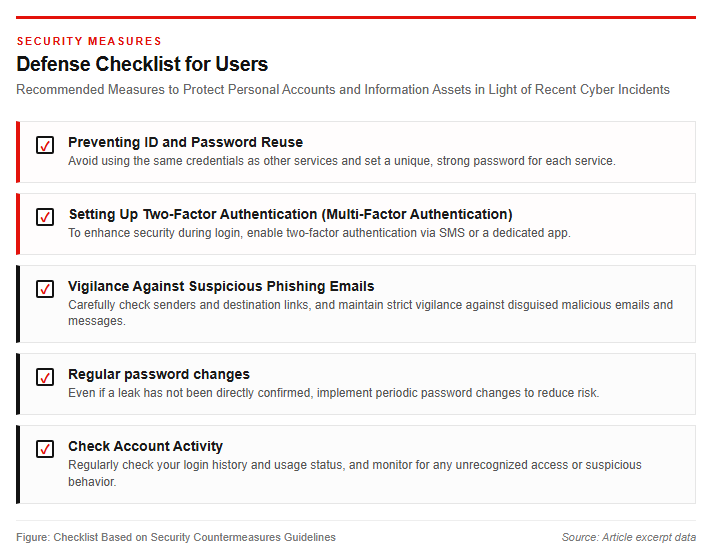
Measures required on the user side include avoiding the reuse of the same ID and password used for other companies’ services, setting up two-factor authentication, and maintaining strict vigilance against suspicious phishing emails. Even if no leakage of the login password itself has been confirmed, regularly changing passwords and checking account activity are recommended.
The diagram below shows a checklist of security measures that users should take.
Reference page
- [Report on the Investigation Regarding Unauthorized Access (4th Report)] https://www.capcom.co.jp/ir/news/html/210413.html
- [Notice and Apology Regarding Information Leak Due to Unauthorized Access] https://www.capcom.co.jp/ir/news/html/201116.html
- [Sustainability Initiatives | Information Security] https://www.capcom.co.jp/ir/sustainability/security.html
- [Strengthening Cybersecurity Measures in Light of the Current Situation and Responses Regarding Various Transaction Applications, etc.] https://www.fsa.go.jp/news/r8/sonota/20261009/20261009.html
【#Capcom #Cybersecurity #DataBreach #CAPCOMID #UnauthorizedAccess #SecurityMeasures】


コメント