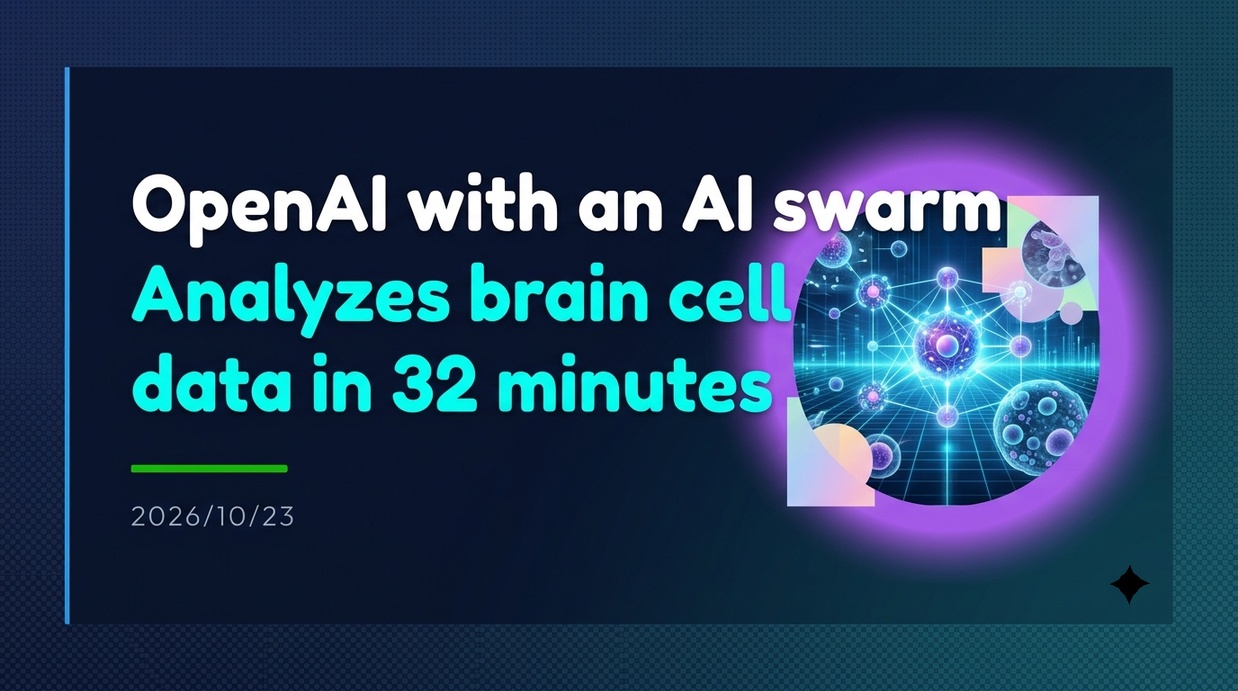
In collaboration with Scripps Research and PerturbAI, OpenAI used 1,946 AI agents to analyze approximately 7.7 million mouse brain cell data points in 32 minutes. The background to this is the problem that human experts’ analytical capabilities cannot keep up with the explosive increase in large-scale CRISPR gene screening data.
- Ultra-fast analysis for 32 minutes by 1,946 AI agents
- The context window limitations faced by conventional single models
- Linkage Between Loss of Function in the DCTN1 Gene and Cholesterol Metabolism Abnormalities
- Functional Differences Between Tsc1 and Tsc2 in the Cerebellum and Implications for Tuberous Sclerosis
- Validation of Expert Endorsement and Literature Search Capabilities in Blinded Evaluation
- Future Developments and Key Areas of Focus for AI Agents in Life Science Research
Ultra-fast analysis for 32 minutes by 1,946 AI agents
On October 21, 2026, OpenAI, in collaboration with Scripps Research and biotechnology company PerturbAI, announced the results of a large-scale demonstration experiment analyzing gene manipulation data across the entire mouse brain. In this study, 1,946 AI agents powered by “GPT-Rosalind,” an AI model specialized in the life sciences, were operated using distributed parallel processing to analyze data from the “Whole-Brain CRISPR Atlas” obtained from approximately 7.7 million brain cells and 1,946 types of gene knockouts.
Traditionally, analyzing the effects of a single gene mutation on various cell types, cross-referencing them with vast amounts of existing literature, and interpreting their biological significance required an immense amount of time—ranging from several months to about a year—even for a team of human researchers. However, in this decentralized AI agent architecture, each agent was dedicated to analyzing a single set of gene mutation data, simultaneously and in parallel executing tasks such as identifying cellular responses, searching existing literature, and inferring biological mechanisms. As a result, the analysis process that previously took months was completed in the remarkably short time of just 32 minutes.
The following diagram shows the processing flow of the distributed AI agents in the whole-brain CRISPR atlas analysis.
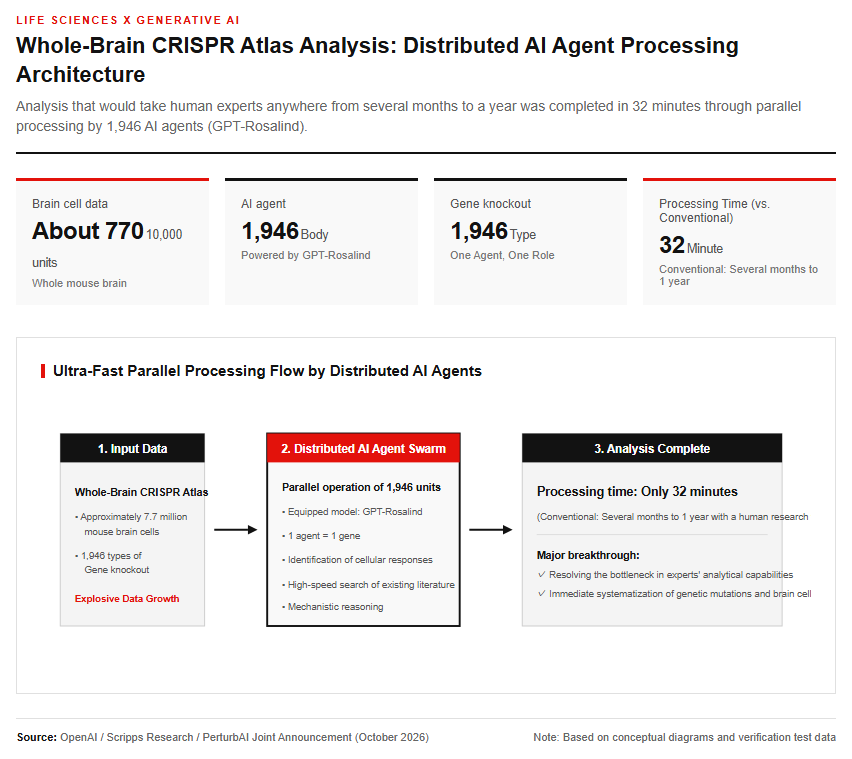
This technology demonstrates not only improved computational speed, but also the ability to transform large-scale screening data into immediately testable hypotheses.
The context window limitations faced by conventional single models
When analyzing large-scale biological data with AI, conventional single models have faced a serious technical challenge known as “context window saturation.” When an entire massive dataset is fed into a single AI model, as the amount of data increases, the allocation of attention to individual genetic mutations or specific cell-type responses diminishes, squeezing out the context space required for detailed literature searches and deep reasoning.
In actual experiments, when the entire dataset was processed sequentially by a single GPT-Rosalind model, only about 11 scientific papers could be extracted and referenced across the entire atlas. This resulted in a determination that literature information did not exist for many genetic mutations, hindering the deepening of the analysis.
In contrast, the distributed architecture adopted this time avoided context window saturation by assigning only a single genetic mutation profile to each of the 1,946 agents. Each agent was able to concentrate its entire processing capacity on a specific genetic mutation analysis, making it possible to conduct independent searches of related literature and detailed programming verification. As a result, the distributed agent group as a whole maintained over 7,000 literature references, achieving more than 700 times the literature coverage compared to a single model.
New Biological Discoveries Unlocked by AI Swarms
Linkage Between Loss of Function in the DCTN1 Gene and Cholesterol Metabolism Abnormalities
One of the most notable biological discoveries in this analysis using distributed AI agents is the proposal of a novel mechanism regarding mutations in the “DCTN1” gene. DCTN1 (dynactin 1) is a component of the molecular motor that transports substances such as proteins and organelles along axons inside nerve cells, and its mutations are known to cause severe neurodegenerative diseases such as Perry syndrome, amyotrophic lateral sclerosis (ALS), and Parkinson’s disease.
When a group of AI agents analyzed data on the functional loss of DCTN1, they discovered a phenomenon where the activity of a series of genes involved in cholesterol synthesis and metabolism is remarkably elevated in brain neurons. By cross-referencing a vast amount of past literature, the agents formulated a novel pathophysiological hypothesis: due to intracellular transport stalling caused by DCTN1 dysfunction, neurons sense a local shortage of cholesterol and compensatorily over-enhance their own cholesterol production.
The figure below illustrates the conceptual impact of DCTN1 gene mutations on the cholesterol metabolism pathway.
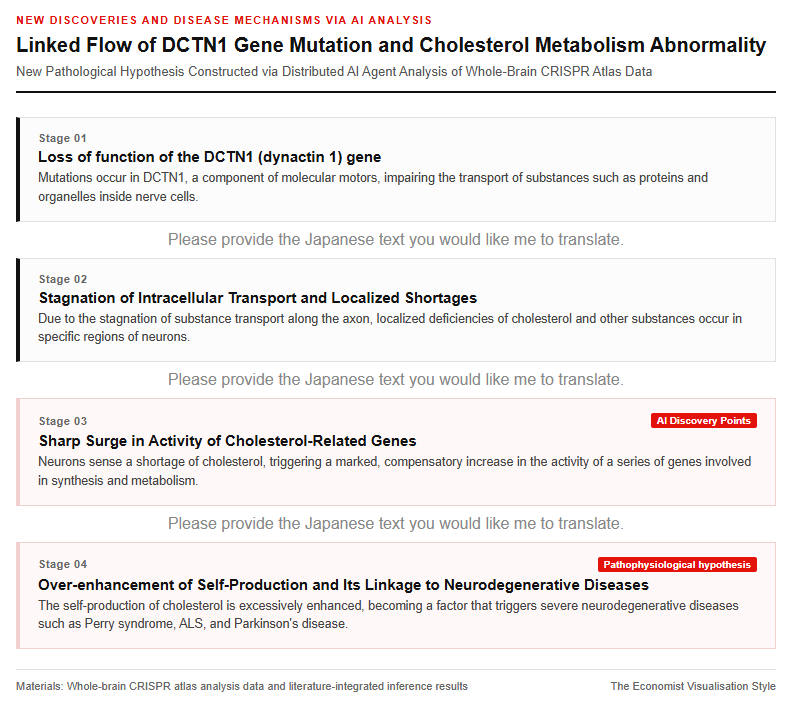
This discovery points to a novel drug discovery target—lipid metabolism disorders in neurodegenerative diseases—and has received extremely high praise from experts.
Functional Differences Between Tsc1 and Tsc2 in the Cerebellum and Implications for Tuberous Sclerosis
The AI agents also uncovered important cell-type-specific differences in responses that deepen conventional understanding regarding the “Tsc1” and “Tsc2” genes, which are involved in the mTOR pathway, a key regulator of cell growth and metabolism. Because Tsc1 and Tsc2 normally form a protein complex and function together, knocking out either gene results in nearly identical changes in gene expression across many neuronal cell types.
However, when analyzing data from cerebellar GABAergic neurons involved in motor control and cognitive function, a clear functional dissociation was detected: inactivating Tsc2 significantly altered the expression of 83 genes related to neurotransmission and calcium signaling, whereas inactivating Tsc1 resulted in almost no observable changes in gene expression.
Clinically, mutations in Tsc2 tend to cause more severe symptoms of tuberous sclerosis compared to Tsc1 mutations, with a particularly strong association noted with cerebellar lesions and autism-like symptoms. The cerebellum-specific molecular changes presented by the AI agent provide a direct clue to explaining the long-standing mystery of why two genes forming the same complex produce different clinical pictures, and are expected to contribute to the development of cell-type-focused targeted therapeutics.
Evaluation of Decentralized AI Analysis and Future Prospects
Validation of Expert Endorsement and Literature Search Capabilities in Blinded Evaluation
To verify the validity of the analytical reports and hypotheses generated by the distributed AI agent system, a blind evaluation was conducted by 30 biology experts holding Ph.D.s. The reports were presented to the evaluators without disclosing the analytical methods or the AI architecture, and evaluated from perspectives such as novelty, evidentiary support, and priority for future follow-up experiments.
As a result, 75% of experts clearly preferred the analysis results produced by distributed AI agents over those by a single AI model. In particular, regarding the replication priority metric of “whether the presented findings are worth replicating in the lab,” it was confirmed that the output of the distributed agents strongly correlated with the intuition and judgment criteria of human experts.
Furthermore, in a control experiment where the dataset’s gene labels were randomly shuffled, the literature matching rate dropped significantly. This demonstrates that the AI agent is not simply connecting general biological terms at random, but is instead rigorously detecting and evaluating the true biological consistency between the input gene expression profile and existing literature.
Future Developments and Key Areas of Focus for AI Agents in Life Science Research
The results of this research mark a major turning point in overcoming the bottleneck of interpreting large-scale experimental data in the field of life sciences. In recent years, advancements in CRISPR screening and single-cell RNA sequencing technologies have generated petabyte-scale causal genomics data, but the speed at which it can be interpreted has relied on human processing capacity.
Moving forward, primary analysis by groups of decentralized AI agents and the construction of inference atlases are expected to become the standard process for target identification. By having agents automatically extract promising mechanisms from thousands of experimental data points and prioritize them, researchers will be able to focus on the most creative tasks: designing validation experiments and making decisions.
On the other hand, hypotheses presented by AI are merely predictions, and wet-lab validation in the laboratory is essential. Going forward, attention is focused on the establishment of an automated research cycle that closely integrates predictive models and distributed agents, seamlessly connecting everything from in silico hypothesis generation to validation by automated experimental robots and data feedback.
Reference Page
- [Official OpenAI Announcement] https://openai.com/index/scaling-ai-research-for-complex-biological-data/
- [bioRxiv Paper] https://www.biorxiv.org/content/10.64898/2026.10.15.759436v1
- [GitHub Repository] https://github.com/jinlabneurogenomics/distributed_agent
- [Hugging Face Dataset] https://huggingface.co/datasets/perturbai/wholebrain_crispr_atlas
[#AI #BrainScience #OpenAI #LifeSciences #DrugDiscovery #CRISPR]
コメント