On October 22, 2026, Toshiba announced that it has developed two AI technologies that accurately recognize site-specific equipment noises, alarm sounds, and workers’ utterances using a small amount of data. The background to this includes the worsening labor shortage in manufacturing and social infrastructure sites, as well as the challenge of passing down expert know-how.
- Announcement of a New Technology for High-Accuracy Recognition of On-Site Sounds and Speech Using Limited Data
- The Barrier of Large-Scale Data Collection and Environmental Noise That Has Hindered Traditional AI Adoption
- Few-Shot Acoustic Event Detection Technology That Misses No Abnormal Sounds with Few Examples
- Speech Recognition Technology Utilizing Error Correction Records, Linking User Correction History with LLMs
- Technical Evaluation and Benchmark Performance at the International Conference Interspeech 2026
- Social Implementation and Future Prospects of Physical AI as a “Sense of Hearing”
Announcement of a New Technology for High-Accuracy Recognition of On-Site Sounds and Speech Using Limited Data
On October 22, 2026, Toshiba Corporation announced the development of two AI technologies for manufacturing and social infrastructure sites that recognize equipment sounds, alarm sounds, and worker utterances with high precision using small amounts of data. The two developed technologies are “Few-shot acoustic event detection technology,” which detects specific sounds from a small number of sound examples, and “Error-correction-record-utilizing speech recognition technology,” which improves the transcription accuracy of technical terms by utilizing user correction history. In the social implementation of physical AI, which recognizes real-world information to make decisions and take actions, the role of “hearing” in accurately capturing equipment state changes and the operational know-how of skilled workers contained in sound and speech is growing increasingly important. This technological development is positioned as a groundbreaking achievement that drives on-site DX while significantly reducing the burden of implementation and operation. Please refer to the figure below.
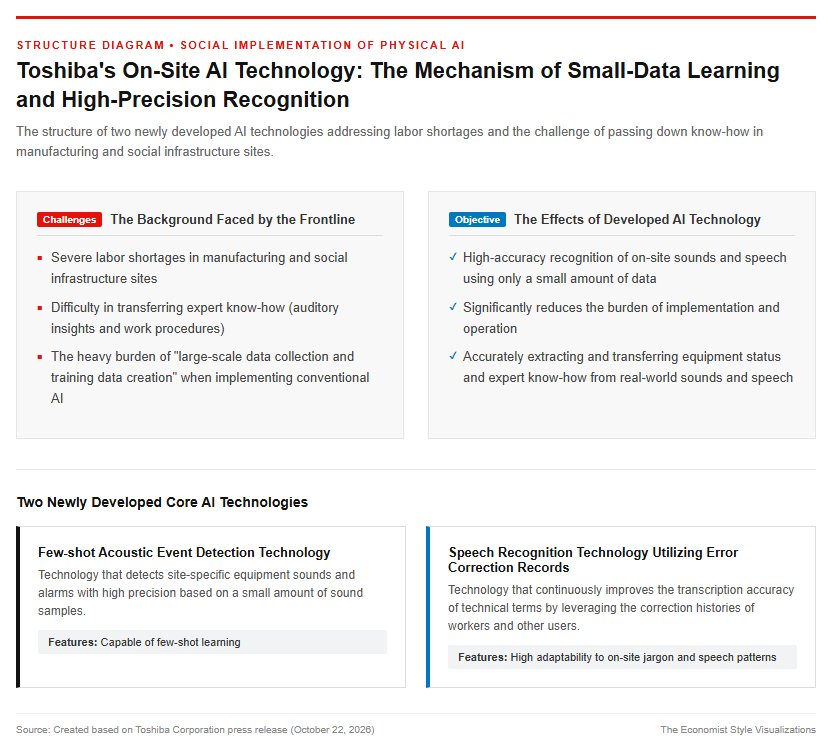
A major feature is that it can instantly adapt to the sound environments and specialized vocabulary that differ from site to site, eliminating the need for large-scale data collection and model retraining, which have traditionally been challenges in AI implementation.
The Barrier of Large-Scale Data Collection and Environmental Noise That Has Hindered Traditional AI Adoption
In workplaces such as factories and infrastructure facilities, the sounds generated vary greatly depending on the target equipment, monitoring purpose, and work process. With conventional AI recognition technology, every time the site or application changed, it was necessary to collect a large amount of sound data and additionally train a dedicated AI model. However, because sounds indicating equipment failures or anomalies occur with extremely low frequency, there has been an inherent challenge in that it is difficult to collect the data necessary for training in advance. In addition, in actual operational sites, machine operating sounds, ambient noise, and sound reverberation are mixed together, creating a problem where the detection accuracy of AI models tends to drop significantly. Even in the field of speech recognition, low-frequency words such as new product names, equipment-specific model numbers, and technical terminology are prone to misrecognition, and every time new words increase, manual dictionary updates and recognition error correction tasks arise, increasing the operational burden.
Technical Features of the Two Core Technologies Developed
Few-Shot Acoustic Event Detection Technology That Misses No Abnormal Sounds with Few Examples
The first developed technology, few-shot acoustic event detection technology, identifies intervals where the same type of sound occurs from long-duration recorded data and outputs the start and end times simply by registering a few sample data items of the sound you want to detect. By utilizing a sound foundation model that has learned the characteristics of various sounds in advance, it flexibly changes detection targets such as abnormal sounds or alarm sounds without requiring site-specific data collection or additional training. As a noise countermeasure, we adopted a proprietary method that estimates background noise characteristics from the sound samples and on-site recorded data, and performs matching by suppressing the influence of noise from the target sound. This minimizes false positives and missed detections even in harsh environments where machine operation sounds and other noises overlap. Please refer to the figure below.
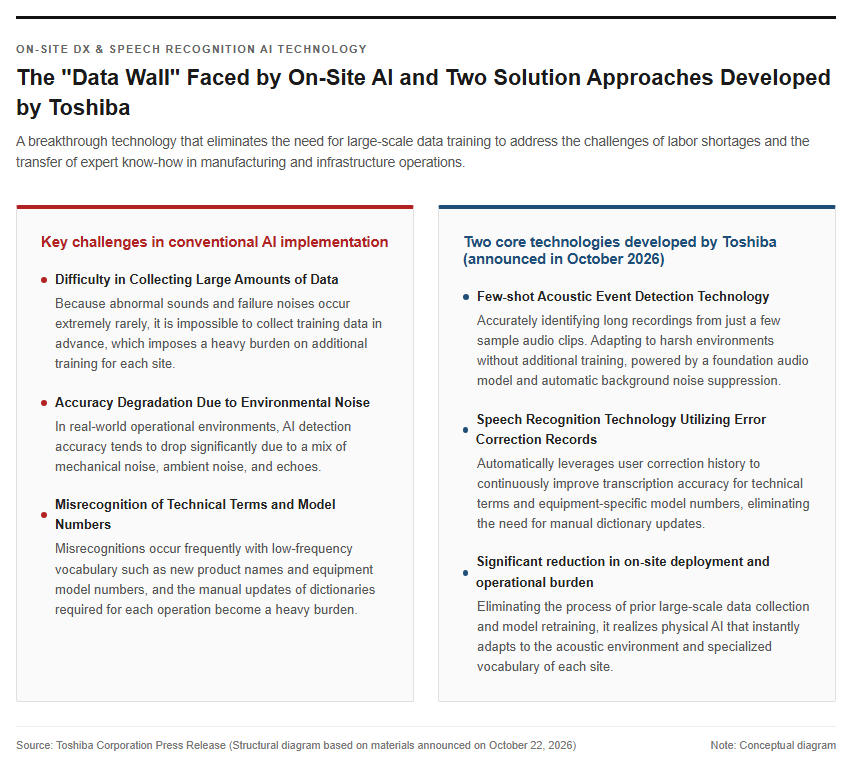
Because it also supports real-time sound detection, it is ideal for integration into remote monitoring and anomaly detection systems for equipment where promptness is required.
Speech Recognition Technology Utilizing Error Correction Records, Linking User Correction History with LLMs
The second is an error-correction-log-utilizing speech recognition technology, which accumulates pairs of incorrect transcriptions by speech recognition AI and correct expressions manually corrected by users as correction logs, and inputs them into a large language model (LLM) to post-correct similar errors. It can improve the recognition rate of technical terms and proper nouns without requiring retraining of the speech recognition model itself or dictionary updates. On the other hand, as operation continues and correction logs grow to hundreds or thousands of entries, a method of passing all logs to the LLM every time raises concerns about increased processing load and decreased correction accuracy due to irrelevant logs. To address this, this technology achieves a two-stage control mechanism in which an edge-based keyword detection AI extracts keywords likely to have been spoken from the audio, carefully selects only the relevant correction logs, and passes them to the LLM. This makes it possible to maintain stable correction processing while suppressing the amount of input data.
実証成果と社会実装に向けた将来展望
Technical Evaluation and Benchmark Performance at the International Conference Interspeech 2026
The results of both technologies were presented at Interspeech 2026, an international conference in the field of speech and acoustic signal processing held in Sydney, Australia. In the evaluation of acoustic event detection using validation data from the international competition “DCASE 2024 Task 5,” the model achieved an F-measure of 62.35% under conditions without additional model training, demonstrating top-tier detection performance comparable to conventional methods that utilize additional training. Furthermore, in speech recognition evaluations using English (Earnings-21) and Japanese (Corpus of Spontaneous Japanese, CSJ) speech data, the keyword selection function successfully reduced the number of characters input to the LLM by 70.9% for English and 71.7% for Japanese. Despite significantly reducing the character count, the F-measure for specialized terminology keyword recognition improved from 83.6% to 85.6% in English and from 64.8% to 67.3% in Japanese, proving the simultaneous achievement of reduced processing load and higher accuracy in both languages.
Social Implementation and Future Prospects of Physical AI as a “Sense of Hearing”
Toshiba plans to deploy these technologies across a wide range of industrial sites in the future, including manufacturing, energy, and social infrastructure, as well as logistics, construction, and contact centers. By applying them to equipment anomaly detection, operational monitoring, and supporting the automated generation of work logs and maintenance reports containing technical terminology, the company aims to drive on-site operational efficiency and facilitate the transfer of tacit knowledge from veteran workers. Toshiba is currently advancing system development toward this implementation, targeting practical application in approximately three years. Looking ahead, the company also envisions expanding into autonomous support functions where the AI itself determines the appropriate countermeasures based on detected sounds, rather than merely identifying their occurrence. By building an audio and speech understanding foundation that integrates “auditory” information with video and sensor data, this initiative is expected to strongly accelerate the societal deployment of physical AI capable of sophisticated decision-making and actions in real-world environments.
Reference page
- [Toshiba Official R&D News] https://www.global.toshiba/jp/technology/corporate/rdc/rd/topics/26/2610-01.html
【#Toshiba #AITechnology #SpeechRecognition #AcousticEventDetection #PhysicalAI】

コメント