In October 2026, Google Cloud announced “Agent Compute Engine (ACE),” a compute service dedicated to AI agents. This announcement comes in response to challenges regarding execution efficiency and security assurance, which have arisen due to the rapid surge in the use of autonomous AI agents.
- Events and Key Points of ACE Announced in October 2026
- Comparison with Traditional Virtualization Infrastructure and How MicroVM Technology Works
- Resource efficiency and fast startup/shutdown using dedicated microVMs
- Hardware Isolation and Security Design That Leaves No Credentials
- Governance Extension to Third-Party Clouds and Local Environments
- Future Developments and Challenges & Prospects for Company-Wide Rollout
Events and Key Points of ACE Announced in October 2026
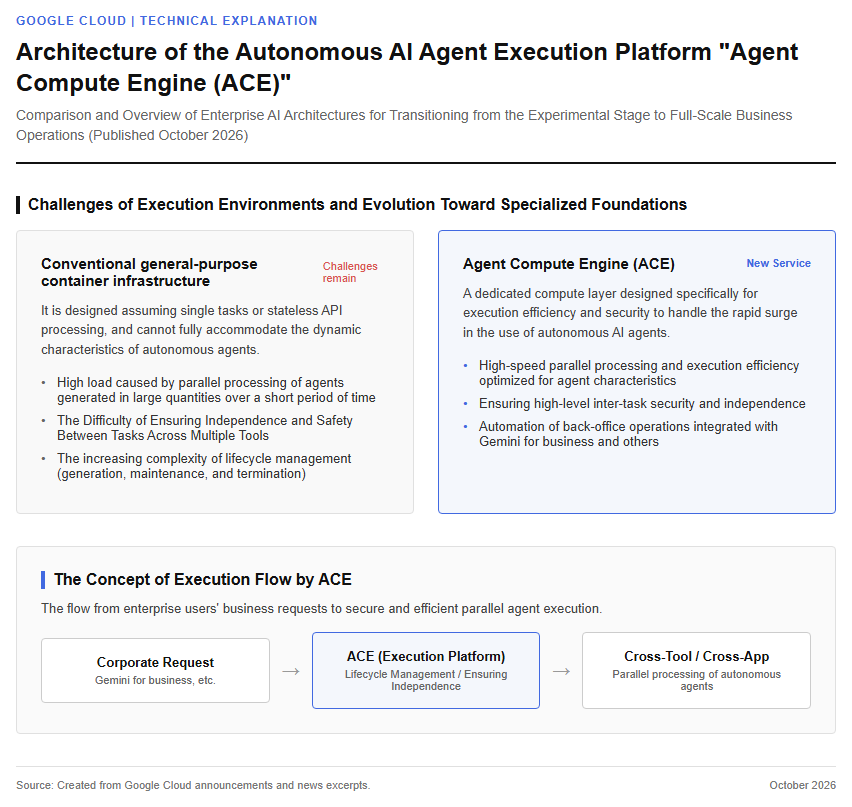
On October 22, 2026, at the “AGNTCon + MCPCon” conference held in the United States, Google Cloud announced the Agent Compute Engine (ACE), a new compute service dedicated to AI agents. ACE is designed as a dedicated execution infrastructure to support autonomous AI agents operating within enterprise AI services such as “Gemini for business.” This announcement comes as enterprise adoption of AI agents shifts from the experimental stage to full-scale business operations in 2026, leading to a rapid surge in the load and security risks associated with agents operating autonomously across multiple tools and applications. Traditional general-purpose cloud environments and container infrastructures have made it difficult to generate and process large volumes of agents in parallel in short periods, or to safely maintain independence between tasks. To address these challenges, Google Cloud developed ACE as a compute layer specialized for the lifecycle and execution characteristics of agents. A preview of ACE is scheduled to begin within the next few months, and it is expected to serve as a core infrastructure supporting the automation of enterprise back-office operations and development processes. The following image shows an overview of the agent execution environment.
Comparison with Traditional Virtualization Infrastructure and How MicroVM Technology Works
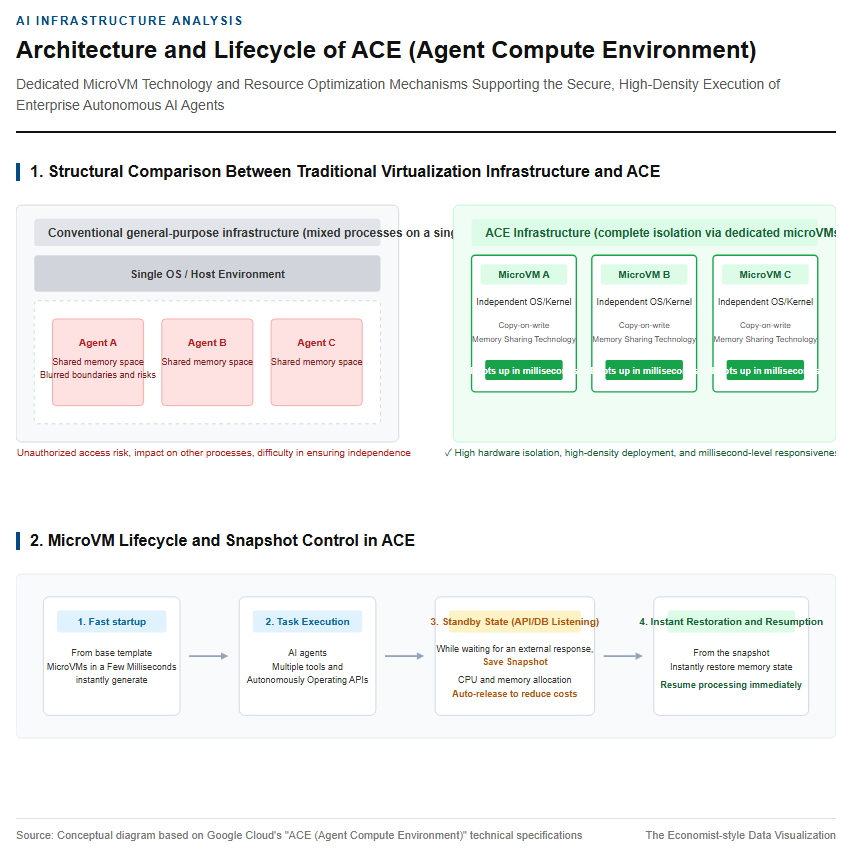
The defining feature of ACE lies in its adoption of an architecture that independently allocates a dedicated “microVM” to each executing AI agent. In conventional systems, mixing multiple agent processes on a single operating system (OS) blurred memory space boundaries, creating the problem of unauthorized access risks to other agents or the host system. In contrast, ACE utilizes efficient memory-sharing technology based on a copy-on-write approach, realizing a mechanism that instantly spins up lightweight microVMs in milliseconds from a common base OS template. This overcomes the challenges of long startup times and overhead inherent in traditional virtual machines, while enabling high-density deployment and rapid response comparable to containers. Furthermore, when an agent enters a standby state waiting for the execution results of a tool, the microVM is immediately paused, its memory state is saved as a snapshot, and processing is put on hold. By instantly restoring from the snapshot upon resumption, the system drastically reduces wasteful consumption of computational resources, dramatically improving cost performance and scalability.
Advanced Architecture and Security Provided by ACE
Resource efficiency and fast startup/shutdown using dedicated microVMs
A major characteristic of AI agent task execution is that the time spent waiting for external API calls and database search results accounts for the majority of the total execution time. ACE is optimized for this processing pattern, implementing control that automatically releases CPU and memory allocations for agents in a waiting state. By achieving this fast startup and pause cycle, it has successfully and dramatically increased the number of agents that can run simultaneously on a single physical server (workload density). Gautham Tambidurai, Vice President for Gemini, states that millisecond-level responsiveness and high hardware isolation are essential to delivering interactive agent sandboxes to users worldwide. Such microVM-level resource control builds an infrastructure capable of processing tasks generated simultaneously by thousands of agents without delay, even within large-scale enterprise networks. The conceptual diagram below illustrates the flow of stopping and resuming snapshots in ACE.
Hardware Isolation and Security Design That Leaves No Credentials
From a security standpoint, ACE provides a complete hardware-driven isolation environment powered by “Titanium,” Google’s proprietary infrastructure processing unit, and “Cloud Hypervisor,” a lightweight hypervisor. Each microVM possesses its own guest kernel and administrator privileges (root privileges), and is individually assigned a cryptographically verified unique identifier (ID) along with short-lived credentials. A particularly groundbreaking design principle is that no credentials required for connecting to external services, such as access tokens or private keys, are held inside the microVMs whatsoever. During actual communication, a checkpoint (proxy layer) located outside the microVM automatically injects the credentials and sends the request. This architecture fundamentally eliminates the risk of credentials leaking from the inside, even if the agent within the microVM is compromised by a prompt injection attack or the reading of a malicious email. A zero-trust architecture that ensures thorough data protection even against advanced threats has been realized.
Governance Beyond the Cloud and Future Challenges
Governance Extension to Third-Party Clouds and Local Environments
Google Cloud revealed plans, alongside the announcement of ACE, to significantly expand agent governance features in “Gemini for business” beyond the Google environment. A major concern that businesses have faced is the “rogue agent problem,” where custom-built agents or those running on third-party clouds become unmanaged, making it impossible to thoroughly enforce security policies. To address this, Google is providing the “Agent Gateway” to act as a communication checkpoint, the “Agent Registry” to manage approved agents and tools, “Agent Identity” to assign unique identities to each agent, and OpenTelemetry-compliant Agent Observability. For third-party clouds (such as AWS and Microsoft Azure) and on-premises environments, it enables centralized policy enforcement by deploying Envoy proxy-based execution points. Furthermore, for coding agents used on developer devices (such as Claude Code and Antigravity CLI), it provides seamless governance from the development environment to the production environment by combining OS-level sandboxes.
Future Developments and Challenges & Prospects for Company-Wide Rollout
The movement toward company-wide deployment of autonomous AI agents is projected to accelerate further from 2026 onward, yet alongside technological advancements, challenges in operational practice are also coming to light. While robust execution environments like ACE have been established, the establishment of “AgentOps” is indispensable—such as designing how to configure data access permissions for agents created by frontline users, and how to audit and review agents created by departed employees. The role of IT departments and AI Centers of Excellence (AI CoE) is shifting from a position of developing all agents to one of providing guardrails that allow the frontline to safely create and operate them. Furthermore, the deepening integration between ACE and its surrounding ecosystem, such as data linkage in multi-cloud environments and the automation of cost monitoring, will be a future focal point. The fusion of open specifications and a robust security infrastructure led by Google Cloud serves as a crucial stepping stone for enterprises to deploy AI agents company-wide with peace of mind, and is expected to shape future industry standards.
Reference Page
- 【Introducing Agent Compute Engine and expanded agent governance】https://cloud.google.com/blog/topics/ai-infrastructure/introducing-agent-compute-engine-and-expanded-agent-governance
【#GoogleCloud #AIAgent #AgentComputeEngine #ACE #CloudSecurity #AIGovernance #MicroVM】
コメント