On July 8, 2026, OpenAI officially announced its next-generation voice model, “GPT-Live-1,” marking the start of its global rollout. With the advent of this model, which adopts a “full dual approach” that enables natural dialogue with humans, AI is evolving from a mere information search tool into an autonomous partner that completes real-world tasks.
- Adoption of full-duplex communication redefining human interaction
- Advanced system design that separates inference and dialogue
- Benchmarks Demonstrate Leaps in Scientific Reasoning and Search Capability
- Multifaceted safety measures addressing voice-specific risks
- A Paradigm Shift from ‘Talking AI’ to ‘Executing AI’
- Future developments and the changing attitudes expected of users
Adoption of full-duplex communication redefining human interaction
OpenAI’s latest voice model, GPT-Live-1, marks a technological turning point that fundamentally changes the way AI dialogue has been conducted. Its biggest feature is the adoption of a full duplex architecture that enables simultaneous listening and speaking. Traditional ChatGPT voice mode mainly used cascade-type systems that converted speech into text, generated responses by large language models, and then returned them to voice. This approach not only caused a delay of several seconds in responses but also allowed for turn-based interactions, where AI could not respond until the user finished speaking.
With GPT-Live-1, the model can process input while simultaneously generating output, enabling advanced decisions such as multiple speeches, continuous listening, pauses, and interruptions within one second. Please refer to the diagram below for the dialogue diagram.
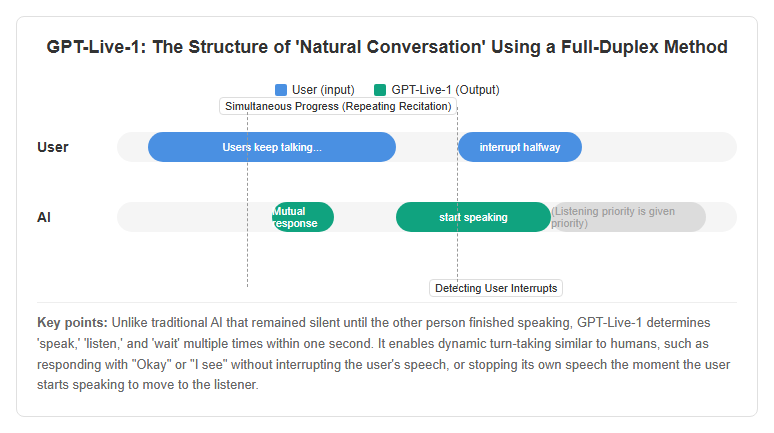
This evolution enables natural interactions that feel like talking with real people, such as users nodding “Okay” or “I see” while speaking, or quietly waiting while the user is stuck in thought. OpenAI’s human-based evaluation tests also yielded favorable results, far surpassing traditional advanced voice modes in conversational flow and naturalness.
Advanced system design that separates inference and dialogue
Another key technical feature of GPT-Live-1 is its design, which separates the voice interaction layer responsible for natural conversation and the inference layer that handles complex calculations and searches as modules. While simple greetings and everyday interactions are handled directly by the voice layer, web searches and questions requiring deep logical thinking are delegated to the latest frontier model, GPT-5.5, in the background.
A groundbreaking aspect of this design is that even while the inference model is doing the heavy work behind the scenes, the voice layer continues to maintain conversations with the user. This eliminated the “unnatural silence during searches” that occurred in traditional systems. The main specifications at launch are as follows.
-
Paid plans (Go, Plus, Pro): High-performance GPT-Live-1 comes standard
-
Free users: Lightweight GPT-Live-1 mini available
-
Selection of inference levels: Users can switch between three levels—Instant (immediate response), Medium (moderate reasoning), and High (advanced thinking)—according to their needs.
-
Visual Card Function: Information cards such as weather, stock prices, sports scores, and maps are automatically displayed on the screen according to the conversation
This modular design ensures the flexibility to update only inference capabilities without retraining entire voice models when even more powerful AI models emerge in the future.
Outstanding reasoning skills and safety for social implementation
Benchmarks Demonstrate Leaps in Scientific Reasoning and Search Capability
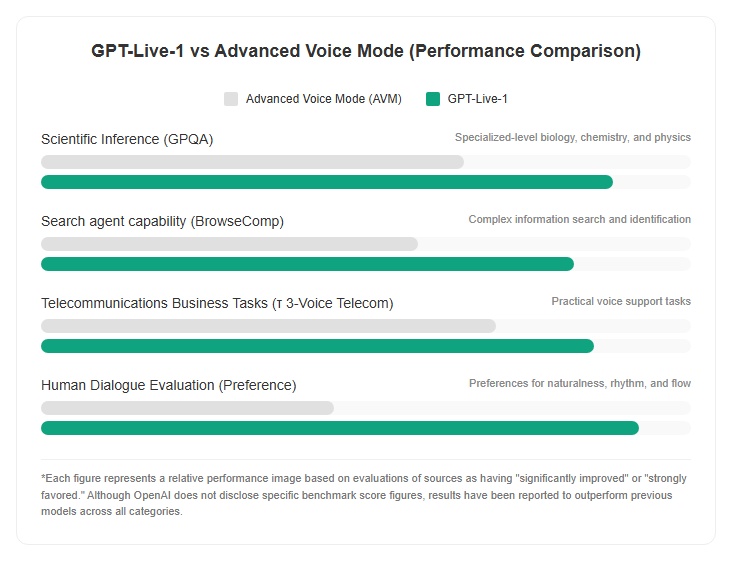
GPT-Live-1 has not only made conversations smoother, but has also made significant improvements in its underlying intelligence. According to data released by OpenAI, it scored far above traditional advanced voice modes on the benchmark GPQA (Biology, Chemistry, and Physics), which measures professional scientific reasoning ability. This demonstrates that AI can not only respond with words but also engage in conversations based on complex expertise.
Additionally, significant improvements were observed in “BrowseComp,” which measures the ability to search for information on the internet. GPT-Live-1 demonstrates excellent agent capabilities in multi-step information exploration and identifying hard-to-find facts. The specific performance improvements include the following points:
-
Specialized reasoning: Advanced contextual understanding in science, medicine, engineering, and more
-
Web search agents: Obtain real-time information and respond without interrupting conversations
-
Telecommunications Business Support: High performance in the “τ 3-Voice Telecom” test simulating realistic customer service scenarios
These performance improvements have greatly enhanced GPT-Live-1’s practicality as a research assistant supporting experts and automating customer service. In the AI model race as of 2026, OpenAI has demonstrated a strong advantage over competitors such as Google and Anthropic. For more details on the degree of performance improvement, please refer to the graph below.
Multifaceted safety measures addressing voice-specific risks
While advanced voice interactions are becoming widespread, concerns about voice misuse and privacy are also increasing. With the release of GPT-Live-1, OpenAI introduced a new safety layer designed to address voice-specific risks. This system monitors conversations in real time and can guide to safe responses when detecting signs of self-harm or illegal requests, or, in the worst case, forcibly end voice conversations.
Particularly noteworthy is the strict stance on voice cloning. In response to the issue at the time of GPT-4o’s announcement where the voice of the “Sky” model closely resembled the voice of actor Scarlett Johansson, GPT-Live now offers nine remastered voice types, emphasizing that these are “original voices designed for dialogue and not imitations of specific individuals.”
Furthermore, as part of efforts to protect younger users, the following features have been implemented.
-
Parental Control: A feature that allows parents to restrict and manage ChatGPT’s voice mode usage.
-
Automated notification system: A system that notifies parents when teen users engage in high-risk conversations (such as suicidal intent).
-
Ensuring transparency: Introducing technology that mechanically detects that the voice is AI-generated
These measures also take into account international regulatory trends such as the European AI Regulation Act (EU AI Act), reflecting OpenAI’s commitment to balancing technological advancement with ethical responsibility.
2026 Roadmap and the Future of AI Agents
A Paradigm Shift from ‘Talking AI’ to ‘Executing AI’
In OpenAI’s strategic roadmap for 2026, GPT-Live-1 is positioned not just as a chatbot but as the first step toward an “AI agent” that autonomously performs tasks. Until now, AI has been a “tool for teaching methods,” but from now on, it will become a “substitute for you.” GPT-Live-1 is expected to serve as the interface at the core of this evolution.
As a concrete vision of future agent functions, the following uses are envisioned.
-
Autonomous Practice Outsourcing: Booking trips, coordinating meeting schedules, and automatically generating reports based on complex data analysis
-
AI Research Intern: Research support that reads vast amounts of papers and materials to compile and propose new insights.
-
Real-time video understanding: AI interprets footage from smartphone cameras and provides real-time voice instructions for machine repairs and directions.
Although it is not yet supported, voice interaction via video (camera) sharing and screen sharing is planned to be introduced soon. This allows AI to fully integrate vision and hearing, becoming a powerful partner that directly supports real-world problem-solving. Please take a look at the illustration below showing the future vision.
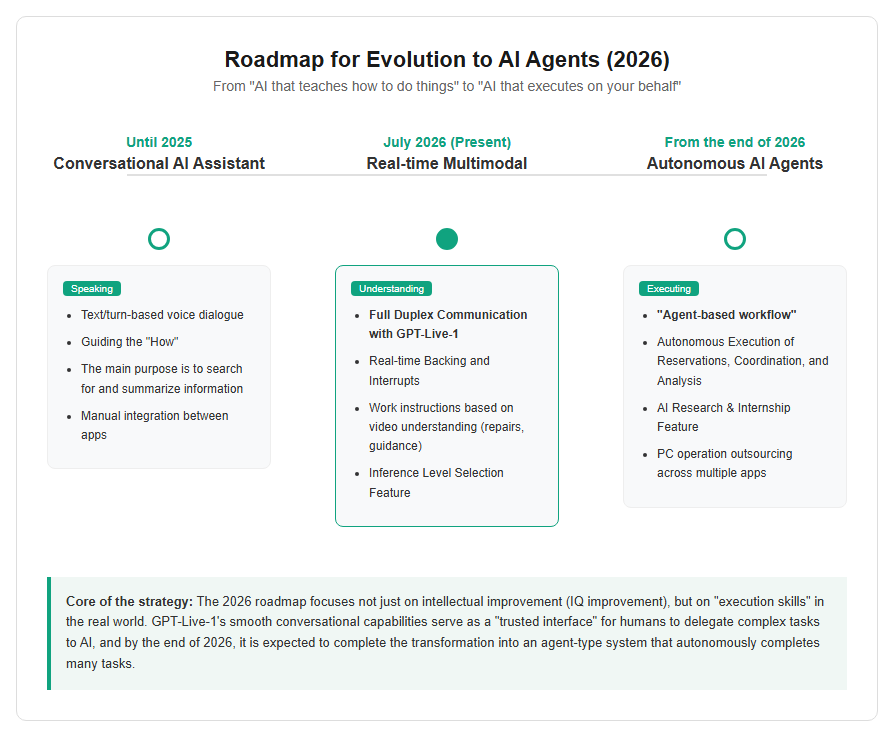
By the end of 2026, OpenAI plans to further strengthen its focus on agent-based workflows, accelerating development in this field through $122 billion in funding.
Future developments and the changing attitudes expected of users
With the release of GPT-Live-1, we have shifted from “what to ask the AI” to the phase of “what to entrust to the AI.” By making voice the primary interface with AI, users are freed from the hassle of text input, enabling more intuitive and faster decision-making. However, this also means that humans need to hone not only the ability to give clear instructions to AI (prompt engineering) but also the ability to creatively make AI proposals.
There are three key points to watch going forward.
-
API Public: APIs to be available to developers soon, accelerating the development of custom voice agents for companies
-
Offline support: With the evolution of on-device AI, AI can operate directly within the smartphone device, enabling ultra-fast responses while protecting privacy.
-
Eliminating language barriers: Improved performance as a translation model now supports over 70 input languages, standardizing real-time multilingual communication.
Despite recording net losses of several trillion yen annually, OpenAI continues this massive tech investment aiming to turn a profit in 2029. The global rollout of GPT-Live-1 will mark a decisive milestone as AI moves beyond mere “wordplay” and becomes an essential part of our social infrastructure.


コメント