
On June 27, 2026, the ceasefire memorandum signed between the United States and Iran effectively collapsed, and large-scale fighting resumed. Due to retaliatory airstrikes by the U.S. military in response to commercial ship attacks in the Strait of Hormuz and the corresponding missile strikes by Iran, the global economy is once again facing a severe energy crisis.
- The Collapse of the Ceasefire Memorandum and U.S. Retaliatory Attacks
- Iran’s missile retaliation and the spread of fire to neighboring countries
- Re-blockade of the Strait of Hormuz and Volatility in Crude Oil Prices
- Paralysis of shipping and logistics routes and soaring insurance premiums
- President Trump’s hardline stance and domestic political intentions
- Iran’s Asymmetric Forces and the Effectiveness of the Blockade Card
- Success or failure of negotiations toward a final peace agreement
- Medium- to Long-Term Risk Management and Economic Security
The Collapse of the Ceasefire Memorandum and U.S. Retaliatory Attacks
On June 27, 2026, the Islamabad Memorandum, which set the course for a ceasefire between the U.S. and Iran, effectively collapsed, reigniting fighting between the two armies. Under direct orders from President Donald Trump, the U.S. military carried out retaliatory airstrikes targeting Iran’s domestic surveillance infrastructure, communication systems, air defense bases, drone storage facilities, and mine-laying capabilities. This military action is considered a direct countermeasure against ships navigating the strait being attacked by drones. President Trump strongly condemned on social media that Iran repeatedly violated the ceasefire agreement signed on June 17, calling it a foolish breach of the agreement. It has been reported that the U.S. military attacks precisely targeted five military strongholds along the Iranian coast. President Trump warned that if Iran continues to violate past mistakes without learning from its past mistakes, the U.S. military will have no choice but to resume full-scale military intervention to complete its mission, which would jeopardize the very existence of Iran’s current regime.
Iran’s missile retaliation and the spread of fire to neighboring countries
After being attacked by U.S. forces, the Iranian military launched a large-scale retaliatory strike on June 28, 2026. According to the Iranian government, concentrated attacks were carried out using ballistic missiles and suicide drones against the U.S. military’s Ali Al-Salem Air Base in Kuwait and the U.S. Navy’s Fifth Fleet Command based in Bahrain. Iran claims that this attack is a legitimate exercise of self-defense against the previous day’s unjust attacks by U.S. forces on five points along Iran’s coast. In response to this situation, tensions have once again escalated to the extreme in neighboring Gulf countries such as Kuwait and Baharene, making the expansion of conflict across the Middle East a real reality. Prior to this, numerous civilian casualties had already occurred in fighting since February 2026, and significant damage was suffered to girls’ schools, residential areas, hospitals, and even historic buildings within Iran, including UNESCO World Heritage sites. The resumption of fighting risks further worsening the accumulated human and material damage and pushing the humanitarian crisis warned by the United Nations and others to an irreparable level.
A devastating blow to the economy and business
Re-blockade of the Strait of Hormuz and Volatility in Crude Oil Prices
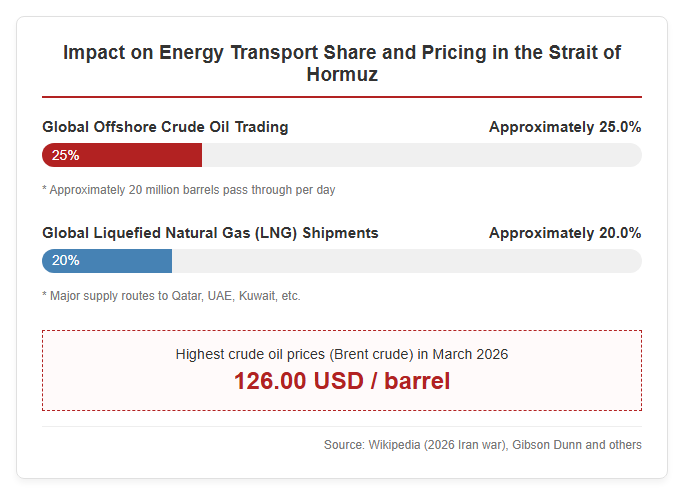
The resumption of fighting has hit the global energy market hard, especially causing a sharp rise in crude oil prices. On June 20, 2026, Iran claimed that Israel’s attack on Lebanon violated the ceasefire agreement and once again declared a blockade of the Strait of Hormuz. Subsequently, on June 25, a cargo ship navigating the UN-approved route in the strait was attacked by an unknown assailant, forcing the International Maritime Organization (IMO) to temporarily suspend evacuation plans for ships stranded in the Persian Gulf. Immediately after this incident, crude oil prices temporarily surged by about 4%. The Strait of Hormuz was a critical maritime transport hub through which about 25% of global maritime crude oil trade (approximately 20 million barrels per day) and about 20% of liquefied natural gas (LNG) shipments passed through before the conflict broke out. In March 2026, it temporarily reached a record high of $126 per barrel, and the prolonged lockdown following the resumption of fighting could deliver a blow to the global economy that surpassed the energy crisis of the 1970s. Please refer to the diagram below.
Paralysis of shipping and logistics routes and soaring insurance premiums
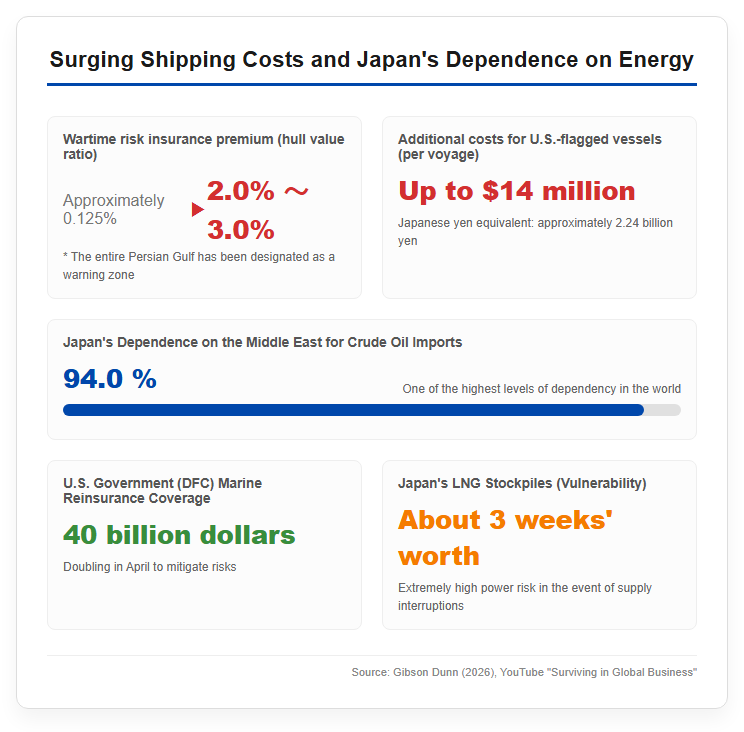
With the loss of security in the Strait of Hormuz, global supply chains and shipping businesses have fallen into unprecedented disruption. The Lloyd’s Market Association (LMA) Joint War Committee has already designated the entire Persian Gulf as a warning area, with wartime risk insurance premiums surging to between 2% and 3% of hull value. This means additional costs ranging from several million dollars per voyage to up to 14 million dollars for U.S.-flagged vessels. The U.S. Development Finance Corporation (DFC) has established a $40 billion government-backed marine reinsurance program to mitigate risks, but unless the safety of the vessels themselves is ensured, many shipowners continue to avoid passage. Especially for countries like Japan, which rely on the Middle East for 94.0% of its energy imports, dysfunction in this strait could fundamentally shake their economies. The Japan Shipowners’ Association has officially warned that easy passage is currently impossible, and private companies are being forced to manage crisis management without regard for costs, such as changing logistics routes or dispersing sourcing sources. Please refer to the diagram below.
Strategic Background and Political Risks of Both Countries
President Trump’s hardline stance and domestic political intentions
Behind this tough military operation lies a deep connection to the domestic political situation in the United States. The Trump administration is preparing for the crucial midterm elections in November 2026, and the surge in gasoline prices caused by the Strait of Hormuz blockade poses a fatal political risk of losing voter support. President Trump is being pressured to appeal for early resolution and achievements through force to gain an advantage in the election. Additionally, the administration has set a massive budget of $1.5 trillion (about 240.8 trillion yen) for military spending in fiscal year 2027, aiming for an increase of about 44% from current levels. To support this, the Department of Defense is advancing procurement reform strategies and has put forward the Freedom Arsenal Initiative to rapidly rebuild depleted weapons stockpiles. Multiple contracts have been signed with major defense-related companies to quadruple their stockpiles of critical munitions, such as Tomahawk cruise missiles and ballistic missile interceptors. While the renewed conflict brings stable orders to the defense industry, it also raises bipartisan concerns about the financial sustainability of the United States.
Iran’s Asymmetric Forces and the Effectiveness of the Blockade Card
In contrast, Iran is engaging in asymmetric warfare aimed at political and economic attrition for the United States, while avoiding direct military confrontation. Iran’s strategic doctrine prioritizes the survival of the regime, building its own deterrence by combining nuclear development, ballistic missiles, and regional proxy forces. Iran has adopted a distributed mosaic defense strategy, delegating significant authority to individual commanders, establishing a wartime system that allows the central leadership to continue organized resistance even when hit. Even after the fighting resumes, Iran is using a cheap suicide drone costing about $50,000 to consume approximately $4 million worth of U.S. interceptor missiles per missile, resulting in an overwhelming cost-effective war of attrition. Moreover, Iran’s de facto control over the Strait of Hormuz functions as a devastating economic weapon against the global economy, serving as a powerful trump card to exert maximum pressure on the Trump administration ahead of midterm elections.
Future Outlook and Corporate Focus
Success or failure of negotiations toward a final peace agreement
The biggest upcoming focus will be whether negotiations toward a 60-day final agreement based on the Islamabad Memorandum signed on June 17, 2026, will continue. This memorandum sets ambitious and complex goals alongside a permanent end to hostilities, resolving Iran’s nuclear issue, establishing a $300 billion reconstruction fund, and lifting all sanctions against Iran. However, fully implementing the sanctions relief promised by the United States faces significant hurdles, including congressional review, legal constraints, and even UN Security Council resolutions. Sanctions for human rights violations or support for terrorism are difficult to immediately lift solely by the president’s authority. Moreover, it remains unclear how much the U.S. and neighboring countries can compromise on Iran’s proposal to collect a nominal toll for services in the Strait of Hormuz. At present, there is no guarantee that a tactical victory on the battlefield will necessarily lead to strategic peacebuilding, and the path to a final agreement remains full of uncertainty.
Medium- to Long-Term Risk Management and Economic Security
There is a need to fundamentally strengthen corporate risk management, assuming prolonged conflicts and intermittent resumption of fighting. As this situation shows, in an unstable situation where a temporary ceasefire agreement could be jeopardized in just about 10 days, it is unrealistic for companies to plan based on optimistic scenarios. Specifically, it is urgent to fully redundant energy supply routes, establish defensive frameworks that can paralyze critical infrastructure due to cyberattacks, and review plans to ensure the safety of expatriates and assets in response to the spread of fighting across the region. Additionally, attention must be paid to public opinion trends and reputational risks caused by boycotts as the conflict worsens. The United Nations Development Programme (UNDP) has tragically predicted that if the conflict continues, Iran’s GDP will shrink by more than 10%, with over 4 million people falling into poverty again, and a decline in purchasing power across the region, including neighboring countries, is inevitable. Companies are being pressured to prioritize economic security as their top management priority and build resilient business models that can respond flexibly and swiftly to unforeseen circumstances.
[#中東紛争 #経済安全保障 #原油高騰 #ホルムズ海峡 #地政学リスク #トランプ政権 #サプライチェーン #経済ニュース]

コメント