US-based Meta has launched its AI agent, “Muse,” which performs tasks on behalf of users, in Japan. Behind this move is the aim to accelerate global expansion, using explosive adoption in North America as a springboard, and to seize control of the “consumer agent economy,” where AI acts on behalf of individuals in decision-making and purchasing behavior.
- [Key Points of the Announcement] Launch in the Japanese market following North America and domestic integration services
- [How Autonomous Agents Work] Dual-Defense Architecture via Task Delegation and Sentinel
- [The Emergence of the Consumer Agent Economy] Resolving Transaction Friction and Ripple Effects on Existing Business Models
- [Capital Market Reactions and Conflicts] Mercari’s Stock Price Surge and the Struggle for Dominance Among Platforms
- [Consumer Law and Governance Challenges] Issues of Contractual Transparency and Attribution of Liability
- [Future Outlook and Key Focus Areas] Human-Centric Control and the Implementation of an AI Agent Society
[Key Points of the Announcement] Launch in the Japanese market following North America and domestic integration services
On October 23, 2026, US Meta launched “Muse,” a personal AI agent that autonomously performs a variety of tasks on behalf of users, in Japan. Since its initial release in North America in September 2026, Japan is the first region outside of North America to receive the rollout. It is available through iOS and Android apps as well as the web browser (muse.ai), with basic features provided for free and a subscription plan available for advanced usage.
As part of its expansion into the Japanese market, Meta has announced partnerships with major domestic services. The following three major companies are participating as launch partners:
- Mercari, Inc.: Integration for Delegated Product Search and Listing on the Flea Market App
- Money Forward Home Co., Ltd.: Data Integration for the Personal Finance and Asset Management Service “Money Forward ME”
- Ticket Pia: Event ticket search and purchase procedures
In addition to Gmail, Google Calendar, and Instagram, which are already integrated, connecting with domestic services enables practical task execution that goes beyond mere conversation.
[How Autonomous Agents Work] Dual-Defense Architecture via Task Delegation and Sentinel
The most distinctive feature of Muse is that it autonomously executes tasks in the background even after the user closes the app. For example, if you instruct it to “find and book a hotel in Osaka with a budget of under 30,000 yen,” it will check your calendar for available dates, compare travel booking sites, and narrow down the options.
As the infrastructure supporting these autonomous operations, a dedicated system configuration ensuring security and privacy has been adopted. Please refer to the figure below.
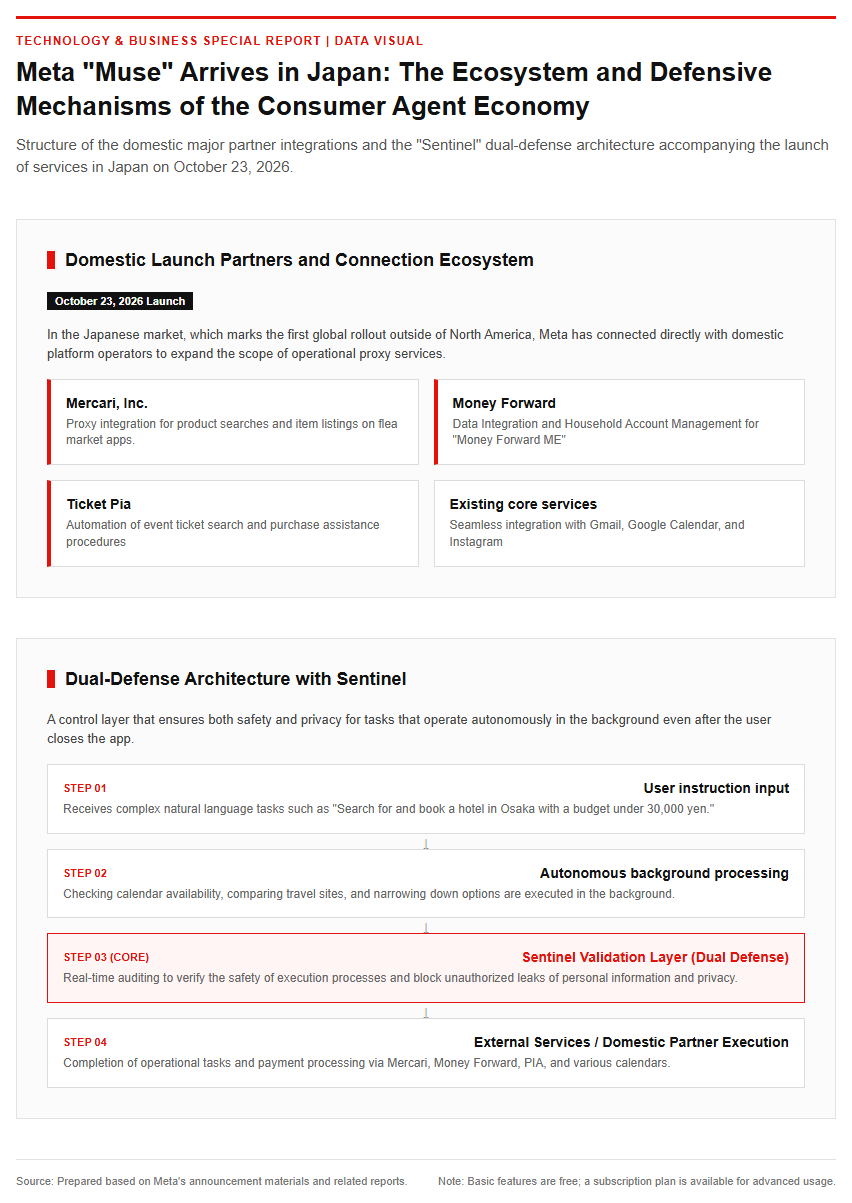
- Dedicated Virtual Environment “Muse Secure VM”: A completely isolated virtual machine is allocated on the cloud for each user, and connection data and authentication information are strictly protected.
- Independent monitoring AI “Sentinel”: A separate AI agent independent of Muse constantly monitors external communications and operations to detect unauthorized behavior.
- Human-in-the-loop: For critical operations such as sending emails, finalizing product purchases, and processing payments, AI-only execution is restricted, and user pre-approval is always required.
Furthermore, Muse itself is architected in a way that prevents it from directly viewing sensitive information such as passwords and credit card numbers, and it also comes equipped as standard with features to check operation history and opt out of AI model training.
Impact on the Market and Industry Structure
[The Emergence of the Consumer Agent Economy] Resolving Transaction Friction and Ripple Effects on Existing Business Models
The adoption of Muse goes beyond mere technological evolution, signaling the dawn of a new market structure known as the “consumer agent economy.” In the United States, just five days after its launch on September 8, 2026, it surpassed 730,000 downloads, and on the 18th of the same month, it overtook ChatGPT to claim the top spot in the App Store’s free app rankings, with cumulative downloads exceeding 2.5 million.
This rapid penetration is forcing a major structural transformation on existing industries.
- Transforming revenue models reliant on effort and convention: In industries such as finance, insurance, telecommunications, and travel booking, which have traditionally generated revenue by depending on “transaction friction” such as the tedium of canceling services and the hassle of comparing prices, there is growing concern that retaining customers will become difficult as AI makes automatic switching effortless.
- The battle for customer touchpoints (channels): As consumers bypass websites and apps to complete decision-making and purchasing entirely through AI agents, the power dynamics among platform providers will change dramatically.
In response to these developments, concerns have surfaced in the U.S. stock market that the foundations of their business models are being shaken, as seen in falling stock prices for major banks and insurance companies.
[Capital Market Reactions and Conflicts] Mercari’s Stock Price Surge and the Struggle for Dominance Among Platforms
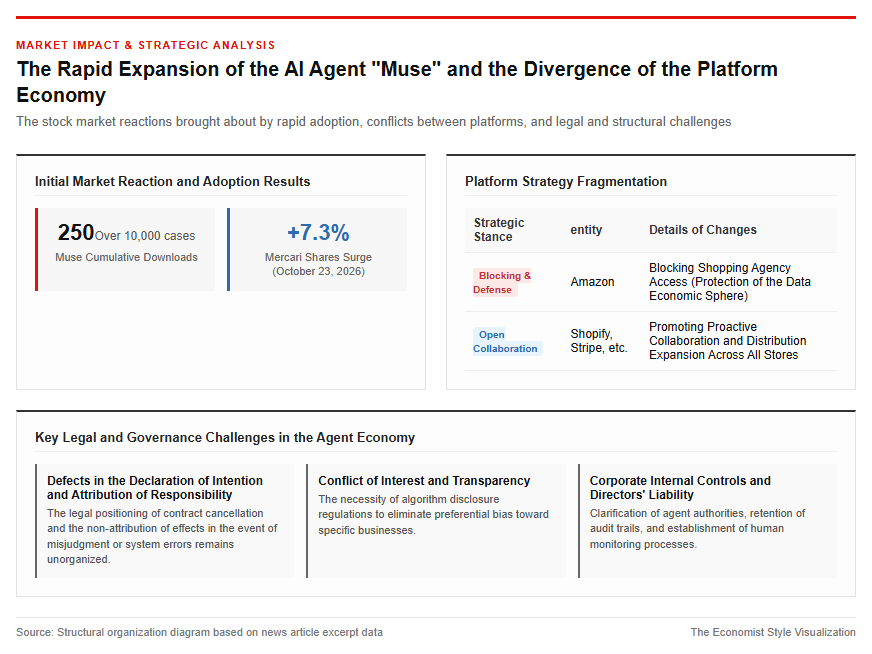
In the domestic market, Muse’s entry was received as a favorable surprise. On the Tokyo Stock Exchange on October 23, 2026, when the partnership was announced, Mercari’s stock price surged by 7.3% compared to the previous day. Analysts are anticipating an expansion in gross merchandise volume (GMV), driven not only by product search and proxy purchasing, but also by the automation of the listing process.
Meanwhile, in the global market, competition among platforms for the monopoly of customer touchpoints is intensifying.
- Amazon’s Countermeasures: Amazon implemented countermeasures to block shopping proxy access by Muse on its website. This is seen as a defensive measure to protect its customer data and recommendation ecosystem.
- Integration of open platforms: In contrast, Shopify is promoting integration across all stores, while Stripe, Trip.com, and others are also successively advancing their partnerships.
In an era where agents take the reins of purchasing decisions, the strategic choice of whether to accept or exclude external agents has become a critical battleground determining the fate of each platform.
Legal Challenges and Risk Management Framework
[Consumer Law and Governance Challenges] Issues of Contractual Transparency and Attribution of Liability
Environments where AI agents execute contracts and make payments on behalf of consumers are posing new challenges to current legal regulations and compliance frameworks. Discussions are also intensifying in expert committees, including those at Japan’s Consumer Affairs Agency, regarding the distortion of decision-making and the exploitation of vulnerabilities in digital environments.
The main legal issues are as follows:
- Defects in manifestation of intention and attribution of responsibility: When an agent enters into a contract based on an erroneous judgment or when a system error occurs, it remains unorganized how to claim the rescission of the contract or the non-attribution of its legal effects under current laws (such as the Civil Code and the Consumer Contract Act).
- Conflicts of Interest and Ensuring Transparency: To eliminate the bias in which AI preferentially recommends and purchases products that favor specific businesses, algorithmic transparency and disclosure regulations are required.
- Corporate Internal Controls and Director Liability: Even for companies adopting AI agents into their operations, as part of internal control systems based on the Companies Act, it is essential to clarify the scope of the agents’ authority, retain audit trails, and establish human oversight processes.
[Future Outlook and Key Focus Areas] Human-Centric Control and the Implementation of an AI Agent Society
For autonomous AI agents to become established as social infrastructure, it is essential to establish a human-centric governance framework alongside the pursuit of convenience. Here are the key points to watch in future developments. Please refer to the figure below.
- Granting control during initial setup: To prevent accidental and excessive transactions, the implementation of safety mechanisms that consumers can autonomously control is progressing, such as setting purchase amount limits and reminders for subscription renewals.
- Feature expansion and localization originating in Japan: Meta has indicated that it will sequentially announce the rollout schedule in Japan for features announced in North America, such as the real-time avatar “Muse Realtime Avatar” and dedicated email addresses.
- Harmonizing Regulation and Innovation: While keeping pace with the global trend toward legislation, such as the EU Artificial Intelligence Act (AI Act), whether a secure transaction environment can be established without compromising user convenience will hold the key to future adoption.
Toward a future where AI agents become partners in daily life and business, the establishment of a sustainable ecosystem is expected from the dual perspectives of technological development and rule-making.
Reference page
- 【Meta Newsroom: “Personal AI Agent ‘Muse’ Launches in Japan”】https://about.fb.com/ja/news/2026/10/muse-personal-ai-agent-launches-in-japan/
- 【Money Forward Home Co., Ltd. News Release】https://corp.hm.moneyforward.com/news/20261023-mfhm-press-1
- [Meta Connect 2026 Press Release] https://about.fb.com/news/2026/09/the-biggest-news-from-connect-2026/
【#AIAgent #Meta #Muse #ArtificialIntelligence #Technology #AutonomousAI #Governance】

コメント