Amid escalating tensions in the Middle East, the Strait of Hormuz has been effectively blockaded, causing European benchmark natural gas prices to surge to record highs. In the background lies a structural crisis driven by the compounding effects of disrupted Qatari LNG supplies and depleted gas inventories within Europe.
- Worsened Middle East Situation and the Disruption of Passage through the Strait of Hormuz
- Surge in European Gas Benchmark TTF and Global Market Turmoil
- Record-Low Gas Inventories and the Challenge of Backwardation
- Blow to the Eurozone Economy and Risks of Resurgent Inflation
- Joint Procurement and Market Intervention Measures by the European Commission
- Future Outlook and Key Focus Areas: Accelerating the Shift Away from Middle East Dependence and Contract Flexibility
Worsened Middle East Situation and the Disruption of Passage through the Strait of Hormuz
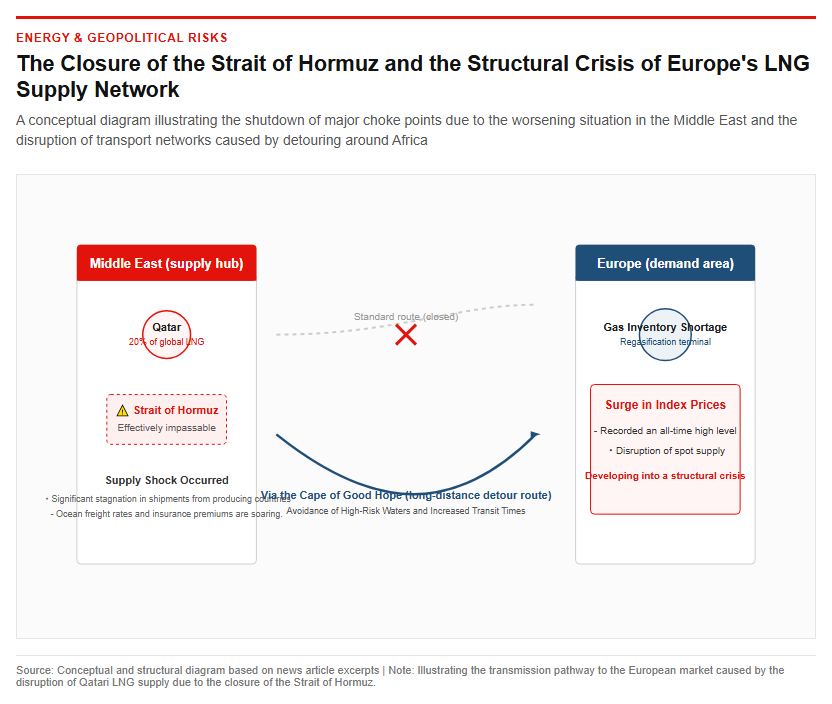
Entering 2026, military tensions in the Middle East rapidly escalated, and the Strait of Hormuz—a crucial hub for energy transport—fell into a state of de facto impassability. The direct trigger was the intensification of military conflicts between the U.S. and Israel on one side and Iran on the other, coupled with a series of attacks on Saudi Arabian oil facilities and infrastructure by Yemen’s Houthis. In response to this situation, shipments from Ras Laffan in Qatar, the world’s largest liquefied natural gas (LNG) production hub, were severely delayed, causing an unprecedented supply shock in which approximately 20% of the global LNG supply was abruptly wiped from the market. To avoid dangerous waters, energy carriers were forced to switch to a long-distance detour route via the Cape of Good Hope at the southern tip of Africa, causing maritime freight rates and war risk insurance premiums to soar. Consequently, spot supplies to European regasification terminals were disrupted, immediately escalating into a severe energy crisis. The following figure illustrates the positional relationship between major choke points and transport routes in the Middle East.
Surge in European Gas Benchmark TTF and Global Market Turmoil
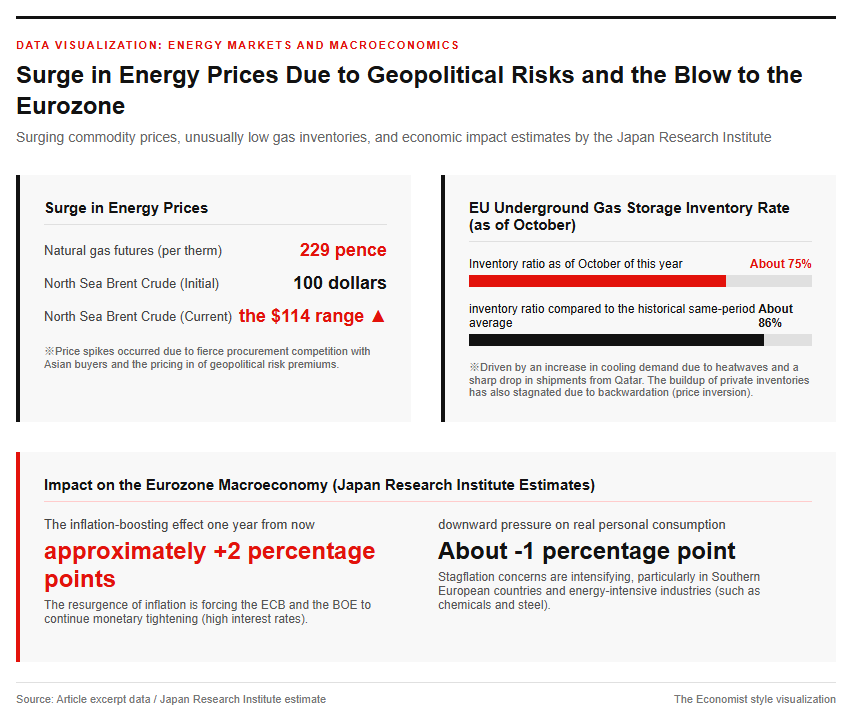
Fears of transport disruptions and physical supply shortages caused prices to soar in the European natural gas market. The benchmark Dutch TTF front-month futures price surged from around 31 euros per megawatt-hour before the outbreak of war, reaching a high of 93.40 euros/MWh in October—the highest level since the end of 2022. The UK’s NBP natural gas futures also rose sharply to 229 pence per therm. North Sea Brent crude oil prices similarly jumped from 100 dollars to the 114-dollar range per barrel, as geopolitical risk premiums were rapidly priced into the broader energy market. European buyers rushed to secure Atlantic spot cargoes to compensate for the reduced supplies, triggering fierce competition with Asian buyers such as Japan and Korea who were likewise scrambling for alternative procurement. As a result, the surge in energy prices was not confined to Europe, but triggered tight supply-demand conditions and price spikes on a global scale.
[Structural Vulnerabilities and Economic Impact] The Double Shock of Inventory Shortages and Resurgent Inflation
Record-Low Gas Inventories and the Challenge of Backwardation
A factor exacerbating the current European gas crisis is the record-low inventory levels at underground gas storage facilities across the region. As of October, the EU’s overall natural gas storage rate stood at only around 75%, falling well short of the historical average of 86% for the same period. In addition to a surge in thermal power generation demand for cooling driven by intense summer heatwaves, a sharp decline in shipments from Qatar further fueled the sluggish storage. Furthermore, an abnormal market phenomenon known as backwardation unfolded, in which current spot prices exceeded future winter prices. Normally, there is an economic incentive to buy cheap gas in the summer, store it, and sell it in the winter, but this price inversion stripped private companies of the motivation to voluntarily build up inventories. This economic distortion has further delayed stockpiling efforts ahead of the peak winter demand season, significantly elevating the risk of supply disruptions upon the arrival of cold waves.
Blow to the Eurozone Economy and Risks of Resurgent Inflation
The surge in natural gas prices is exerting immense downward pressure on the entire European economy. According to estimates by the Japan Research Institute, in a scenario where crude oil and natural gas prices remain persistently high, the eurozone’s inflation rate one year later would be pushed up by approximately 2 percentage points, while real private consumption would be pushed down by about 1 percentage point. The blow is particularly notable in Southern European countries with high energy intensity, such as Italy and Spain, as well as in regions concentrated with manufacturing industries like chemicals, steel, and cement. Prompted by the resurgence of soaring prices, the European Central Bank (ECB) and the Bank of England (BOE) are being forced to raise or maintain high policy interest rates, raising concerns about a vicious cycle in which monetary tightening chills residential and corporate capital investments. Unlike during the disruption of Russian pipeline gas in 2022, today’s Europe—having increased its reliance on LNG—is structurally exposed directly to market price fluctuations, raising fears of economic stagflation.
[Policy Responses and Future Outlook] The European Commission’s Emergency Measures and the Reconstruction of Energy Security
Joint Procurement and Market Intervention Measures by the European Commission
To address the rapidly expanding energy shock, the European Commission has presented a unified response strategy for its member states. President Ursula von der Leyen outlined a policy to restart the joint gas procurement framework utilizing the Energy Platform and prevent excessive price competition among buyers by aggregating demand at the EU level. She also decided to stabilize market sentiment through a coordinated release of emergency oil and gas reserves, while applying temporary relaxations of state aid rules to severely impacted energy-intensive industries. In the medium to long term, while advancing systemic reviews of grid fees and electricity taxes that constitute energy bills, she is prepared to launch structural reforms that reduce the very dependence on fossil fuels through building insulation retrofits and the accelerated deployment of renewable energy and nuclear power. The figure below illustrates the overall policy response presented by the European Commission.
Future Outlook and Key Focus Areas: Accelerating the Shift Away from Middle East Dependence and Contract Flexibility
The future focus will shift to the restructuring of global energy supply chains, assuming the risk of dependence on the Middle East, and navigating supply and demand through the winter. In the short term, the timing of the lifting of the blockade of the Strait of Hormuz, the pace of recovery of liquefaction facilities in Qatar, and winter weather conditions will hold the fate of the market. If a severe cold wave arrives in the winter, securing the EU’s target storage rate will become difficult, and demand-suppression measures such as industrial gas supply restrictions and electricity usage limits may become essential. Over the medium to long term, a rapid transition is expected from long-term, destination-fixed gas contracts—which are vulnerable to risks in specific regions—to flexible portfolio contracts that eliminate destination clauses. European players are strengthening their procurement shift toward North American LNG from sources such as the U.S. Gulf Coast and Canada, making the establishment of sustainable energy resilience that accounts for geopolitical risks an urgent priority.
Reference Page
- 【International Energy Agency (IEA)】https://www.iea.org/news/middle-east-crisis-disrupts-international-natural-gas-markets-and-delays-global-lng-supply-wave
- [European Commission] https://ec.europa.eu/commission/presscorner/detail/en/statement_26_800
- [The Japan Research Institute, Limited] https://www.jri.co.jp/report/medium/euro/
- 【Japan Organization for Metals and Energy Security (JOGMEC)】https://www.iea.org/reports/energy-system-resilience
【#NaturalGas #EuropeanEconomy #MiddleEastSituation #EnergyCrisis #Inflation #LNG】


コメント