Sakura Internet has temporarily suspended new applications in response to the critical Linux kernel vulnerability “CVE-2026-99999.” This is a preventive measure aimed at ensuring the security of the entire virtualization infrastructure.
- Suspension of acceptance announced on October 16, 2026, and its scope of impact
- Impact on Active Services and Actions Required of Users
- Flaw in IPv4 Checksum Verification in the Linux Kernel
- The Risk of PwnEscape Extending from Virtual Machines to the Host Infrastructure
- The Significance of Preventive Incident Response for Cloud Service Providers
- Future Resumption Outlook and Key Points for Users to Watch
Suspension of acceptance announced on October 16, 2026, and its scope of impact
On October 16, 2026, SAKURA Internet Inc. announced that it would temporarily suspend the acceptance of new applications for its core services in response to CVE-2026-99999, a critical vulnerability existing within the Linux kernel. The affected services span across the company’s major cloud and infrastructure platforms in general. Specifically, this includes the suspension of new project creation in SAKURA Cloud, as well as the suspension of new applications for all plans across all three regions—Ishikari, Tokyo, and Osaka—for SAKURA VPS. Furthermore, for SAKURA VPS, not only new contracts, but also the acceptance of plan scale-ups, OS installations using user-provided ISO images, and migration functions to SAKURA Cloud have been simultaneously restricted. In addition, new applications were also suspended starting October 16, 2026, for all plans of SAKURA Shared Hosting (Lite, Standard, Business, and Business Pro) and the Email-dedicated plan, as well as all plans of SAKURA Managed Server (Small, Medium, and Large). The following architectural diagram illustrates the service areas to which this temporary suspension measure has been applied.
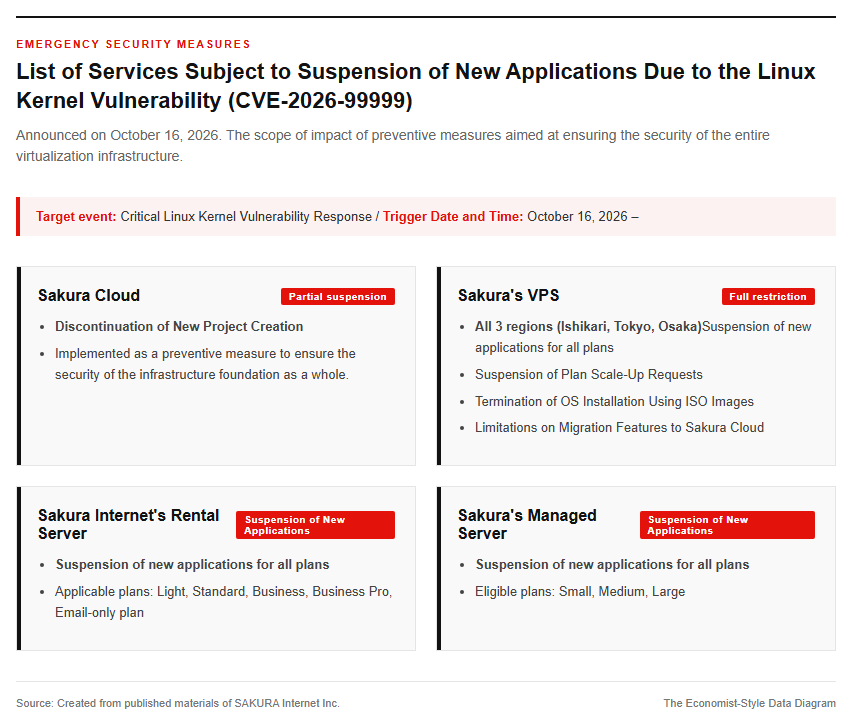
While these latest restrictions are affecting a wide range of the company’s infrastructure, they are notably being implemented not as an emergency shutdown due to unauthorized access, but for the purpose of investigating the impact of vulnerabilities and taking proactive security measures.
Impact on Active Services and Actions Required of Users
While new applications and the addition of certain features are restricted, services currently under contract and in operation, as well as various resources already created, continue to operate normally without being affected. According to an announcement by Sakura Internet, no damage or compromise that would cause an immediate system shutdown has been confirmed in existing operating environments. However, because this vulnerability stems from a fundamental issue at the Linux kernel level, users may also be required to take action depending on their administrative privileges. In particular, for services where users manage OS root privileges and kernel management themselves, such as Sakura Dedicated Server PHY and Kahokuryoku PHY, users are required to individually check the security advisories provided by each Linux distribution and proactively apply updates to the patched kernel. On the other hand, for environments operated on virtualization platforms such as Sakura Cloud and Sakura VPS, future host maintenance by the provider may be necessary. Users must closely monitor the provider’s support information and announcements, and perform system backups and schedule adjustments in accordance with advance notices when maintenance is conducted.
Technical Background of the Critical Vulnerability CVE-2026-99999
Flaw in IPv4 Checksum Verification in the Linux Kernel
CVE-2026-99999, which was the direct cause of this temporary suspension, is a vulnerability originating from the network processing of the Linux kernel, also commonly known as PwnEscape. It was officially disclosed by the Linux kernel CVE team on October 15, 2026, and is classified as a critical severity level with a base score of 9.3 out of 10.0 on the Common Vulnerability Scoring System (CVSS) v3.1. The root of the problem lies in insufficient validation processing regarding the checksum field used to detect data corruption in network packets during IPv4 packet processing inside the Linux kernel. Due to this flaw, when maliciously crafted invalid metadata or packets are processed within the kernel, there is a risk that unauthorized reference or corruption of memory areas will occur. It has been revealed that this vulnerability had been lurking for a long time across a wide range of Linux kernel versions starting from version 2.6.27 and later. A fix patch was committed by the upstream Linux kernel development community dated October 14, 2026, and updated versions in stable series such as 5.10.272, 5.15.223, 6.1.190, 6.6.159, 6.12.113, 6.18.57, and 7.2.11 have been sequentially released. The following diagram illustrates the concept of the validation defect in IPv4 packet processing.
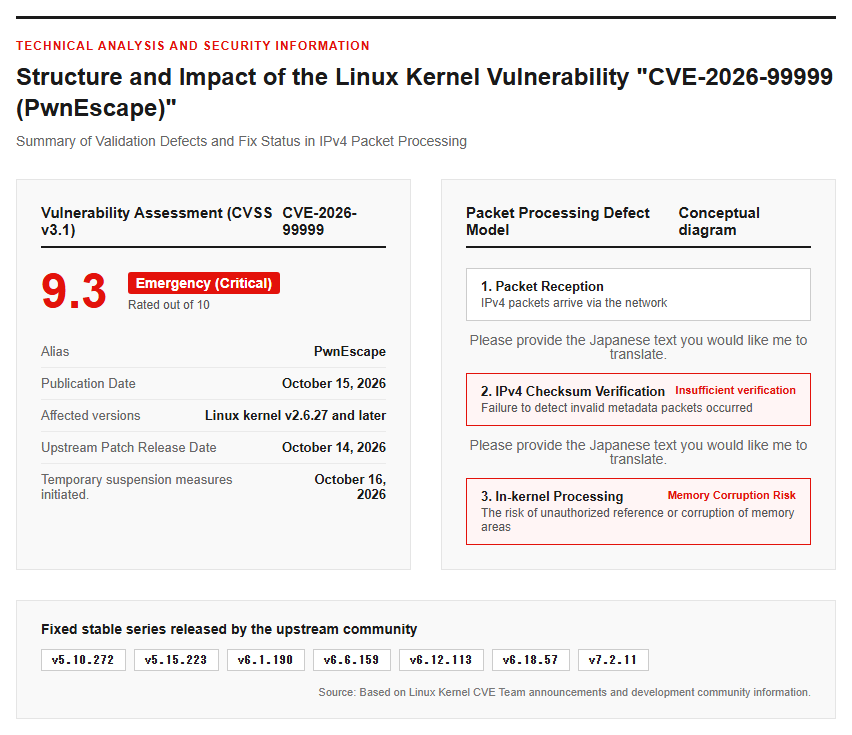
Because this vulnerability resides in a core part of the OS known as network processing, it has the potential to impact a vast number of systems running Linux.
The Risk of PwnEscape Extending from Virtual Machines to the Host Infrastructure
The reason CVE-2026-99999 is considered a particularly serious threat to cloud and VPS providers is that it carries the risk of boundary-breaking vulnerabilities in virtualized environments (guest-to-host escape). According to security researchers’ investigation reports, it has been demonstrated that in virtualization infrastructures utilizing hypervisors such as KVM, executing specific programs inside a guest virtual machine makes it possible to unlawfully read shared physical host Linux kernel memory or execute arbitrary code on the host. In cloud and VPS operational models, a multi-tenant architecture where multiple users’ virtual machines coexist on a single physical server is common. Normally, virtual machines and the host are strictly isolated and protected by the hypervisor; however, if vulnerabilities like PwnEscape are exploited, there is a risk that an attacker who has taken over a single virtual machine could seize control privileges of the physical host and expand their access to other users’ virtual machine areas and data on the same host. Because mounting the attack requires the attacker to first provision a virtual machine on the affected infrastructure and secure an environment to execute local code, Sakura Internet’s decision to temporarily suspend new subscriptions is regarded as an effective and highly rational defensive measure to physically block malicious third parties from creating new tenants for the purpose of the attack.
Cloud Providers’ Security Measures and Future Outlook
The Significance of Preventive Incident Response for Cloud Service Providers
This latest rapid service restriction by Sakura Internet is attracting attention as an advanced case study of security incident response by a cloud infrastructure provider. When cyberattacks or vulnerabilities are discovered, many companies often respond reactively only after damage has actually occurred. However, in the response to CVE-2026-99999, a proactive measure was deliberately taken to immediately suspend new applications and expansion features during the investigation stage, before any intrusion into their own environment or actual damage was confirmed. While other major public cloud providers such as AWS have announced that no user action is required due to differences in management functions and hypervisor structures, Sakura Internet—acting as a domestic independent infrastructure provider—conducted a detailed risk analysis ahead of others and made the immediate decision to stop accepting new requests. This action has been highly praised from the perspective of minimizing secondary damage. In the modern zero-trust security mindset, which operates on the premise that infrastructure providers will be breached, the thorough implementation of proactive operations to nip threats in the bud at an early stage has become an essential element in protecting user data and business continuity.
Future Resumption Outlook and Key Points for Users to Watch
Regarding the resumption timing for new applications for each Sakura Internet service, it remains undecided as of the announcement on October 16, 2026, and is scheduled to be announced sequentially depending on future response statuses. In order for the provider to resume service delivery in a fully operational state, it is necessary to complete kernel updates for all physical hosts, verification of the hypervisor layer, and safety checks for all affected server areas. Along with this, host maintenance across the entire service infrastructure is likely to be carried out sequentially going forward, and temporary server reboots and migration work are expected to occur during maintenance. It is important for users to regularly check support information and maintenance notices issued by the company, and to take measures such as acquiring backups and implementing system redundancy in preparation for maintenance work. Furthermore, this issue is not someone else’s problem for general companies that build and operate their own Linux servers. It will become even more crucial in addressing future cyber risks to not only simply apply patches, but also to correctly understand the boundaries of responsibility of the cloud provider being used and to periodically review security measures at the layers above the OS.
Reference page
- [Status of Response to the Linux Kernel Vulnerability (CVE-2026-99999) in Sakura’s VPS] https://vps.sakura.ad.jp/contents/info/202610-pendingapply/
- [Notice Regarding Suspension of New Applications for SAKURA Rental Server and Managed Server] https://help.sakura.ad.jp/notification/n-2696/
- CVE-2026-99999: ipv4: validate checksum_start before completing checksum
【#SakuraInternet #Linux #CVE202699999 #Vulnerability #CloudSecurity #Cybersecurity】


コメント