NVIDIA and Nokia have partnered to ramp up initiatives to transform base stations and telecommunication networks into distributed AI infrastructure. This is driven by the surge in data traffic caused by the rapid expansion of generative AI, as well as the necessity for telecom operators to improve capital expenditure efficiency and secure new revenue sources.
- 1-1. Overview of the AI-RAN Strategy Led by NVIDIA and Nokia
- 1-2. Results of Demonstration Experiments and Commercial Calls in the United States and Europe
- 2-1. An Integrated Architecture for Processing Communications and AI on a Single Infrastructure
- – AI-in-RAN: A feature that uses AI to improve the performance of communications itself, such as optimizing spectrum efficiency, channel estimation, and energy control.
- 2-2. Transformation of Base Stations into Distributed AI Data Centers and Evolution Toward 6G
- 3-1. Challenges and Discussions Regarding Deployment Cost (TCO) and Power Consumption
- 3-2. Initiatives in the Japanese Market and Key Points for 2027 Commercialization
1-1. Overview of the AI-RAN Strategy Led by NVIDIA and Nokia
Semiconductor giant NVIDIA and telecommunications equipment giant Nokia are accelerating their strategic partnership to integrate AI processing on Radio Access Networks (RAN). Following NVIDIA’s $1 billion investment in Nokia in October 2025, the two companies have been driving efforts to introduce accelerated computing technology into telecommunications infrastructure. At GTC Berlin in October 2026, they announced a vision to leverage the NVIDIA Aerial RAN Computer (ARC) and Nokia’s anyRAN software, in collaboration with major carriers worldwide, to transform entire networks into distributed intelligence platforms. While traditional base stations relied on dedicated telecommunications hardware, transitioning to a GPU-based common platform makes it possible to execute both 5G operations and AI inference processing simultaneously. Through this approach, telecommunications operators are preparing the groundwork to deploy new, advanced services for the AI era while maximizing the utilization of their existing infrastructure assets.
1-2. Results of Demonstration Experiments and Commercial Calls in the United States and Europe
Proof-of-concept trials by global telecommunications operators have already moved beyond the laboratory stage into active commercial networks. In the United States, T-Mobile successfully completed the world’s first AI-RAN call on its commercial network in Bellevue, Washington, using Nokia software and NVIDIA ARC servers. In Europe, Finland’s Elisa completed a test in an outdoor 5G environment in Helsinki, simultaneously running voice calls (VoNR), mobile data communications, and video analytics processing on a single AI-RAN platform. This is a European first and marks an important stepping stone toward the launch of commercial AI-RAN services in 2027. Furthermore, the UK’s BT and Germany’s Deutsche Telekom are also advancing plans for field trials aimed at 2027, heightening the momentum for deployment among major European carriers.
2. Technical Mechanisms and Infrastructure Innovation of AI-RAN
2-1. An Integrated Architecture for Processing Communications and AI on a Single Infrastructure
The technological innovation of AI-RAN lies in running radio access network (RAN) processing and advanced AI algorithms on the same accelerated hardware platform. Specifically, it consists of the following two processing layers.
– AI-in-RAN: A feature that uses AI to improve the performance of communications itself, such as optimizing spectrum efficiency, channel estimation, and energy control.
By integrating Nokia’s anyRAN software with servers powered by NVIDIA RTX PRO 4500 and 6000 Blackwell Server Edition GPUs provided by NVIDIA, general-purpose GPU processing is realized as an alternative to telecom-specific ASICs. Please refer to the conceptual diagram below.
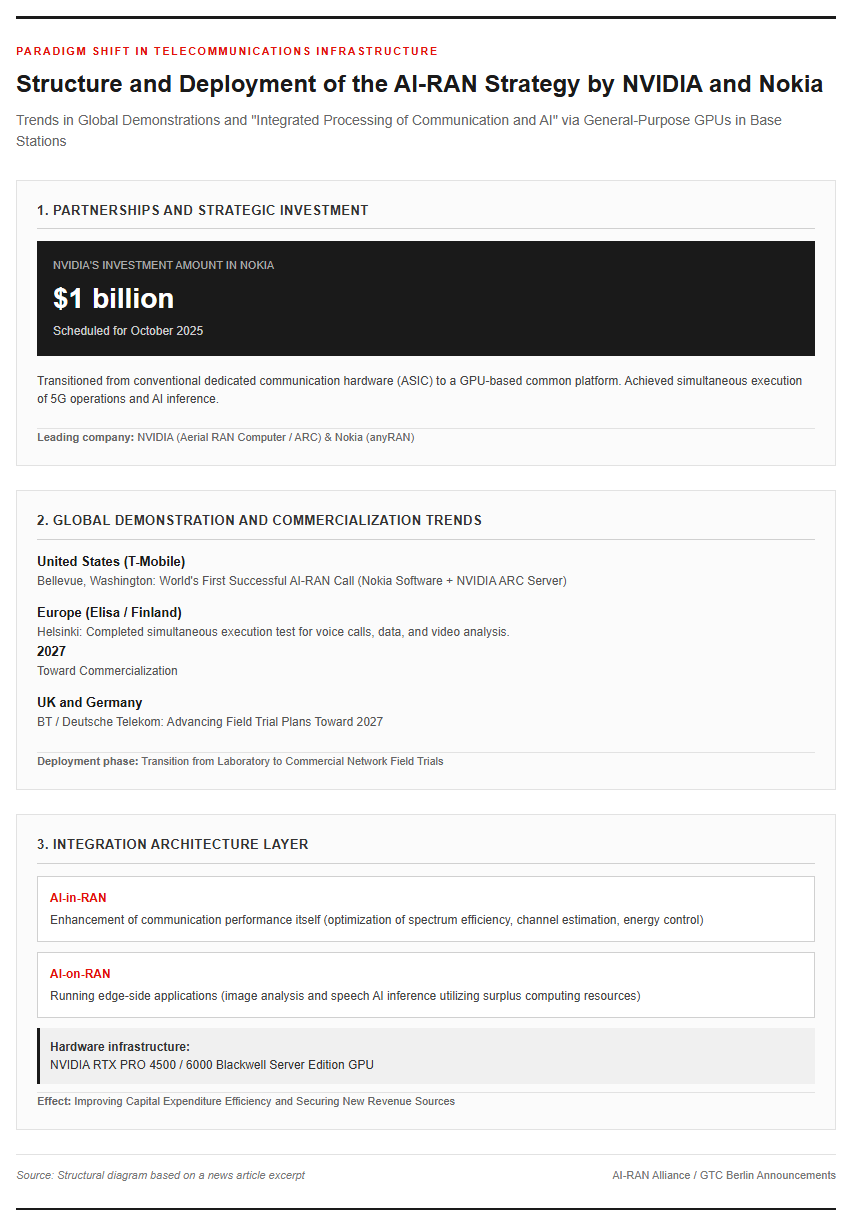
By utilizing shared infrastructure in this way, a model is built to accelerate return on investment by selling surplus resources generated outside of mobile traffic peak hours to enterprise AI services.
2-2. Transformation of Base Stations into Distributed AI Data Centers and Evolution Toward 6G
Traditional AI processing has been performed in centralized cloud data centers, resulting in response latencies on the order of hundreds of milliseconds. In contrast, by placing GPUs at cell sites and regional hubs in metropolitan areas to create decentralized AI data centers, it becomes possible to perform inference processing in locations extremely close to users. This significantly reduces response latency to tens of milliseconds or less, making it possible to realize the following next-generation use cases.
- Security Camera Video Analysis for Real-Time Hazard Detection
- Ultra-low latency real-time two-way voice AI assistant
- Advanced cooperative control of autonomous mobile robots and self-driving vehicles
Furthermore, this software-defined architecture also facilitates future upgrades to 6G networks. A major strength lies in its ability to minimize physical hardware replacement and achieve a smooth evolution from 5G-Advanced to 6G through software updates.
3. Industry Challenges, Future Outlook, and the Japanese Market
3-1. Challenges and Discussions Regarding Deployment Cost (TCO) and Power Consumption
While the AI-RAN initiative is gaining traction, cautious views regarding deployment costs and energy efficiency remain deeply rooted among telecommunications operators. According to an analysis by research firm Dell’Oro, operators are hesitant to pay more than $10,000 in GPU costs per cell site sector, and clear proof of cost-effectiveness is required. Please refer to the graph below.
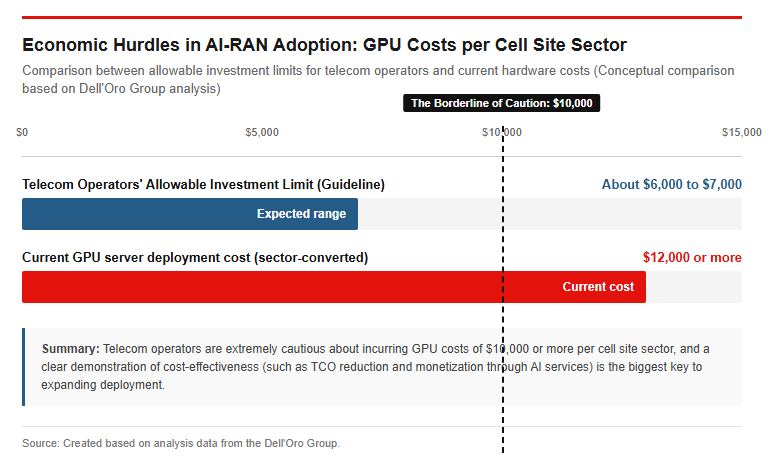
Executives at major carriers such as Vodafone and Verizon point out that many AI functions can be executed even with conventional vRAN configurations using general-purpose CPUs and dedicated silicon, such as the Intel Granite Rapids. Additionally, rising power costs and the need for enhanced cooling facilities caused by deploying numerous high-power GPUs at cell sites have become a matter of concern. For telecommunications operators to commit to full-scale deployment, it is necessary to demonstrate not just technological innovation, but that improvements in communication performance and monetization through external AI services will reliably outweigh the increase in TCO (Total Cost of Ownership).
3-2. Initiatives in the Japanese Market and Key Points for 2027 Commercialization
Specific movements toward the commercialization of AI-RAN are accelerating in the Japanese market as well. SoftBank has announced that it will collaborate with NVIDIA and Nokia to conduct a field trial in 2027 combining its proprietary AI-RAN integrated solution, “AITRAS,” with Nokia’s anyRAN software. AITRAS integrates the NVIDIA Aerial platform and an orchestrator, serving as the core of the company’s strategy to turn base stations across the country into compact AI data centers. More than 100 companies participate in the industry body AI-RAN Alliance, and standardization and ecosystem expansion are progressing. 2027 is positioned as a milestone year when actual field deployment of AI-RAN will begin in earnest in Japan and Europe, and whether communication networks will evolve from mere transmission paths into social intelligence infrastructure is the greatest point of focus moving forward.
Reference page
- [NVIDIA Press Release] https://nvidianews.nvidia.com/news/nvidia-nokia-and-leading-telecom-operators-turn-networks-into-distributed-intelligence-platforms
- [Elisa Press Release] https://elisa.com/corporate/news-room/press-releases/elisa-taps-nvidia-and-nokia-for-its-journey-towards-commercial-ai-ran-in-finland/77294262920282/
- [Nokia Press Release] https://www.nokia.com/newsroom/nvidia-and-nokia-to-pioneer-the-ai-platform-for-6g–powering-americas-return-to-telecommunications-leadership/
[#NVIDIA #Nokia #AIRAN #5G #6G #TelecomInfrastructure]

コメント