AI software company Unsloth and AMD announced a partnership in November 2026, launching official support for local inference on AMD XDNA 2 NPUs built into PCs. This is driven by the growing demand to avoid inflated cloud inference costs and the monopolization of GPU resources, enabling AI agents to run locally in a power-efficient and continuous manner.
- Key Takeaways and Background of the Partnership
- Technical Foundations of Lemonade and FastFlowLM Supporting Operations
- Practical Benefits of Reduced GPU Load and 2–4x Greater Power Efficiency
- Memory Requirements and Execution Conditions for Q4NX Quantized Models
- Supported Hardware and Diverse Development Tool Environments
- Future Developments and Key Highlights of the Local AI Ecosystem
Key Takeaways and Background of the Partnership
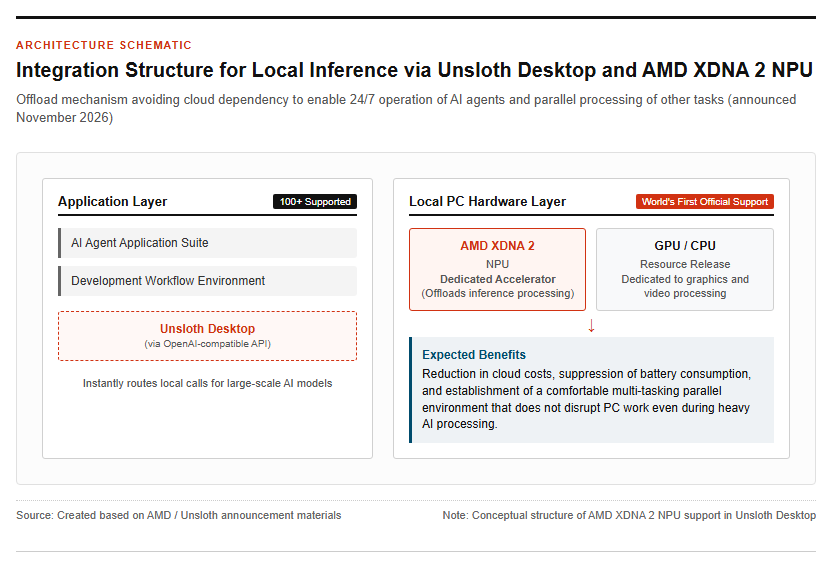
On November 19, 2026 (US time), semiconductor giant AMD and AI software company Unsloth announced official support for NPUs featuring the AMD XDNA 2 architecture in Unsloth Desktop. This collaboration marks the world’s first instance of an NPU supported by Unsloth Desktop. This makes it possible to offload computational processing for large-scale AI models running on local PCs from traditional CPUs and GPUs to a dedicated accelerator, the NPU. In recent AI adoption, battery consumption and the pressure on GPU resources caused by the continuous operation of AI agents have become challenges. With the introduction of this feature, an environment has been established where users can perform other tasks such as graphics processing and video rendering in parallel, without being hindered by heavy AI processing. In addition, via Unsloth Desktop’s OpenAI-compatible API, a mechanism has been built allowing immediate access to local NPU inference functions from over 100 AI agent applications and development workflows. The diagram below is a schematic overview illustrating the NPU processing structure within a local PC.
Technical Foundations of Lemonade and FastFlowLM Supporting Operations
Behind the scenes, the smooth execution of inference by the NPU is supported by the integrated Lemonade inference delivery platform and the FastFlowLM (FLM) NPU optimization engine. Inference requests from applications are first received at the OpenAI-compatible API endpoint provided by Unsloth Desktop. Afterward, Lemonade acts as a model server to route the processing, and FastFlowLM sends instructions directly to the AMD XDNA 2 NPU to execute high-speed and high-efficiency computations. Conventionally, when connecting agent-based applications to local models, developers had to rewrite hardware-specific control code on the side of each application. However, because this architecture adopts a standard OpenAI-compatible API as its interface, developers can realize a local AI environment utilizing the NPU simply by changing the connection URL of existing integrated development environments and assistant tools (such as Cline, Visual Studio Code, Open WebUI, and Hermes Agent). Software components required for execution are securely managed by Unsloth with version pinning and SHA-256 verification, significantly reducing the effort required to set up the environment.
Optimization of Power Efficiency and Memory Structure through NPU Utilization
Practical Benefits of Reduced GPU Load and 2–4x Greater Power Efficiency
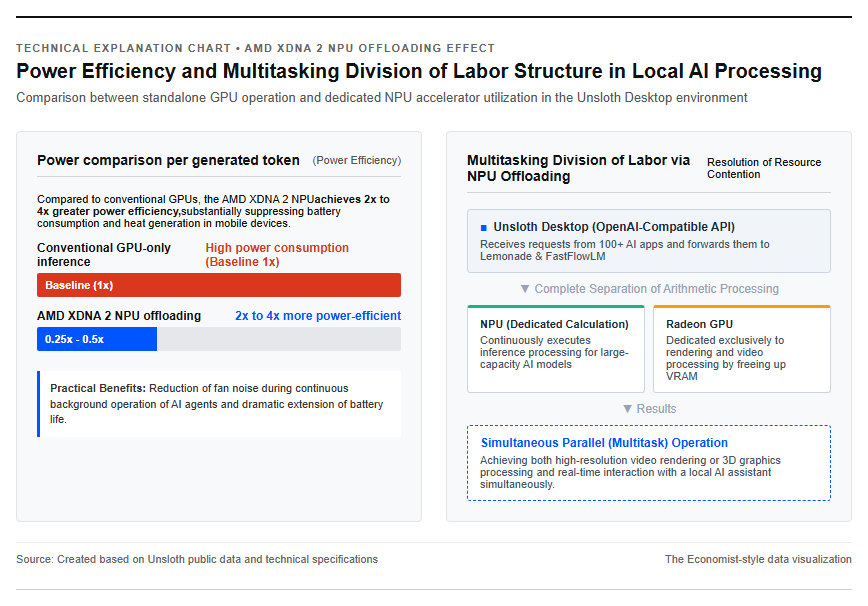
The greatest technical advantage of utilizing an NPU as an inference engine lies in the dramatic improvement of power efficiency. According to published data from Unsloth, the AMD XDNA 2 NPU operates with 2 to 4 times less power consumption per generated token compared to conventional graphics boards (GPUs). This makes it possible to continuously run AI agents in the background while significantly suppressing device heat generation and cooling fan noise, especially on battery-powered mobile laptops. Furthermore, the GPU computing resources and VRAM (video memory) that were previously monopolized by the generation of AI model responses are completely freed up. This turns multitasking operations into reality, such as rendering high-resolution video or processing 3D graphics on a Radeon GPU while simultaneously interacting with a local AI assistant on the NPU in real time. The diagram below illustrates the division of labor for processing between standalone GPU operation and NPU offloading.
Memory Requirements and Execution Conditions for Q4NX Quantized Models
In this official announcement, AMD and Unsloth demonstrated local inference on an NPU using Qwen 3.6, a Mixture of Experts (MoE) model with a total of 35 billion (35B) parameters. Running this model at its maximum context length requires allocating approximately 28GB of working memory to the NPU itself. Since Windows standard settings limit the shared memory allocation cap to 50%, this calculation means that a total of 64GB of system RAM is required across the PC to meet this requirement. Furthermore, running the model on the NPU requires using a model file in the “Q4NX” format, which is FastFlowLM’s dedicated 4-bit quantization format. Users who already own models in the conventional GGUF format can convert them into NPU-compatible models beforehand on the CPU using Unsloth’s Export feature. Users are encouraged to select an NPU model of an appropriate size to match the system memory capacity installed on their PC (such as a 4B model for 16GB RAM environments or a 12B model for 32GB RAM environments).
Outlook for the Adoption of Agentic AI
Supported Hardware and Diverse Development Tool Environments
As a hardware requirement for utilizing this feature, AMD Ryzen AI processors with built-in NPUs featuring XDNA 2 or later are specified. Specific targets include the Ryzen AI 300 series (Strix Point, Krackan Point), Ryzen AI Max series (Strix Halo), and Ryzen AI 400 series (Gorgon Point). Supported operating systems extend to both Windows 11 and Linux (64-bit environments). In Linux environments, NPU inference is enabled by using the amdxdna driver standardized in kernel 7.0 and later or a DKMS module for older kernels, along with updating the firmware and configuring memlock limits to be unlimited. Regarding supported tools, more than 100 diverse agentic tools are progressively adding support, including Cline and GitHub Copilot for software development assistance, LangChain for orchestration frameworks, and OpenClaw and Open WebUI.
Future Developments and Key Highlights of the Local AI Ecosystem
This official support for AMD NPUs by Unsloth symbolizes the transition of local AI operations from mere technical experiments into practical business and development infrastructure. For enterprises and individual developers, mounting pay-as-you-go costs from cloud dependency and the risks of sending sensitive data externally have been severe challenges, but low-power local inference utilizing NPUs can serve as a fundamental solution to these problems. As for future developments and key points to watch, the first is the expansion of Q4NX quantized models and further advancements in lightweight technologies. The second is the expectation of standardized workflows where agentic AI operates autonomously in the background 24/7, as well as the integrated control of multiple NPUs. Moreover, identifying the migration tipping point that can reduce cloud inference costs by up to 60% or more and building hybrid AI operations will hold the key to future AI deployment strategies.
Reference Pages
- 【AMD Newsroom – AMD and Unsloth Bring NPU Support】https://newsroom.amd.com/news/amd-unsloth-bring-npu-support-agentic-ai-applications/
- 【AMD Official Blog – AMD x Unsloth: Unlocking the World’s First NPU for Unsloth Desktop】https://www.amd.com/en/blogs/2026/unlocking-the-amd-ryzen-ai-npu-for-unsloth-desktop.html
- 【Unsloth Documentation – AMD NPU Guide】https://unsloth.ai/docs/get-started/install/amd/amd-npu
- 【FastFlowLM (FLM) Repository – GitHub】https://github.com/ROCm/FastFlowLM
【#Unsloth #AMD #RyzenAI #NPU #AIAgents #LocalInference】


コメント