On October 22, 2026, US-based Anthropic announced the general availability of all “Claude” features in a format managed and operated by the company on Google Cloud. Behind this is a strategy to simplify the adoption of advanced AI agents for enterprise companies and to fully integrate cloud infrastructure and billing systems.
- Key Points of the Announcement and Launch of Anthropic-Managed Offerings
- The latest models and high-speed processing features provided
- Differences Between the Traditional Offering and the Anthropic-Managed Model
- Google Cloud IAMとMarketplaceによる運用一本化
- Integration of Autonomous AI Agent Features and Developer Tools
- Background of the Capital Alliance and the Infrastructure Circular Structure
- Enterprise AI Adoption Strategies in the Multi-Cloud Era
Key Points of the Announcement and Launch of Anthropic-Managed Offerings
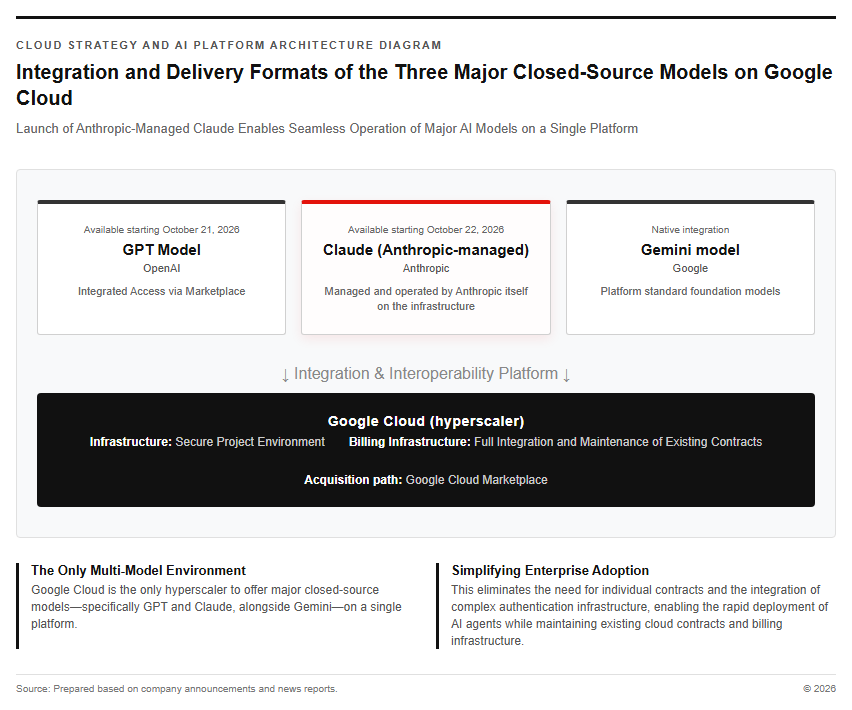
On October 22, 2026, US-based Anthropic officially launched “Claude Models on Google Cloud (Anthropic managed),” which is available directly from Google Cloud project environments. This initiative provides an API service managed and operated directly by Anthropic on Google Cloud infrastructure, achieving a global rollout for enterprise users. Conventionally, utilizing AI models at an advanced level required individual contracts with each developer and the integration of complex authentication infrastructures, but this announcement enables seamless deployment via the Google Cloud Marketplace. As a result, enterprises can quickly access the full range of platform features of Claude, a state-of-the-art language model, while maintaining their existing cloud contracts. Furthermore, OpenAI’s GPT models also became available on Google Cloud on October 21, 2026, making Google Cloud the only hyperscaler to handle the three major closed-source models—Gemini, Claude, and GPT—on the same platform. The following diagram illustrates the overall structure of this offering format.
The latest models and high-speed processing features provided
With this launch, users now have access to the complete lineup of major models provided by Anthropic. Specifically, the coverage includes Claude Opus 5.5, which handles advanced reasoning and specialized tasks; the Fast mode feature, which significantly improves response speed; Claude Sonnet 5.5, which offers an excellent balance of processing performance and cost; Claude Haiku 5.5, designed for high-volume data processing; and Claude Fable 5.1, which tackles highly difficult scientific research and complex reasoning. In particular, the Fast mode in Opus 5.5 delivers a dramatic improvement in user experience for real-time assistants and conversational interfaces where high-speed output is required. Furthermore, direct access to the developer environment, Claude Console, is supported, allowing API evaluation, prompt design, and tuning tasks to be completed within a single environment. The pricing structure has also been clarified; for example, Opus 5.5 is priced at $4 per million input tokens and $20 per output token, while Haiku 5.5 starts at $0.10 for inputs and $0.50 for outputs, enabling cost optimization tailored to scale.
Differences Between the Traditional Offering and the Anthropic-Managed Model
With the new specifications, the API pathways for using Claude on Google Cloud have been streamlined into three main categories. The first is the conventional route, connecting via API keys through a direct contract with Anthropic; the second is the “Google managed” route, where Google fully operates the infrastructure and data processing; and the third is the newly established “Anthropic managed” route. The “Google managed” option is configured to be suitable for financial, healthcare, and government institutions that require strict regulatory compliance regarding data residency and governance. On the other hand, the newly introduced “Anthropic managed” option’s greatest feature is that Anthropic directly manages the API and rate limits, guaranteeing same-day access to the latest beta features and new models. Companies can now compare and evaluate their own security standards, data retention policies (such as Zero Data Retention), and the deployment speed of necessary new features to select the optimal connection model.
Infrastructure and Security Accelerating Enterprise Adoption
Google Cloud IAMとMarketplaceによる運用一本化
When enterprise companies deploy AI into production at scale, the biggest hurdles are operational costs and the increasing complexity of security management. With the Anthropic-managed delivery format, all usage fees are consolidated into a single invoice via Google Cloud Marketplace. This allows companies to directly apply their previously contracted annual commitments (minimum spending pledges) toward Claude usage fees. Additionally, the management and rotation of individual API keys are completely eliminated, and centralized access management is applied through Google Cloud IAM (Identity and Access Management). Because roles for viewing, usage, and management can be configured on a per-project basis, it is possible to enforce strict access controls for each internal team and department. Furthermore, data perimeter protection via VPC Service Controls, as well as the visualization of token consumption and latency through Cloud Logging and Cloud Monitoring, are realized on the same stack.
Integration of Autonomous AI Agent Features and Developer Tools
Another major feature this time is the high level of integration of AI agent capabilities that go beyond mere text generation to autonomously execute complex tasks. Users can take advantage of features such as the long-running agent “Claude Managed Agents” (offered in beta), code execution, computer use, advanced agent skills, and an advisor strategy feature to assist with strategic planning. Furthermore, for integration with external data and internal knowledge, it is fully equipped with the Files API, citations, web search and fetch functions, and the MCP connector, which is an external tool connection standard. The diagram below illustrates the structure in which AI agents integrate with each system.
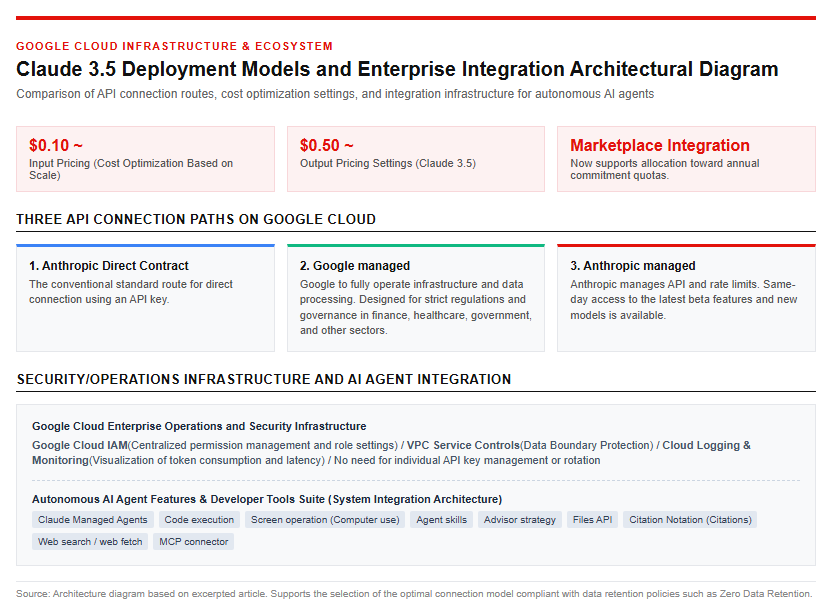
By leveraging these features, it is possible to build autonomous workflows integrated with internal databases and cloud storage.
Background of Big Tech Partnerships and Future Outlook of the Cloud Market
Background of the Capital Alliance and the Infrastructure Circular Structure
The relationship between Google and Anthropic is built on a massive capital and infrastructure partnership that goes far beyond the scope of a mere service provider and customer. Following its $3 billion investment in 2023, Google agreed in April 2026 to a massive investment of up to $40 billion ($10 billion immediately, with $30 billion contingent). Meanwhile, Anthropic has committed to paying at least $111 billion between April 2026 and July 2033 for the use of Google Cloud and next-generation TPUs (Tensor Processing Units). This relationship forms an interdependent “circular structure” where the funds invested by Google are returned to Google as cloud and TPU usage fees. Furthermore, the two companies, alongside Broadcom, have agreed to secure 5 GW (gigawatts) worth of computing resources for next-generation TPUs. Backed by a vast amount of electricity equivalent to five nuclear power plants and a robust computing infrastructure, they are strongly supporting the development and stable operation of next-generation models from the physical infrastructure layer.
Enterprise AI Adoption Strategies in the Multi-Cloud Era
This strengthening of the partnership is bringing a major transformation to the correlation between AI models and cloud platforms. Traditionally, choosing a specific AI model meant being locked into a specific cloud provider; however, Anthropic has forged large-scale partnerships not only with Google Cloud, but also with Amazon Web Services (AWS) and Microsoft Azure, thoroughly pursuing a multi-cloud deployment strategy. For enterprise users, an environment is now in place where they can flexibly select the most advanced AI models optimal for their business operations without changing their existing cloud environments or infrastructure budgets. From 2027 onward, next-generation 5GW TPU infrastructure is expected to begin full-scale operations, further advancing processing speed improvements and the easing of usage restrictions. Moving forward, it will be essential for companies to pursue AI strategies that balance governance and cost-effectiveness while avoiding reliance on specific vendors to achieve sustainable growth.
Reference Page
- Anthropic Official Announcement: Claude Models on Google Cloud (Anthropic managed)
- 【Google Cloud Blog: Claude at Scale on Google Cloud】[suspicious link removed]
[#Anthropic #GoogleCloud #Claude #GenerativeAI #AIAgents #CloudInfrastructure #TPU]
コメント