According to the National Consumer Price Index for September 2026 released by the Ministry of Internal Affairs and Communications, the core CPI, excluding fresh foods, rose 2.1% year-on-year. This reflects the reality that, even as the suppressing effects of energy subsidies continue to linger, the passing on of soaring raw material and labor costs to a wide range of items has entered a full-fledged phase.
- Acceleration of Major Price Index and Recovery to the 2% Range for the First Time in 9 Months
- Upward momentum spreading to both goods and services
- The surging pressure of import prices and corporate goods prices from upstream
- The Contrast Between Upward-Pushing Items and Unusually Declining Items
- The October BOJ Meeting’s Decision and the December Additional Rate Hike Scenario
- Increased Household Financial Burden and the Need for Sustained Wage Growth
Acceleration of Major Price Index and Recovery to the 2% Range for the First Time in 9 Months
According to the national consumer price index (2025 base) for September 2026 released by the Statistics Bureau of the Ministry of Internal Affairs and Communications on October 23, 2026, the overall index excluding fresh foods, which are subject to large price fluctuations (core CPI), came in at 102.3, registering a 2.1% increase compared to the same month of the previous year. The rate of increase expanded by 0.4 percentage points from 1.7% in August 2026, the previous month, marking a return to the 2% range for the first time in nine months, since December 2025.
The headline index also came in at 102.2, marking a 2.1% increase year-on-year and accelerating its growth from 1.9% in the previous month. What is even more noteworthy is the movement of the index excluding fresh food and energy (core-core CPI). The index stood at 102.8, recording a 2.4% year-on-year rise and jumping significantly by 0.5 percentage points from 1.9% in the previous month. This exceeded the pre-release market consensus forecast of 2.3% by 0.1 percentage points.
Please refer to the figure below for recent trends and a comparison of the headline index and each core index.
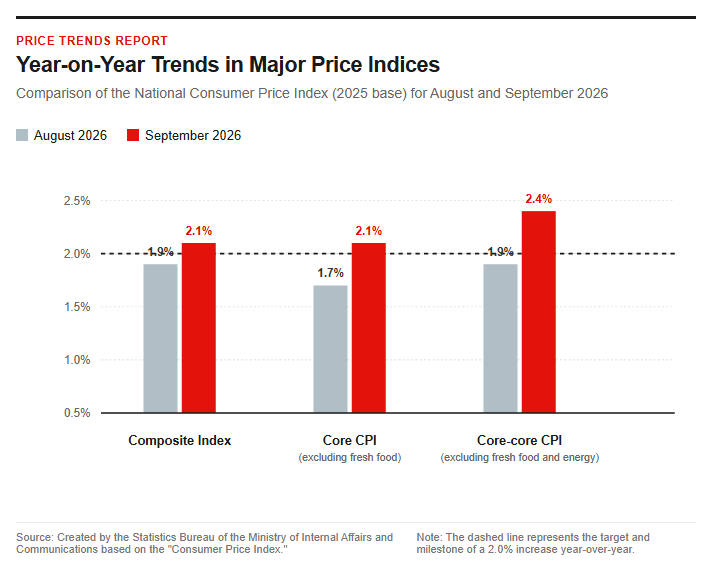
Looking at the seasonally adjusted month-on-month figures, which indicate single-month momentum, the headline index rose by 0.4%, the core CPI by 0.5%, and the core-core CPI by 0.5%, all showing strong growth. This clearly confirms through statistical data that underlying inflationary pressures are once again gathering momentum throughout Japan, extending beyond just temporary boosts from energy prices.
Upward momentum spreading to both goods and services
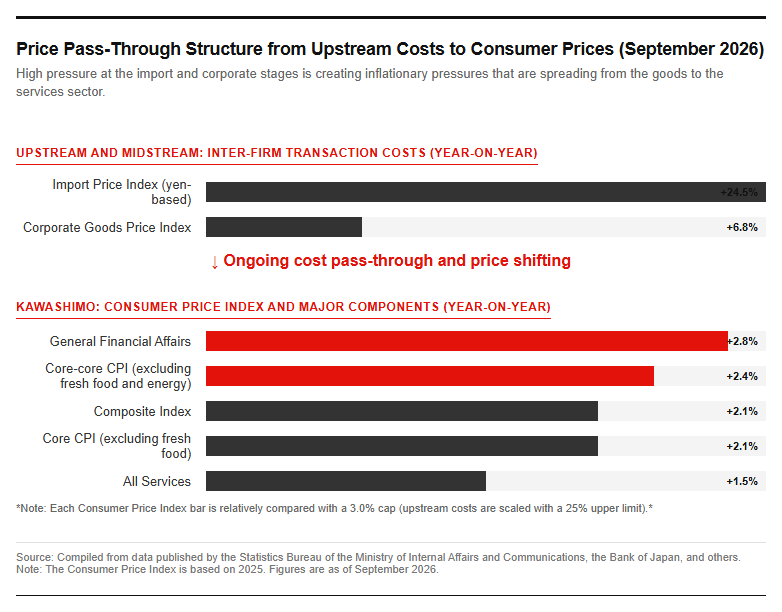
Analyzing price trends in September 2026 by category highlights a structure in which the wave of price increases is steadily spreading from physical goods to the service sector. The overall goods index rose 2.8% year-on-year, accelerating its growth rate from 2.6% in August 2026. The trend of passing on rising procurement costs to selling prices continues in durable consumer goods, recreational goods, and daily necessities.
Meanwhile, the overall services index—which is closely linked to wage trends and considered a gauge of how firmly underlying inflation is taking root—recorded a 1.5% increase year-on-year. This is an expansion of 0.3 percentage points from the previous month’s 1.2%, indicating a solid upward trend. The details of the breakdown in the services sector and the growth rates of major items are as follows.
- Accommodation rates: Shifted clearly into positive territory year-on-year, driven by the sustained high level of inbound demand.
- Water rates: Revisions implemented against the backdrop of rising aging-infrastructure countermeasure costs and increased burdens of infrastructure renewal across local governments.
- Dining out and various interpersonal services: Increases in labor costs are underway to cope with minimum wage hikes and labor shortages.
Thus, while the price pass-through for goods maintains a steady pace, the fact that service prices are following suit and strengthening their upward trend represents a new development that differs from past cost-push-driven inflation episodes.
The spread of price passing and changes in cost structures
The surging pressure of import prices and corporate goods prices from upstream
The primary structural factor behind the re-acceleration of consumer prices is that intense upward price pressure at the upstream and midstream business-to-business transaction stages is continuously spilling over into final consumer goods. In September 2026, the import price index (on a yen basis) recorded an exceptionally high growth rate, surging 24.5% year-on-year. The prolonged depreciation of the yen in the foreign exchange market and the resilience of international resource prices are strongly pushing up import costs.
Furthermore, the domestic Corporate Goods Price Index also showed a 6.8% increase year-on-year in the same month, and procurement burdens in the manufacturing and distribution industries continue to remain at a high level. The trends in inter-firm transaction costs and the transmission pathway to consumer prices are summarized in the conceptual diagram below.
Examining the data on the ratio of rising and falling prices published by the Bank of Japan, the ratio of rising items reached 74.3% as of August 2026, with price increases occurring in approximately three-quarters of the surveyed items. Meanwhile, the ratio of falling items dropped to 21.2%. Going beyond the localized impact of surging raw material prices for certain goods, the behavior of passing on increased costs to final prices has become firmly established across almost all industrial sectors.
The Contrast Between Upward-Pushing Items and Unusually Declining Items
A close examination of the price breakdown for September 2026 by individual item reveals a clear polarization: price increases for daily necessities alongside a sharp pullback in certain agricultural products. The index for food (excluding perishable foods) rose 2.9% year-on-year, accelerating its growth once again from 2.7% in August 2026. Across processed foods in general—such as prepared meals, seasonings, and confectionery—price revisions reflecting rising raw material and logistics costs are being implemented intermittently.
On the other hand, certain items exhibited unusual movements that suppressed the overall index. The movements by major item are as follows.
- Overall energy: Down 0.6% year-on-year, continuing the downward trend (previous month: down 0.7%)
- Electricity and city gas bills: Suppressed due to the reflected subsidy effects of the government’s emergency support measures for getting through the extreme heat
- Rice: Recorded a significant drop of 20.6% year-on-year (compared to a 15.7% decline in the previous month)
Regarding rice, an increase in the supply of newly harvested rice and the normalization of distribution have caused the year-on-year decline to expand for five consecutive months, serving as a major factor in pulling down the overall headline index. However, the fact that, even after absorbing such downward pressure, the core CPI jumped to 2.1% and the core-core CPI to 2.4% indicates that underlying inflationary pressures remain extremely robust.
Impact on Monetary Policy and Future Economic Outlook
The October BOJ Meeting’s Decision and the December Additional Rate Hike Scenario
The fact that the core CPI has returned to the 2% range for the first time in 9 months, and particularly that the core-core CPI has risen to 2.4%, provides crucial implications for the Bank of Japan’s monetary policy management. At the Monetary Policy Meeting to be held from October 29 to 30, 2026, the dominant view in the market is that the Bank of Japan will leave its policy interest rate unchanged, given that it just implemented a rate hike at the preceding September meeting.
However, in the Outlook for Economic Activity and Prices (Outlook Report) released simultaneously with the meeting, there is a high probability that an official view will be presented indicating that the underlying inflation rate has generally reached the target level of 2%. The schedule and key indicators for the future normalization of monetary policy are as follows.
- October 2026 Meeting: Decided to Keep Policy Interest Rate Unchanged While Clearly Stating Progress Toward Achieving the Price Target
- December 2026 meeting: Expectations rise for an additional rate hike to raise the policy interest rate by another 0.25%
- Outlook for the 2027 Shunto (Spring Labor-Management Wage Negotiations): Initial Moves in Labor-Management Talks to Achieve High-Level Wage Hikes for the Third Consecutive Year
Governor Ueda noted at the previous meeting that the policy phase has changed, and the focus has completely shifted from the conventional “stage of raising it to 2%” to the “stage of stably anchoring it at 2%.” The possibility of another rate hike within the year has become even more realistic.
Increased Household Financial Burden and the Need for Sustained Wage Growth
While inflation figures continue to show resilience, the impact on the household sector in the real economy remains increasingly severe. The ongoing burden of price increases in frequently purchased items that consumers easily notice—such as groceries, daily necessities, and utility bills—persists, and a strengthening defensive mindset toward daily life is resulting in sluggish growth in real consumption expenditures.
Whether the Japanese economy can maintain a stable growth trajectory moving forward depends on whether it can establish a sustainable cycle of real wage increases that outpace inflation. Amid corporate earnings conditions and advancing price pass-through, a virtuous cycle is required in which the created added value is returned to wages.
Specifically, the most critical issue is whether appropriate price pass-through will take place not only in large corporations but also in small and medium-sized enterprises (SMEs), which account for about 70% of employment, and whether continuous base pay increases will be implemented toward fiscal 2027. Amid side effects such as rising mortgage rates and increased corporate financing costs due to higher interest rates, whether a boost in real purchasing power can be achieved will be the turning point that dictates future economic trends.
Reference Page
- 【Statistics Bureau, Ministry of Internal Affairs and Communications: 2025-Base Consumer Price Index, Nationwide, September 2026 (Preliminary Report)】https://www.stat.go.jp/data/cpi/sokuhou/tsuki/pdf/zenkoku.pdf
- [Statistics Bureau of Japan: Consumer Price Index (CPI) National (Summary of the Latest Monthly Results)] https://www.stat.go.jp/data/cpi/sokuhou/tsuki/index-z.html
[#ConsumerPriceIndex #CoreCPI #BankofJapan #MonetaryPolicy #PriceIncrease #Inflation #JapaneseEconomy #Macroeconomy]

コメント