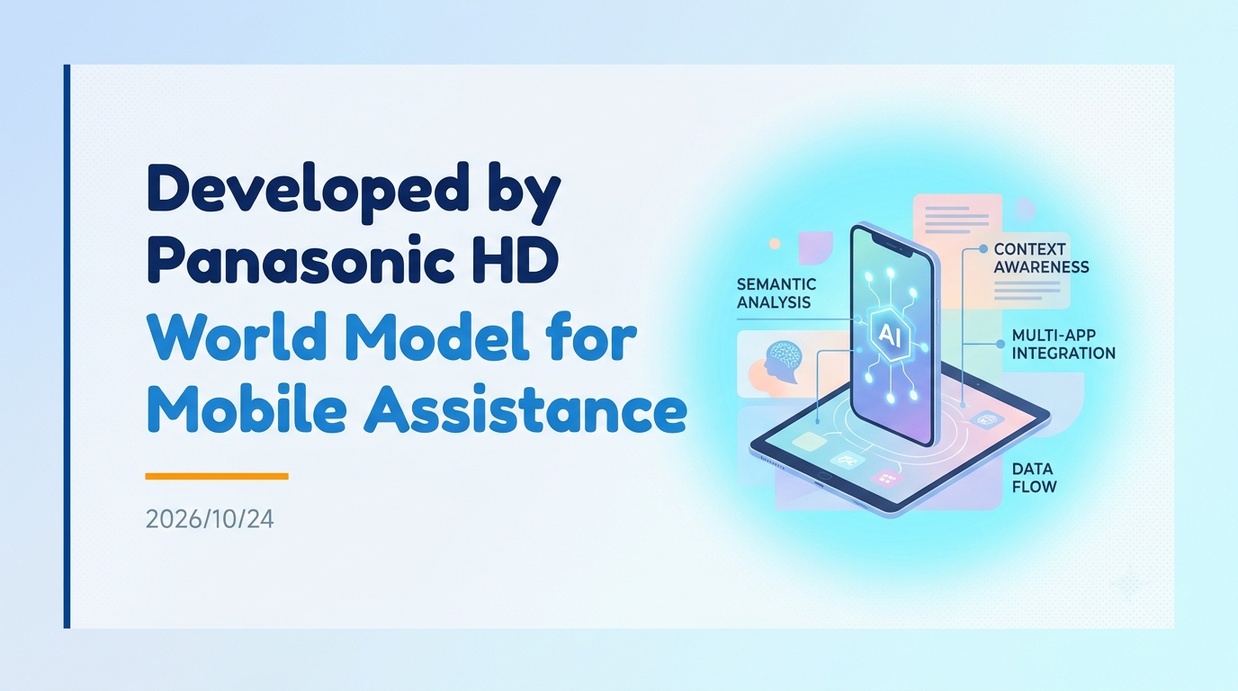
A research team including Panasonic Holdings and the University of California, Los Angeles (UCLA) has developed a “world model” for AI agents operating on mobile devices such as smartphones. By employing a new method that predicts state changes accompanying operations in natural language, rather than relying on conventional screen image prediction, the team has improved the task success rate from 46.9% to 54.3%.
- An Innovation in Natural Language Prediction That Doesn’t Rely on Screen Images
- Building a Massive Training Dataset of Approximately 1.4 Million Samples: MobileWorld
- Empirical data showing a dramatic improvement in task success rate to 54.3%
- The Workload Reduction Effect of Cross-Application Operations On-Site
- Published a paper at EMNLP 2026 as an academic achievement
- The Future of Social Operations Support Expanding into Web and PC Domains
An Innovation in Natural Language Prediction That Doesn’t Rely on Screen Images
Panasonic Holdings Corporation and Panasonic R&D Company of America, in collaboration with researchers at the University of California, Los Angeles (UCLA), have developed a “world model” that uses AI to predict and assist with operations on smartphones and tablets. In fields such as manufacturing, logistics, and maintenance inspections, expectations are rising for AI agents that can take over complex tasks on mobile devices on behalf of humans. However, conventional methods that reproduce and predict screen images at the pixel level have faced the challenge of prediction accuracy being affected by information unrelated to the core task, such as on-screen time, battery levels, notification pop-ups, and minor layout fluctuations. The newly announced technology adopts an approach that predicts state changes themselves—such as a settings screen opening or an input field appearing when a button is pressed—using “natural language (semantics).” This makes it possible to select the optimal operational steps directly linked to achieving a goal, without being distracted by noise information.
Building a Massive Training Dataset of Approximately 1.4 Million Samples: MobileWorld
To realize a new world model, the research team built “MobileWorld,” a large-scale training dataset based on human operation trajectories on Android devices. This dataset contains a total of approximately 1.4 million data points, including about 942,000 text data entries describing screen changes before and after operations, and about 543,000 question-and-answer data entries regarding the next state. After automatically generating and filtering data using vision-language models, they established a high-quality training foundation by conducting manual verification on a portion of the data. Using this MobileWorld, they further trained the open-source 8-billion-parameter vision-language model “Qwen3-VL-8B-Instruct” and evaluated it using their proprietary evaluation benchmark, “MobileWorldBench.” It recorded exceptionally high evaluation scores, outperforming existing comparative methods across all aspects of accuracy, completeness, and relevance.
AI Agent Operation Success Rates and Real-World Applicability
Empirical data showing a dramatic improvement in task success rate to 54.3%
To verify the practicality of the developed world model, comprehensive testing was conducted using “AndroidWorld,” a standard benchmark for evaluating the operational performance of AI agents. A comparative experiment was performed where the world model was used to predict in advance the future state resulting from each candidate action taken by the AI agent, allowing it to choose its next move based on those evaluations. While the baseline method—which does not incorporate the world model—achieved a task success rate of only 46.9%, the agent integrated with this world model dramatically improved its task success rate to 54.3%. By accurately anticipating screen transitions caused by operations, the agent significantly reduced failure patterns, such as making wrong moves halfway through or getting stuck by navigating to unintended screens. Please refer to the figure below.
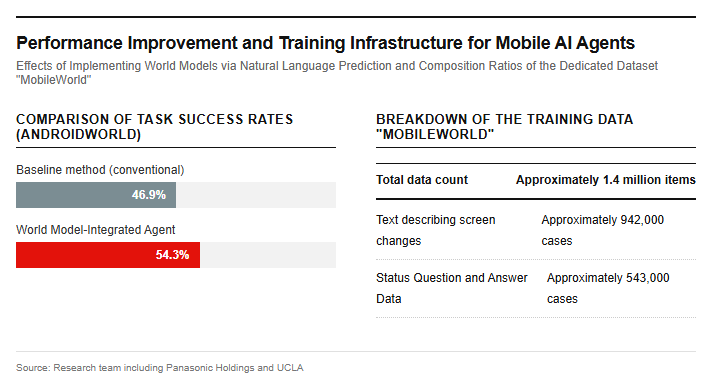
A foundation that enables AI to autonomously reason about situations and advance workflows has been completed.
The Workload Reduction Effect of Cross-Application Operations On-Site
In on-site mobile operations, it is rare for a task to be completed using a single app, and workers routinely switch between multiple applications, such as checking for abnormalities in a facility management app, checking inventory in a parts inventory system, and entering reports into a work recording tool. AI agents equipped with world models are not constrained by the unique button layouts or design differences of individual apps; instead, they can interpret the intent behind state changes, thereby smoothly handling cross-application operations. By incorporating the decision-making expertise of experienced workers into AI agents, it prevents new employees from getting lost during operations while minimizing operational errors and missed checks. In on-site environments facing severe and chronic labor shortages—such as construction sites, infrastructure operations, manufacturing plants, and logistics warehouses—they are expected to deliver significant results as a solution that dramatically reduces the operational burden on workers.
International Conference Presentation and Future Expansion
Published a paper at EMNLP 2026 as an academic achievement
The results of this research have been accepted for presentation at “EMNLP 2026,” one of the world’s top international conferences in the field of natural language processing (held in Budapest, Hungary, from October 24 to 29, 2026), where the paper will be presented on-site. Titled “MobileWorldBench: Towards Semantic World Modeling For Mobile Agents,” the paper has already been made available on the preprint platform arXiv. This collaborative research effort involves Panasonic Group engineers Kazunori Kozuka and Yusuke Kato, Konstantinos Kallidromitis from PRDCA, and Shufan Li from UCLA, drawing high international attention as an advanced case study uniting academia and corporate R&D from Japan and the United States. The approach of immediately releasing the results of basic research as evaluation benchmarks and datasets serves as a catalyst accelerating the trends of next-generation AI development.
The Future of Social Operations Support Expanding into Web and PC Domains
Building on the insights gained from this world model for smartphones, Panasonic Holdings has outlined a policy to further expand its application scope to business support for website navigation and PC applications. Looking toward 2032, the company has established “resolving frontline labor shortages” and “effective energy utilization” as key social challenges, and is driving business transformation to support AI infrastructure and societal operations. By sequentially incorporating this technology into various internal back-office operations and customer solutions, the company will powerfully drive automation and labor-saving across all operational sites. The natural language-predictive world model, which originated on mobile devices, is set to evolve into a foundational technology that will enhance the sophistication of operations across society as a whole, including various smart devices and office PCs in the future.
Reference page
- [Panasonic Holdings Press Release] https://news.panasonic.com/jp/press/jn261021-1
- [Paper (arXiv)] https://arxiv.org/abs/2512.14014
- [Panasonic × AI Official Website] https://tech-ai.panasonic.com/jp/
[#Panasonic #AIAgent #WorldModel #NaturalLanguageProcessing #EMNLP2026 #DigitalTransformation]
コメント