China’s Tencent has released the weights and source code for its interactive video world model “Hy-Nomas” as open source on Hugging Face. This move comes amid a growing demand for world simulation technology that goes beyond generating standalone video clips to sequentially expand a consistent virtual space through text instructions and camera trajectories.
- The Background Behind Tencent’s Release of Hy-Nomas
- The Segment Autoregression Mechanism That Differs from Conventional Video Generation AI
- 54-block MMDiT and dual control of text and camera
- Optimization from an 8-GPU Environment to a Single RTX 4090 and LoRA Expansion
- Verification of Hy-Nomas-Bench Provided with Unpublished Scores
- Potential Applications and Prospects for Robotics and Spatial Intelligence
The Background Behind Tencent’s Release of Hy-Nomas
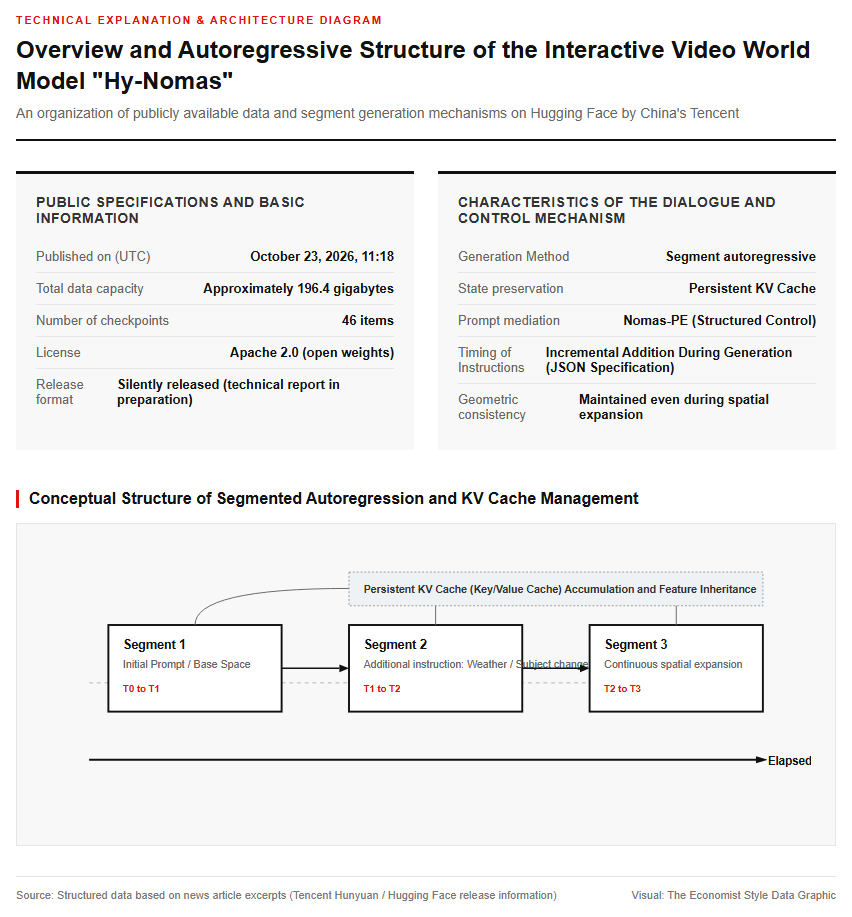
At 11:18 UTC on October 23, 2026, China’s Tencent (Tencent Hunyuan) released the weight files for its new video generation AI model, “Hy-Nomas,” on the AI model-sharing platform Hugging Face. Although the repository itself had been created on October 21, 2026, following an approximately two-day waiting period, a total of 46 checkpoint files amounting to roughly 196.4 gigabytes were uploaded all at once. The main components of the released model are subject to the permissive Apache 2.0 license, taking the form of open weights that researchers and developers can acquire and verify free of charge.
A notable aspect of this release is that it was an extremely quiet launch, unaccompanied by any prior official blog posts or academic paper publications. Although the link to the technical report is still being prepared and the format was unusual in that no benchmark score table was attached, inference code, container images, and a demo site running in the browser were provided simultaneously. On Hugging Face, volunteer-led ported versions for ComfyUI were published immediately afterward, rapidly sparking autonomous verification efforts within the community.
The Segment Autoregression Mechanism That Differs from Conventional Video Generation AI
What decisively differentiates Hy-Nomas from conventional text-to-video generation models is that, instead of outputting a video of a fixed duration from a single prompt and finishing, it continues to generate a world incrementally in segment units. This model sequentially generates short time frames (segments) and employs an autoregressive structure that predicts the next frames while accumulating the latent variables and features of the previously rendered video into a persistent KV Cache (Key/Value Cache). This makes it possible to continue expanding the space while maintaining the geometric consistency of buildings and terrain at street corners passed several minutes prior.
Interactivity is also pursued in the design of instruction inputs, enabling users to sequentially add instructions to introduce new subjects or alter the weather and environment midway through generation. In offline inference, a JSON-format data structure is used, specifying the start and end times of each segment in millisecond units and describing the contents of the changes. Furthermore, in the web demo environment, a prompt expansion model called “Nomas-PE” acts as an intermediary, automatically converting the user’s rough natural language instructions into structured control prompts. The following figure illustrates the conceptual structure of segment generation and cache management over time.
Architecture Features and Hardware Requirements
54-block MMDiT and dual control of text and camera
At the backbone of Hy-Nomas is a multimodal diffusion transformer (MMDiT) composed of 54 blocks. It features a hidden layer dimension of 2,048 and 16 attention heads, accurately encoding the spatial and temporal positional relationships of the video using 3D rotary position embedding (3D RoPE). The open-source vision-language model “Qwen2.5-VL-7B-Instruct” is integrated as the text encoder responsible for language understanding, structured in a way that 3,584-dimensional language features are projected into the diffusion model space via a two-layer token refiner.
In the video control mechanism, explicit camera trajectory control is incorporated as an independent pathway in addition to natural language prompts. A 4×4 normalized extrinsic parameter matrix is aggregated and input every 4 frames, directly reflecting into the video generation through cross-attention within each block. For the video’s latent representation, “DCAE-V”—which features 32 channels and a compression rate of 32x spatially and 4x temporally—is used, and the generated latent variables are rapidly reconstructed into a 720×1280 pixel, 24 FPS video by a fine-tuned PixelUMM decoder with a 35-layer [wait, 36層 -> 36-layer] transformer structure.
Optimization from an 8-GPU Environment to a Single RTX 4090 and LoRA Expansion
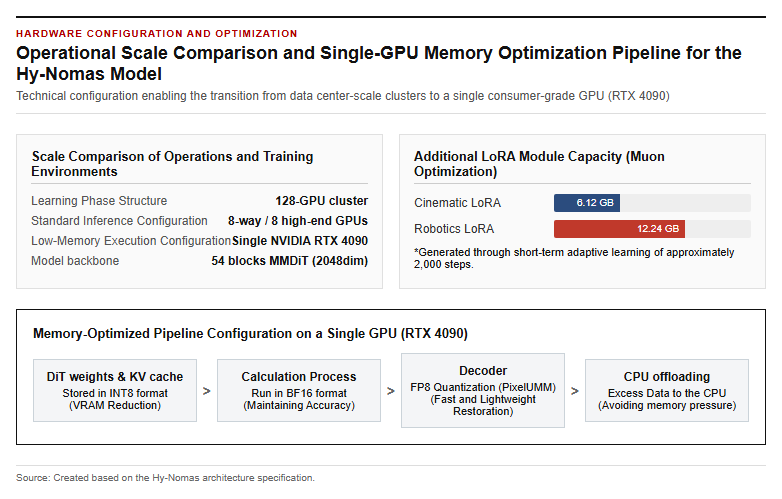
Regarding the operational scale of the model, the standard inference configuration assumes 8-way sequence parallelism (Sequence Parallelism), requiring a compute node equipped with eight high-end GPUs. The configuration example for the training phase uses a 128-GPU cluster, resulting in a heavy-duty design built on the premise of data center-scale infrastructure. However, Tencent has also released a low-memory execution configuration that allows it to run on a single consumer-flagship NVIDIA GeForce RTX 4090 by combining quantization technology and memory control.
In single-GPU mode, VRAM consumption is significantly reduced by keeping the DiT weights and KV cache in INT8 format while executing computations in BF16, as well as by introducing FP8 quantization for the decoder and offloading processing to the CPU. In addition, the model comes bundled with a “Cinematic LoRA” (approx. 6.12 gigabytes) that enhances video quality, and a “Robotics LoRA” (approx. 12.24 gigabytes) pre-trained on real-world dual-arm robot manipulation datasets. These have undergone adaptive learning in a short period of about 2,000 steps using the Muon optimizer, demonstrating the ease of model expansion for specific business domains. The figure below shows an example configuration of the memory optimization pipeline on a single GPU.
Current State of Benchmarks and Challenges for Future Practical Application
Verification of Hy-Nomas-Bench Provided with Unpublished Scores
Simultaneously with the release of the model, the evaluation dataset “Hy-Nomas-Bench” was open-sourced. This benchmark consists of four evaluation axes: multi-turn text dialogue, camera navigation, combined text and camera control, and spatial memory. It includes a total of 280 test cases and approximately 220 reference camera trajectory data, establishing a test environment to objectively measure interactive operability and long-term consistency.
Meanwhile, Tencent has not released any benchmark score lists or comparative evaluation figures with competing models at this time. The model card clearly notes that the 8-step sampling and output resolution in the distillation configuration are merely configuration specifications and not benchmark results that prove performance. Therefore, regarding how much of a quality advantage this model holds over prior world models such as Google’s Genie 3 and Ant Group’s LingBot-World, we must await future hands-on verification by third-party organizations or the community.
Potential Applications and Prospects for Robotics and Spatial Intelligence
The emergence of Hy-Nomas is not merely a video generation tool for entertainment, but holds strong significance as a foundational simulator for robotics, autonomous driving, and game development. As demonstrated by the existence of Robotics LoRA, world models that mimic physical laws and operational environment feedback play an extremely crucial role as a reinforcement learning environment (digital twin) prior to operating real-world robots. Distributed as open weights under the Apache 2.0 license, it has established a foundation for research institutions and companies to develop their own spatial intelligence within their own closed infrastructure.
Future points of focus include the presentation of detailed measurement data accompanying the publication of the official technical report, and the progress of library support by the open-source community. Although operations currently center around a dedicated repository and a Docker environment, integration into general video generation pipelines is expected to drive incorporation into a broader range of applications. While leaving some aspects as unknowns, Hy-Nomas—having emerged with complete functionality and code—serves as a major turning point that significantly advances the race toward the practical application of interactive world models.
Reference page
- 【tencent/Hy-Nomas – Hugging Face】https://huggingface.co/tencent/Hy-Nomas
- 【Tencent-Hunyuan/Hy-Nomas – GitHub】https://github.com/Tencent-Hunyuan/Hy-Nomas
- 【tencent/Hy-Nomas-Bench – Hugging Face】https://huggingface.co/datasets/tencent/Hy-Nomas-Bench
- 【Hy-Nomas Interactive Demo】https://hy-nomas.hy.tencent.com/
【#ArtificialIntelligence #VideoGenerationAI #WorldModel #OpenSource #Tencent #MachineLearning #Robotics】


コメント