German automotive giant Audi has announced that it will invest approximately $4 billion to build its first complete vehicle assembly plant in the U.S. state of Georgia. The move is driven by stricter tariffs on imported vehicles under the U.S. Trump administration and sluggish sales in the North American market, with the aim of restructuring its North American operations through a transition to local production.
- Key points of the establishment of the first U.S. production base and the billion investment
- Location Advantages and Production Plans of the Middle Georgia Megasite
- Creation of local employment and ripple effects on the regional economy and supply chain
- The Background of Profit Pressure and Shifts to Local Production Caused by Trump Tariffs
- Job cuts at the German headquarters factory and friction with labor unions
- Financial Risks and Key Areas to Watch in the North American Market
Key points of the establishment of the first U.S. production base and the billion investment
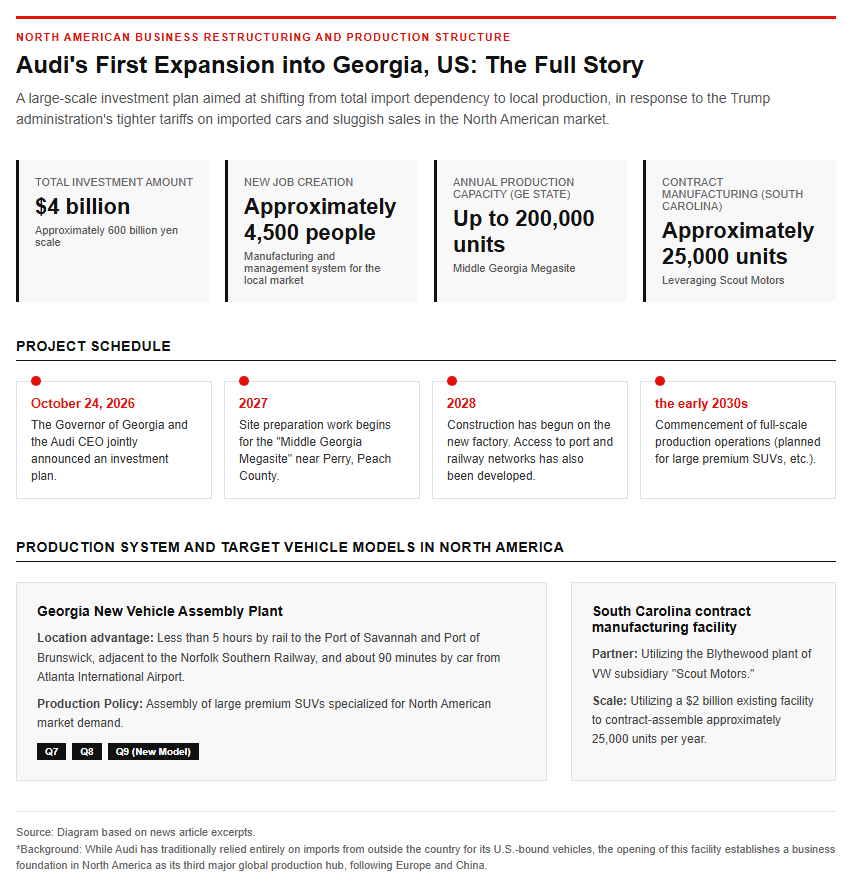
Audi AG, the luxury car brand under Germany’s Volkswagen (VW) Group, has announced that it will open its first-ever automotive assembly plant in the United States, located in Georgia. Audi plans to make a massive investment of approximately $4 billion (roughly 600 billion yen) to build a state-of-the-art manufacturing facility at the “Middle Georgia Megasite,” located near Perry in Peach County, central Georgia. The project is expected to create approximately 4,500 new local jobs. The plant is projected to have an annual production capacity of up to 200,000 vehicles, with site preparation work slated to begin in 2027, construction to start in 2028, and full-scale production targeted for the early 2030s. The joint announcement was made on October 24, 2026, by Georgia Governor Brian Kemp and Audi CEO Gernot Döllner, and U.S. President Donald Trump also highlighted the investment plan at a local rally. Until now, Audi has relied entirely on imports from outside the country for vehicles destined for the U.S. market, but by opening this plant, the company aims to establish a business foundation in North America as its third major production hub globally, following Europe and China.
Location Advantages and Production Plans of the Middle Georgia Megasite
The Middle Georgia Megasite, chosen by Audi as its construction location, is a vast industrial site developed by a joint development authority (JDA) established by Peach County, Houston County, and Macon-Bibb County. Highly praised for its logistical infrastructure and accessibility advantages, it offers rail access to the major ports of Savannah and Brunswick in under five hours, and is adjacent to a Norfolk Southern Class I rail line. Furthermore, it is favorably located approximately 90 minutes by car from Hartsfield-Jackson Atlanta International Airport, which boasts one of the highest passenger volumes in the world. At the new plant, the company plans to focus on producing large premium SUVs tailored to North American market demand, specifically the assembly of the “Q7,” “Q8,” and the new “Q9” model. Additionally, Audi is moving forward with plans to contract out the assembly of approximately 25,000 Audi vehicles per year by utilizing a $2 billion plant currently under construction in Blythewood, South Carolina, by Scout Motors, the electric off-road vehicle brand under the VW umbrella. Please refer to the diagram below for the overall plant layout and logistics structure.
Creation of local employment and ripple effects on the regional economy and supply chain
The approximately 4,500 direct jobs created by Audi’s expansion are expected to bring about a major transformation in the regional economy of central Georgia. The salary levels for the new positions are projected to be exceptionally high, offering strong competitiveness within the local market. On the workforce development front, Georgia’s job seeker assistance program, “Georgia Quick Start,” will establish an Audi-dedicated educational curriculum and training facility, working in cooperation with the local campus of the Technical College System of Georgia (TCSG) to foster highly skilled automotive talent. Furthermore, the establishment of the automobile assembly plant will exert a massive ripple effect on surrounding industries, including parts suppliers, logistics, and various service providers. Much like the case of the Hyundai Motor Group’s “Metaplant (HMGMA)” already operating near Savannah in the state, numerous tier-1 and tier-2 suppliers are expected to cluster in the neighboring area. This is expected to drive expanded orders for local small and medium-sized enterprises and increase municipal tax revenues, which is evaluated as contributing to the long-term development of the entire regional community—including rural areas—and the retention of employment.
Trade Policy, Labor Disputes, and Future Outlook
The Background of Profit Pressure and Shifts to Local Production Caused by Trump Tariffs
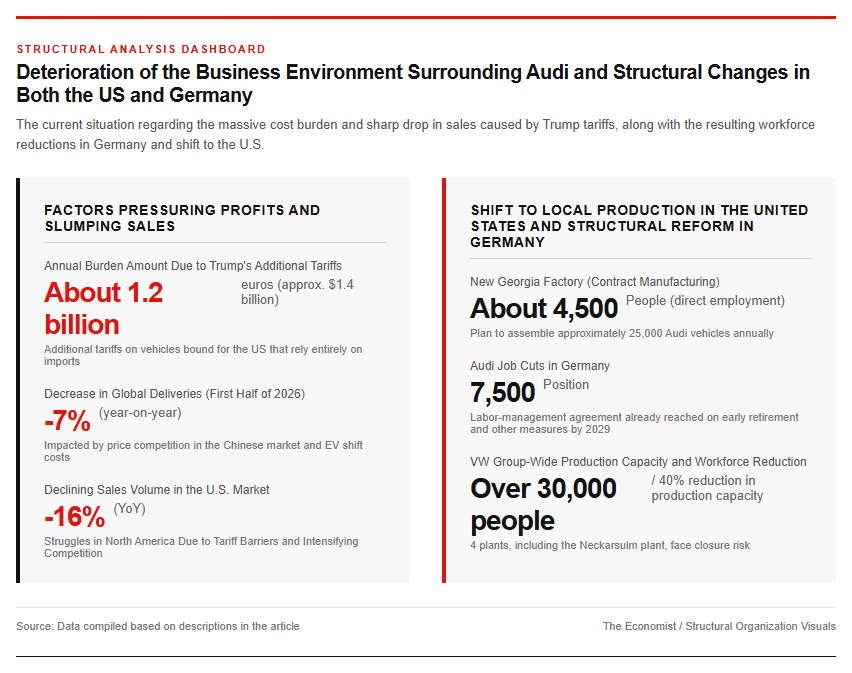
The primary backdrop to Audi’s decision to build its own plant in the United States lies in the Trump administration’s tightening of tariff policies and a sharp business downturn in the North American market. Due to additional tariff measures on European cars introduced in 2025, Audi—which had relied entirely on imports from Germany and Mexico (such as the production base for the Q5) for its US-bound vehicles—was forced to shoulder an annual tariff burden amounting to approximately €1.2 billion (approx. $1.4 billion). This tariff cost became a major factor significantly squeezing the company’s profit margins. In addition, compounded by intense price competition with local manufacturers in the Chinese market and rising costs associated with the shift to electric vehicles (EVs), Audi’s global deliveries fell by 7% year-on-year in the first half of 2026, and its sales volume in the US market also suffered, dropping 16% year-on-year. Building a local production system that can bypass tariff barriers and quickly respond to North American demand has become an inevitable management strategy for defending profitability and recovering market share.
Job cuts at the German headquarters factory and friction with labor unions
While large-scale investments in the United States have been announced, severe workforce reductions and labor-management friction are underway at Volkswagen Group and Audi in their home country of Germany. As part of cost structure reforms, Audi had previously agreed with labor representatives to cut 7,500 positions in Germany by 2029 through early retirement and buyouts. Furthermore, across the VW brand as a whole, plans are moving forward to cut over 30,000 jobs domestically and reduce production capacity by 40%, with four German plants—including Audi’s Neckarsulm facility—facing the risk of future closure. Under these circumstances, Jörg Schlagbauer, chairman of Audi’s General Works Council and vice chairman of its supervisory board, emphasized, “Even if a US plant is necessary for political reasons, German employees and plant utilization rates must not be sacrificed,” demanding long-term guarantees for employment and production capacity at home. Christiane Benner, president of the IG Metall trade union, has also pointed out that final approval by the VW supervisory board is a prerequisite for any investment decision, making the maintenance of labor-management cooperation a major challenge. The relationship between the domestic plants and the US plant is as shown in the diagram below.
Financial Risks and Key Areas to Watch in the North American Market
Rating agency S&P Global Ratings maintains Volkswagen AG’s issuer credit rating at “BBB+” (Outlook: Stable), analyzing that cost-reduction measures for the Audi and VW brands, the introduction of new vehicle models, and technical partnerships with Rivian and XPeng will contribute to mid- to long-term cash flow improvements. On the other hand, the VW Group also faces legal risks such as massive legal disputes related to the diesel emissions scandal (including approximately €8.7 billion in German investor lawsuits) as well as tariff and tax risks. As points to watch moving forward, the first hurdle will be whether the investment in the Georgia plant is formally approved by the VW Supervisory Board. Following approval, the focus will shift to schedule management toward site preparation in 2027, the start of construction in 2028, and full-scale operations with an annual capacity of 200,000 units in the early 2030s. The trajectory of trade policies under the Trump administration and the outcome of labor-management negotiations in Germany will greatly influence the success or failure of Audi’s restructuring of its global production network.
Reference Page
- [Official Announcement: Audi AG / State of Georgia] https://georgia.org/press-releases/audi-ag-selects-georgia-invest-4-billion-first-us-manufacturing-facility
- 【Volkswagen Group Annual Report 2024】https://annualreport2024.volkswagen-group.com/group-management-report/report-on-risks-and-opportunities/risks-and-opportunities/legal-risks.html
【#Audi #Georgia #Volkswagen #AutomotiveIndustry #TrumpTariffs #GlobalExpansion】


コメント