Following the Council on Economic and Fiscal Policy on July 21, 2026, the government approved the “Basic Policy on Economic and Fiscal Management and Reform 2026” at a Cabinet meeting. The background to this is the aim to shift the focus from the conventional single-year primary balance surplus target to a “stable decline in the debt-to-GDP ratio,” thereby realizing a “strong economy” through the expansion of public and private investment.
- Key Event: The Takaichi administration’s shift toward “responsible proactive fiscal policy”
- Redefining Fiscal Discipline and Moving Away from Single-Yearism
- Public-Private Investment and Growth Targets in 17 Strategic Fields
- Market Reactions and Fluctuations in Interest Rates and Foreign Exchange in the “Basic Policies Shock”
- Measures Against Rising Prices, Social Security Reform, and Impact on Households and Businesses
- Future Developments and Key Focus Areas: Medium-to-Long-Term Plans and Fiscal Verifications Toward the Fiscal Year-End
Key Event: The Takaichi administration’s shift toward “responsible proactive fiscal policy”
On July 21, 2026, following a report at the Council on Economic and Fiscal Policy, the government cabinet-approved the “Basic Policy on Economic and Fiscal Management and Reform 2026” (colloquially known as the Basic Policies 2026), which is the first of its kind under the Takaichi administration. Featuring the subtitle “The First Year of Responsible Expansionary Fiscal Policy,” the policy aims to break free from the long-standing issues of insufficient domestic investment and deflationary mindsets. The government declared a fundamental policy shift that goes beyond a mere extension of the past, clearly demonstrating its stance to forcefully promote the strengthening of supply capacity and growth investment.
The main points of this incident are as follows:
- We will position Fiscal Year 2027 (FY2027) as the “inaugural year of responsible expansionary fiscal policy” and begin full-scale budget compilation.
- We aim to simultaneously achieve a “strong economy” and fiscal sustainability through the expansion of domestic investment.
- We will also adopt the “Japan Growth Strategy” and formulate a focused investment roadmap through public-private partnerships.
Please refer to the figure below.
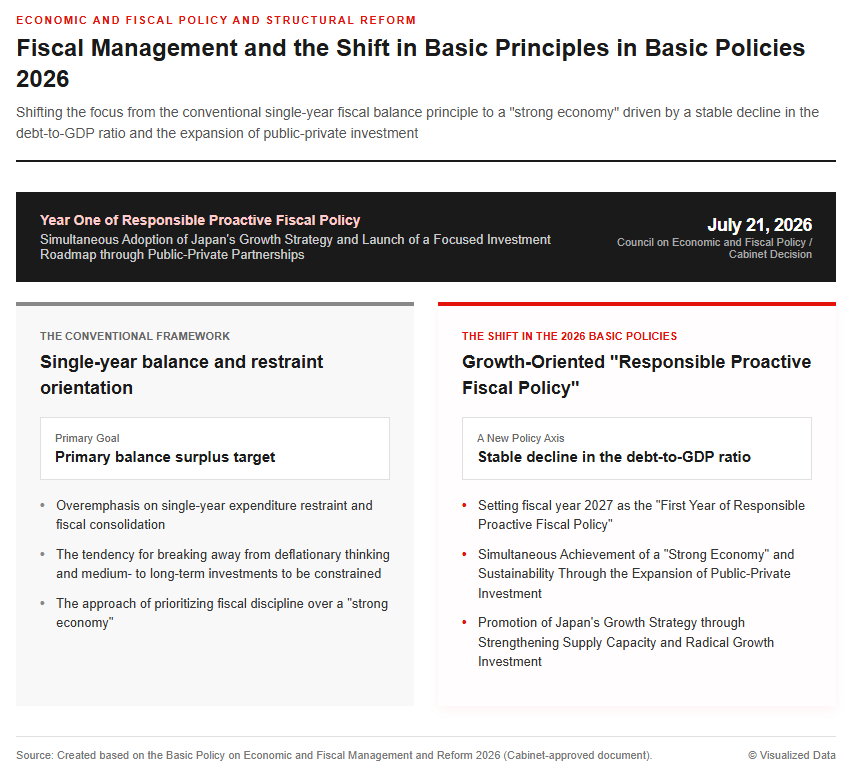
The government aims to increase tax revenue by expanding the scale of the economy, boosting employment, income, and labor productivity through the reinforcement of crisis management and growth investments.
Redefining Fiscal Discipline and Moving Away from Single-Yearism
The greatest structural reform in the Basic Policy of 2026 is the quantitative revision of fiscal management targets. The focus has shifted from the target of achieving a primary surplus on a single-year basis—which has served as the core indicator of fiscal consolidation for a quarter of a century—to a framework that places “the stable reduction of the debt-to-GDP ratio of national and local governments” as the core target.
This shift has the following specific background and objectives.
- Correct the drawbacks of single-year fiscalism, break away from chronic dependence on supplementary budgets, and return to an initial-budget-centered budgeting process.
- Allowing for temporary fiscal deterioration due to economic fluctuations, we will implement flexible, multi-year fiscal management.
- Newly establish the “Strong and Prosperous Japan” Investment Framework without setting a ceiling (a uniform cap on budget requests) to enhance predictability.
According to the “Medium-to-Long Term Economic and Fiscal Projections” submitted by the Cabinet Office on July 30, 2026, under the growth strategy realization case, the ratio of public debt to GDP is projected to decline steadily from around 188.4% in fiscal 2025 to around 182.9% in fiscal 2027. Establishing a planned expenditure structure that does not rely on supplementary budgets is considered the key to enhancing fiscal sustainability.
Investment-Driven Growth Strategy and Financial Market Trends
Public-Private Investment and Growth Targets in 17 Strategic Fields
In the “Japan Growth Strategy” formulated by the government simultaneously with Basic Policy 2026, a public-private investment roadmap targeting 17 strategic fields and 62 key products and technologies—such as semiconductors and AI, GX (Green Transformation), defense, and advanced medicine—was presented. To overcome past underinvestment, the government has set clear investment targets combining both the public and private sectors.
The specific growth targets and investment figures are as follows.
- A cumulative total of over 370 trillion yen in public-private investment is projected by fiscal 2040.
- To expand domestic private-sector capital investment to the scale of 250 trillion yen for the single fiscal year of 2040.
- Aiming to achieve a nominal GDP scale of 1,100 trillion yen in fiscal 2040.
Please refer to the figure below.
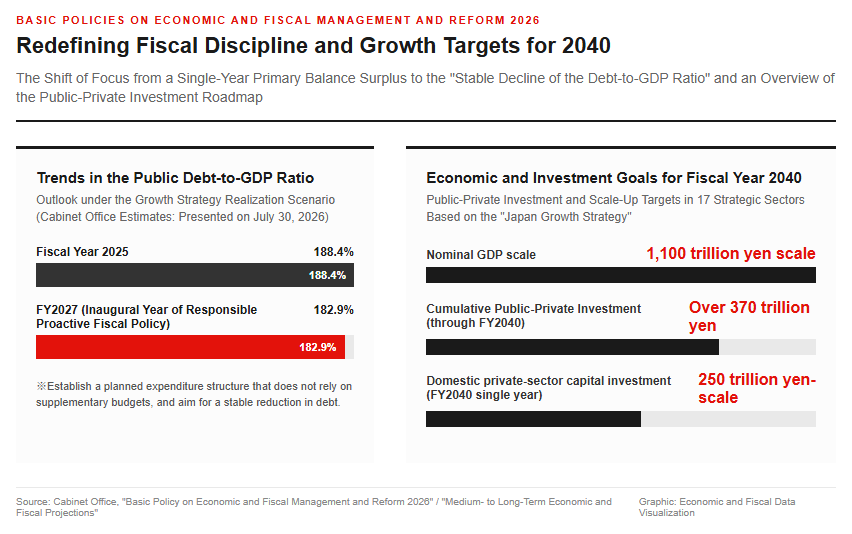
In strategic fields, timeline-based phase management—encompassing “commercialization and mass production,” “demonstration,” and “research and development”—will be conducted to promote effective funding and portfolio management. Furthermore, to encourage the spread of investment to regional areas, the initiative incorporates the formation of industrial clusters for each prefecture and the expansion of “Regional Future Grants,” setting a goal of improving productivity on a nationwide scale.
Market Reactions and Fluctuations in Interest Rates and Foreign Exchange in the “Basic Policies Shock”
When the draft of the Basic Policies was released on June 30, 2026, concerns rapidly intensified in financial markets regarding excessive fiscal expansion and the stance of restraining the Bank of Japan from raising interest rates. This market turmoil was called the “Basic Policies Shock” by market participants, triggering a drop in government bond prices and a rapid depreciation of the yen.
The main fluctuation data in financial markets is as follows.
- The yield on newly issued 10-year government bonds rose from around 2.6% at the end of June to temporarily reach 2.830% (2.900% in some trades) in early July, marking a high not seen in about 30 years.
- In the ultra-long-term bond market, the 20-year bond yield rose to around 3.8%, and the 30-year bond yield climbed into the 4.0% range.
- In the foreign exchange market, the US dollar-yen exchange rate temporarily weakened to the 162 yen range.
It has been pointed out that the rise in interest rates is driven not by changes in the policy rate outlook, but by the expansion of the term premium due to growing caution regarding fiscal risks. To calm market concerns, the government added a note in the final draft stating that “the specific methods of monetary policy are left to the autonomy of the Bank of Japan,” seeking to course-correct by clearly demonstrating its stance of respecting the BOJ’s independence.
Impact on Daily Life and Mid- to Long-Term Challenges
Measures Against Rising Prices, Social Security Reform, and Impact on Households and Businesses
While the Basic Policies on Economic and Fiscal Management and Reform 2026 (honebuto houshin 2026) will promote the building of a “strong economy,” active discussions also took place on measures to alleviate the burden on households and the working-age generation facing rising prices. While setting a goal to establish an annual increase in real wages of about 1% as the “norm for wage hikes,” the target timeline for raising the minimum wage to a national average of 1,500 yen was changed to “as early as possible in the first half of the 2030s.”
The main discussion points directly affecting households and businesses are as follows:
- The proposal for a temporary consumption tax cut on food and beverages (the effectively zero initiative) faced difficult coordination within the ruling party, and a conclusion has been postponed.
- We will proceed with discussions regarding the institutional design and infrastructure development for refundable tax credits targeting low- and middle-income earners.
- Curb the rise in social insurance premium burdens on the working-age generation and flesh out all-generation social security reforms during fiscal 2026.
While rising interest rates have negative aspects such as increased mortgage burdens and corporate funding costs, they also have positive aspects, such as an increase in household deposit interest income and a rise in government bond holdings by foreign institutional investors. Balancing both measures to counter rising prices and achieving structural wage increases will lead to peace of mind for the public’s livelihood.
Future Developments and Key Focus Areas: Medium-to-Long-Term Plans and Fiscal Verifications Toward the Fiscal Year-End
Following the adoption of the Basic Policies 2026, the evaluation of policy implementation and fiscal sustainability will transition to the next phase. Toward fiscal 2027 (Reiwa 9) as the “Inaugural Year of Responsible Proactive Fiscal Policy,” the government plans to officially formulate a “Medium-to-Long-Term Economic and Fiscal Plan” covering fiscal 2027 through 2040 by the end of the year.
The upcoming schedule and key points of attention are as follows.
- In the medium- to long-term economic and fiscal plan to be formulated at the end of the year, the definition of outstanding debt and future projection figures will be clarified.
- Toward the compilation of the initial budget for FY2027, we will carry out the assessment of the “Strong and Prosperous Japan Investment Framework” in budget requests and enforce stricter implementation of EBPM.
- Establish a concrete roadmap for the handling of the carried-over consumption tax on food and social insurance premium reforms.
While expectations for investment-driven growth are mounting within the business community, economists and rating agencies have pointed out risks such as reliance on overly optimistic growth assumptions and rising interest payment costs accompanying higher interest rates. With effective interest rates on debt expected to approach and even surpass nominal growth rates toward the 2030s, the primary focus going forward will be whether the quality of investment can be enhanced to genuinely lift potential growth rates.
Reference Page
- 【Cabinet Office】Basic Policy on Economic and Fiscal Management and Reform 2026 [suspicious link removed]
- [Cabinet Office] Basic Policy on Economic and Fiscal Management and Reform 2026 (Draft) https://www5.cao.go.jp/keizai-shimon/kaigi/minutes/2026/0630_shiryo01.pdf
【#BasicPolicies2026 #CouncilOnEconomicAndFiscalPolicy #ResponsibleProactiveFiscalPolicy #RisingInterestRates #JapanGrowthStrategy #BankOfJapan #FiscalDiscipline】
コメント