Brookfield, a leading global asset manager, has opened a new office in Doha, the capital of Qatar. Behind this move is the acceleration of contrarian investment amid geopolitical tensions in the Middle East, alongside a strategy to massively expand its AI infrastructure and private credit businesses through collaboration with sovereign wealth funds.
- Opening of New Doha Office and Credit Strengthening through Oaktree Partnership
- A Billion Operational Base in the Gulf States and the Perspective of the Regional Head
- Brookfield’s Long-Term Investment Discipline of Viewing the Middle East Conflict as an Opportunity
- LNG Infrastructure Damage and the Continuation of Massive Deals by the Qatar Investment Authority (QIA)
- The Billion AI Joint Venture with Qai and BAIIF’s Global Strategy
- The Sovereign AI Trend and Managed Interdependence in the Middle East
- Competition Among Mega-Asset Managers in the Gulf Market and Future Outlook
Opening of New Doha Office and Credit Strengthening through Oaktree Partnership
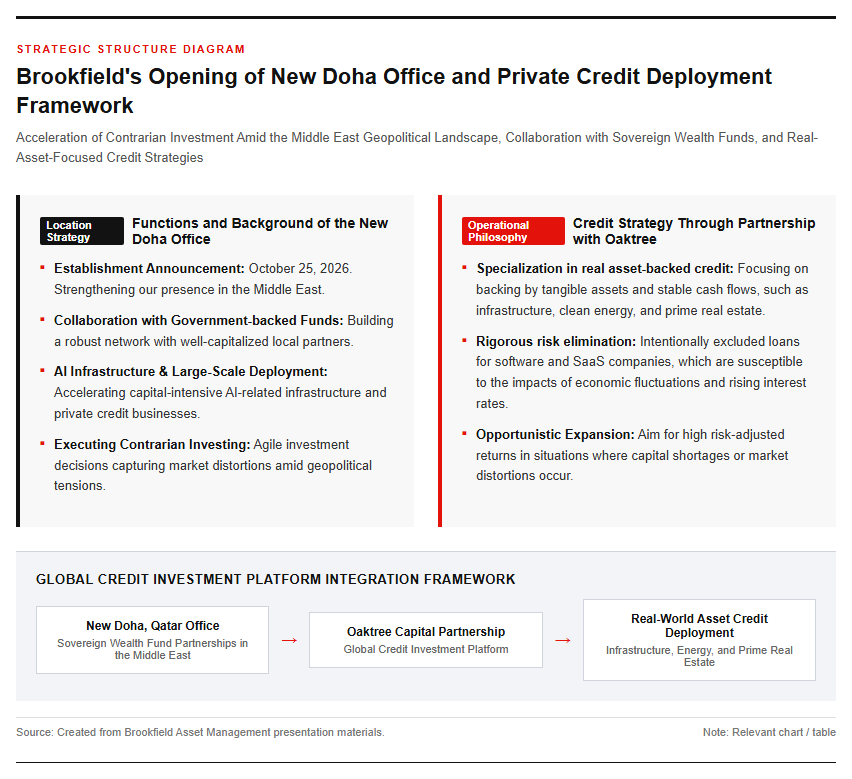
On October 25, 2026, global alternative asset management giant Brookfield Asset Management Ltd officially announced the opening of a new office in Doha, the capital of Qatar. This new hub is planned to operate with the firm’s global credit investment platform at its core, which includes Oaktree Capital Management, a prominent asset manager under the Brookfield umbrella.
In recent years, driven by the tightening of global capital regulations, traditional banks have tightened their lending, while the private credit market has rapidly expanded as a flexible and reliable financing method. In this sector, Brookfield has consistently pursued credit strategies with the following characteristics.
- intentionally excluding exposure to loans to software and SaaS companies that are susceptible to economic fluctuations and rising interest rates
- Specializing in real asset credit backed by tangible assets—such as infrastructure, clean energy, and prime real estate—that generates stable cash flows
- The ability to flexibly deploy opportunistic credit targeting high risk-adjusted returns during periods of market dislocation or capital scarcity
Please refer to the organizational chart below for the new office’s organizational structure and credit rollout framework.
The Doha hub is expected to serve as a core center for providing large-scale, long-term debt financing to companies and projects within Qatar and across the wider Gulf region.
A Billion Operational Base in the Gulf States and the Perspective of the Regional Head
Brookfield currently manages a total of approximately US$20 billion in assets across the four main sectors of private equity, real estate, credit, and infrastructure in the six member states of the Gulf Cooperation Council (GCC). With total assets under management (AUM) exceeding US$1 trillion globally, it is a mega-asset manager that manages funds for pension funds, sovereign wealth funds, institutional investors, and high-net-worth individuals around the world.
Jad Ellawn, the company’s Managing Partner and Head of the Middle East region, stated that regarding the opening of the Doha office, a full-scale expansion into Doha is a very natural next step for the company, which has continuously expanded its business in the Middle East region.
The defining characteristic of Brookfield’s investment approach lies in its local presence strategy, which involves stationing teams directly in the regions where capital is deployed and engaging deeply with local partners. Mr. Elron highly commended Qatar’s evolution into a globally significant investment hub, making clear his intention to further solidify partnerships with leading local institutions—including the Qatar Investment Authority (QIA)—to jointly explore long-term investment opportunities.
Contrarian Investing Under Geopolitical Risks and the Current State of the Qatari Economy
Brookfield’s Long-Term Investment Discipline of Viewing the Middle East Conflict as an Opportunity
As of October 2026, military conflicts and geopolitical tensions persist in the Middle East, prompting many international investors and financial institutions to adopt an increasingly cautious stance amid concerns over market uncertainty. However, Bruce Flatt, CEO of parent company Brookfield Corporation, has described the regional conflict in the Middle East as a “buying opportunity,” openly declaring that he is doubling down on investments in the Gulf region.
Mr. Flat emphasizes that in regions with great companies, wonderful countries, and exceptional talent, it is precisely when others are hesitating that the world’s most attractive investment opportunities are presented. For many years, the firm has strictly adhered to the following investment philosophy.
- Adhering to a disciplined, phased approach of “Watch, Learn, Invest, Perfect, Scale”
- Clearly distinguishing between sudden drops in asset prices driven by short-term geopolitical events or market sentiment, and the long-term corporate value intrinsically generated by the business
- Providing essential infrastructure and indispensable services that can withstand changes in the economic environment, and achieving long-term compound growth
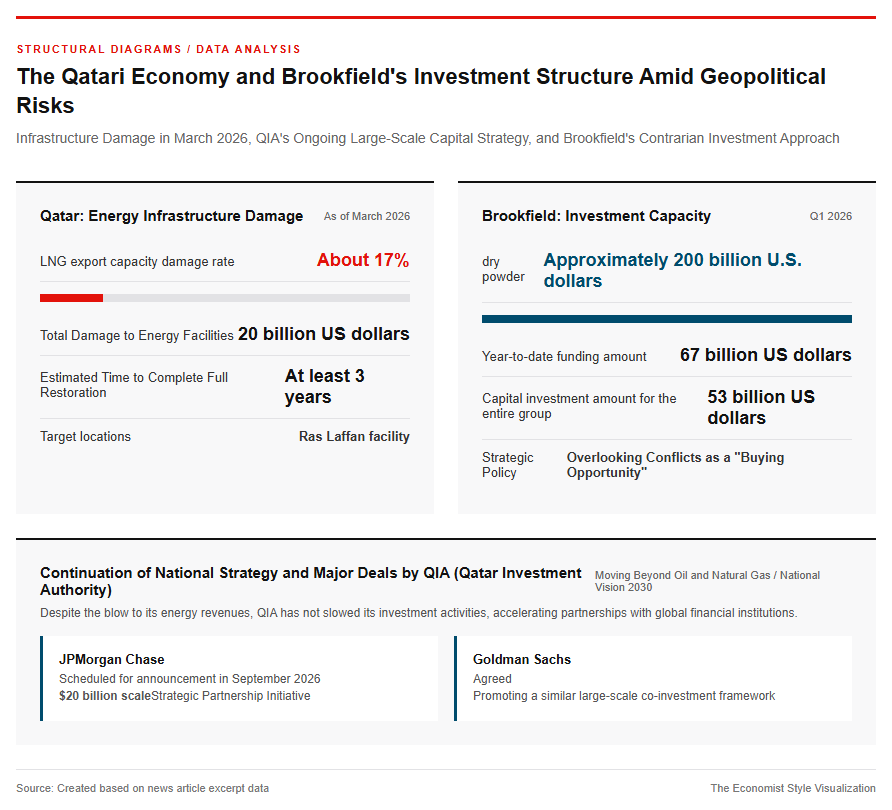
In the first quarter of 2026, the company deployed $53 billion in capital across the group, bringing year-to-date fundraising to $67 billion, and has secured approximately $200 billion in dry powder on hand.
LNG Infrastructure Damage and the Continuation of Massive Deals by the Qatar Investment Authority (QIA)
To understand the background behind the establishment of this new hub, it is essential to look at the severe macroeconomic environment surrounding Qatar. In March 2026, an attack by Iran on energy facilities in Ras Laffan damaged approximately 17 percent of Qatar’s vaunted liquefied natural gas (LNG) export capacity. The total damage is estimated to have reached roughly 20 billion US dollars, and full restoration of the facilities is expected to take at least three years. Moreover, compounded by the risks to tanker navigation in the Strait of Hormuz, Qatar’s LNG shipments remain significantly below pre-conflict levels.
Despite taking a hit to its energy revenues, the Qatar Investment Authority (QIA), which boasts hundreds of billions of dollars in total assets, has not slowed its national investment strategy down at all. Guided by the Qatar National Vision 2030—which aims to break away from dependence on oil and natural gas—the QIA has been successively establishing large-scale partnerships with global mega-financial institutions.
- The $20 billion strategic partnership initiative announced with JPMorgan Chase in September 2026
- Promotion of a similar large-scale co-investment framework agreed upon with Goldman Sachs
Please refer to the following relationship diagram for the structure of energy infrastructure damage and capital reallocation in Qatar.
Brookfield’s expansion into Doha is welcomed locally as an important catalyst for injecting long-term private capital and execution capabilities into the struggling Qatari economy.
Massive Investment in Next-Generation AI Infrastructure and the Future Outlook of Sovereign AI
The Billion AI Joint Venture with Qai and BAIIF’s Global Strategy
One of the primary drivers behind Brookfield’s establishment of its new base in Qatar lies in a historic partnership within the AI (artificial intelligence) infrastructure sector. On December 9, 2025, Brookfield and Qai, an AI-focused firm under the umbrella of QIA, agreed to establish a joint venture with a total value of 20 billion US dollars to jointly develop AI infrastructure within Qatar and in selected international markets.
This strategic partnership plans to construct a state-of-the-art Integrated Compute center within Qatar, dramatically expanding access to high-performance computing capabilities throughout the region. Investment in this project will be executed through the Brookfield Artificial Intelligence Infrastructure Fund (BAIIF), launched by Brookfield.
Bruce Flatt, CEO of Brookfield, has framed the construction of data centers and the power grids supporting them as an undertaking to build social infrastructure—much like the railways, roads, and electrical grids of the past—within the modern digital space, anticipating it to become a massive global market reaching $6 trillion to $10 trillion. The partnership with Qai represents a critical milestone in the company’s global expansion, which aims to deploy up to $100 billion in AI infrastructure investments worldwide.
The Sovereign AI Trend and Managed Interdependence in the Middle East
In recent years, the movement toward “Sovereign AI”—efforts to store and process data domestically and possess independent AI computing infrastructure and large language models to protect national security and industrial sovereignty—has been rapidly gaining momentum. However, as academic research points out, in the modern era where semiconductor supply chains, foundation models, and global data pipelines are interconnected on a worldwide scale, achieving complete self-sufficiency is virtually impossible.
Therefore, Middle Eastern countries such as Saudi Arabia, the United Arab Emirates (UAE), and Qatar have adopted a pragmatic strategy known as “managed interdependence.”
- Strictly maintaining data sovereignty and legal governance under domestic jurisdiction
- Regarding cutting-edge GPU semiconductors, global cloud technologies, and foundational models, to collaborate with leading overseas companies and adopt them rapidly.
- Bringing in know-how on the construction and operation of data centers equipped with clean energy and large-scale cooling facilities from real asset management experts like Brookfield
Through the collaboration between Qai and Brookfield, Qatar is aiming to establish its position as a reliable AI hub in the Middle East and simultaneously acquire national technological independence and international competitiveness.
Competition Among Mega-Asset Managers in the Gulf Market and Future Outlook
Sovereign wealth funds in the Gulf Cooperation Council (GCC) member states manage trillions of US dollars in massive assets, making them the most influential capital sources in the global alternative investment industry. Even in an environment of ongoing geopolitical risks, major asset managers from around the world are racing to expand their local presences in order to secure the backing of Gulf state-owned funds and capture massive co-investment opportunities.
In fact, prominent private equity firms such as Advent International, Eurazeo, EQT, and Pantheon have successively opened offices in Abu Dhabi. Additionally, Robinhood Markets is moving forward with plans to roll out its retail investment services from Dubai across the Middle East by 2027. Furthermore, in Doha, Qatar, Global Infrastructure Partners (GIP)—a subsidiary of BlackRock, the world’s largest asset manager—has established a base, reflecting a growing concentration of foreign asset managers in the region.
As points of focus going forward, how Brookfield’s Oaktree-integrated credit capabilities and the US$20 billion AI infrastructure development with Qai will materialize can be cited. In Qatar, which faces the challenge of restoring its LNG terminals, global financial markets are closely watching the progress of how private capital will contribute to the energy transition and the development of next-generation computing centers.
Reference page
- 【Brookfield and Qai Form \$20 Billion Strategic Investment Partnership for AI Infrastructure】https://bam.brookfield.com/press-releases/brookfield-and-qai-form-20-billion-strategic-investment-partnership-ai
- 【Brookfield Opens Doha Office to Expand Global Credit Investment Business】https://qna.org.qa/en/News-Area/News/2026-10/25/israeli-offensives-persist-across-southern-lebanon-amid-airstrikes-and-artillery-shelling
- 【Sovereign AI: Rethinking Autonomy in the Age of Global Interdependence】
[#Brookfield #MiddleEastBusiness #QIA #PrivateCredit #AIInfrastructure #AlternativeInvestments #SovereignAI]
コメント